
What the day feels like
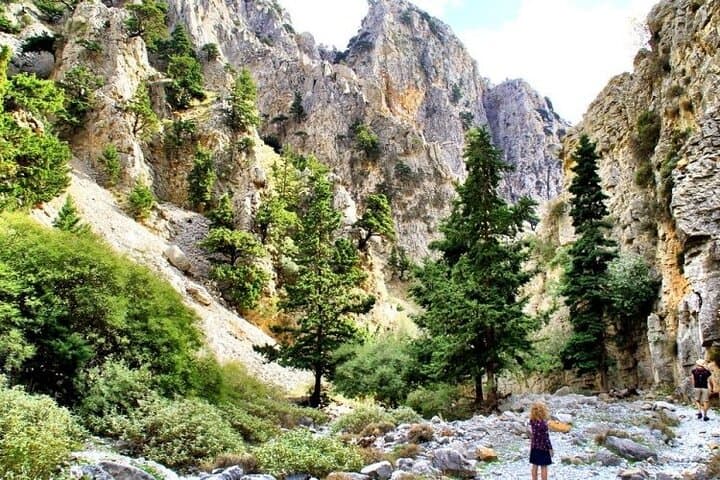
You step off the minibus where the asphalt ends and the village surrender begins—small white houses, a dog lifting its head, a breeze that smells faintly of thyme and sea. The entrance to Imbros Gorge is not dramatic like a movie set; it introduces itself in a low-key way that rewards attention. Limestone walls press in, light filters through scrub oak and kermes oak, and the path narrows until your steps echo. For two hours you’re carried forward by the canyon’s cadence: easy stretches, sudden chimneys of rock, and pockets of shade where the air cools as if the gorge itself is breathing.
Imbros is Crete’s second most popular gorge after Samaria, but it feels like a secret in comparison. The route is roughly 8 km from top to bottom and is frequently recommended for walkers who want a substantial mountain day without the technical commitment of longer canyons. Geologically, the gorge is carved from the limestone of the White Mountains (Lefka Ori). Rain and millennia have sculpted tight slices of canyon and smoothed slabs where steps once were, creating a compact, readable landscape that moves at human pace.
Historically, these gorges are more than scenery. Villages that dot the approach were built to survive and thrive on this rugged land: shepherding, goat cheese, and a hard-won hospitality. During winter storms the gorges funnel rainwater and historically shaped pastoral routes; in summer they offer refuge and cool air. You’re walking pathways used for generations—shepherds still graze their herds on terraces above, and you may pass stone walls and simple chapels tucked into the rock.
The experience is refreshingly straightforward. Trails run mostly downhill if you start at the northern rim and finish at the small village of Komitades or towards the Libyan Sea side depending on the operator. The terrain is a mix of packed dirt and exposed bedrock, with sections of scree and stone steps. Net elevation change is moderate—plan for roughly 300–400 meters of descent over the route—so knees and attention matter more than vertigo. Because the gorge is narrower than Samaria, pockets of shade alternate with exposed stretches; that interplay of sun and shadow is one of the canyon’s quiet drama.
Why go? Imbros is a compact mountain day that delivers variety: geological texture, quiet villages, and coastal glimpses as you near the exit. It’s accessible for families with older kids, seasoned day hikers looking for a half-day challenge, and travelers who want to combine mountain hiking with beach time or a Rethymno town night out. If you want a guided option, there are reliable operators running day tours from Rethymno that include transport and local insight—book ahead and you’ll find practical additions like a picnic or a swim stop. For one such guided option, see this Imbros Gorge day hike from Rethymno for full details and booking: <a href="https://app.advcollective.com/local-experts/imbros-gorge-day-hike-from-rethymno-walk-crete-s-lush-8-km-canyon">Imbros Gorge day hike</a>.
Practical rhythm: start early in spring and fall to avoid heat; in summer you’ll want a dawn departure. Bring trekking poles if your knees are sensitive—the descent is friendly but sustained. Expect a casual 2–3 hours of walking time for the gorge itself; the full tour from Rethymno, including transport, breaks, and a return, will commonly be 5–9 hours depending on the operator and stops. Water: at least 1.5–2 liters per person in warm weather. Footwear: sturdy, grippy hiking shoes are recommended—rubber soles and ankle support make the rocky sections easier.
Culturally, winding up your day with a meal in Rethymno’s Venetian quarter feels appropriate. The island’s food is elemental—raki as a welcome, dakos salad for a light hit of tomato and barley rusks, and grilled fish if you plan to finish by the coast. Locals still keep the pace measured: a chat with a taverna owner or a shepherd passing by will add context to the landscape you’ve just traversed.
If you’re planning: choose shoulder seasons for balanced weather; carry sun protection and a light wind layer; and respect local farming and grazing areas by keeping to the trail. Photographers should arrive with a wide-angle lens for the canyon’s depth and a polarizer to manage bright Mediterranean skies. And don’t underestimate the satisfaction of finishing the canyon—there’s an uncomplicated pleasure in trading rock walls for open scrub and a coastline that promises a swim. For logistical ease, guided transfers from Rethymno mean you can concentrate on the hiking rather than the driving; independent travelers should allow extra time for road navigation and parking.
Imbros Gorge is an offering of manageable scale and real character: a day that threads geology, culture, and simple movement into something that feels crafted rather than manufactured. It’s a hike you’ll recommend to friends—accessible enough to invite them, rugged enough to earn their respect. If you want a tour that handles transport and local expertise, check the organized Imbros Gorge day hike from Rethymno and use that as your basecamp for a balanced day in the White Mountains and Crete’s rugged heart: <a href="https://app.advcollective.com/local-experts/imbros-gorge-day-hike-from-rethymno-walk-crete-s-lush-8-km-canyon">book the Imbros Gorge walk</a>.
Trail wisdom
Small choices, better day.
Start Early
Heat builds quickly in summer; begin at first light to enjoy cooler temperatures and softer light for photography.
Bring Trekking Poles
Poles protect knees on the sustained descent and help with balance on scree and stone slabs.
Pack Enough Water
Carry 1.5–2 liters per person in warm months—there are no reliable water sources in the gorge.
Wear Grippy Shoes
Sticky rubber soles and ankle support reduce slips on limestone slabs and loose scree sections.
Local knowledge
Read the place, not just the route.
Watch for native species including Cretan wild goat (Kri-kri), Songbirds and raptors such as the Bonelli's eagle.
Keep an eye out for wildlife during the transition between areas and habitats. Respect distance guidelines.
Stick to established trails, avoid disturbing grazing flocks, and carry out all waste—local ecosystems are sensitive and recovery is slow.
Follow the guide's instructions on size limits, ethical handling, and leave-no-trace practices.
Small chapels tucked into the canyon walls near the upper section. A quiet olive press museum in a nearby village (seasonal openings)
Locally recommended viewpoints and quiet spots known best to local operators.
Local villages historically used the gorge as a pastoral route between mountain fields and coastal markets; stone terraces and shepherd huts dot the upper approaches.
Maritime roots and regional tradition shape the waterways and working coasts.
Seasonal guide
Four versions of the same landscape.
Spring
Best forwildflowers · comfortable temperatures · photography
Challengesmud after heavy rains · cool mornings
Spring brings wildflowers and mild weather, making it the most comfortable season for the full hike; pack a light rain layer for occasional showers.
Summer
Best forclear skies · post-hike swimming · long daylight
Challengeshigh temperatures · limited shade mid-day
Summer is hot—start pre-dawn and plan a seaside cooldown after the hike; avoid peak midday heat.
Fall
Best forcrisp air · fewer crowds · good light
Challengesshortening days · possible early rains
Autumn mirrors spring—temperatures drop and the trail is quieter, ideal for those who prefer solitude and cooler walking.
Winter
Best fordramatic skies · muted landscapes · soft light
Challengesstormy weather · potential trail erosion
Winter is the quietest season but can be wet and windy; check local conditions and avoid the gorge during heavy storms.
Operator details
What the booking data adds.
Included
- ✓Hotel pickup and drop-off
- ✓Guide
Not included
- —Entrance Fee 2.50euro
Good to know
- ✓Infants are required to sit on an adult’s lap
- ✓Suitable for all physical fitness levels
Pack with intention
What to bring.
Good to know
Common questions.
The gorge trail is about 8 km; walking time typically ranges 2–3 hours depending on pace and stops.
Plan the edges
The details that make the day easier.
Imbros Gorge is roughly 8 km long and carved from the limestone of Crete’s White Mountains, making it one of the island’s most accessible gorges.
Finish in Rethymno’s Venetian quarter: try dakos (Cretan barley rusk salad), grilled seafood by the harbor, and a shot of raki at a family-run taverna to round out the day.
- Closest airports
- Chania (CHQ) ~65 km, Heraklion (HER) ~80 km
- Cell service
- patchy in the gorge
- Permits
- none required
This gorge sits in a fragile Mediterranean ecosystem—pack out waste, keep dogs leashed, and avoid picking plants or disrupting shepherding areas.
Explore by topic
Follow the threads.
Keep exploring
Make the story part of the trip.
Set out from Bass Harbor for a private, customizable day on Blue Hill Bay — lighthouses, puffins, seals, and the chance to feel Acadia from the water. Small groups, local captains, unforgettable views.
In four hours you can move from shaded canyon ferns to wind-scoured coastal ridgelines, guided by someone who knows where the light—and the hidden views—live. This private half-day hike on the Monterey Peninsula or Big Sur is compact, curated, and perfect for travelers who want depth without a multiday commitment.
 Related story
Beneath a sky of shifting light, Skaftafell’s ice reads like a map of time. This three-hour guided glacier hike mixes technical instruction with geology and culture: compact, safe, and unforgettable.