
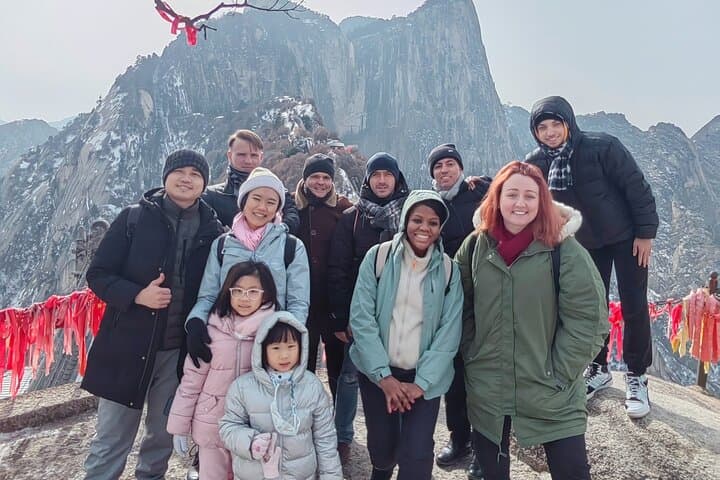
What the day feels like
You step off the coach in Huayin with the granite spine of Huashan filling the horizon—five serrated peaks jutting skyward like a row of ancient teeth. The morning mist clings low in the valley, the sun prying itself through talus and temple roofs, and the mountain seems animated: cliffs daring you, gullies whispering, the east peak already catching light like a blade. A full-day tour from Xi'an turns that first impression into a measured confrontation with exposure, history, and a rare kind of vertical beauty.
Huashan is not a gentle walk in the park. It is one of China’s Five Great Mountains—a Taoist backbone with ridge trails carved by monks and thousands of pilgrims over centuries. The geology is blunt and uncompromising: hard, jointed granite that cleaves into narrow ledges and precipitous steps. That stone is why the routes feel so dramatic; the paths hug seams and flake into vertical faces, and the peaks read as sculpted by time and human hands at once. Temples cling to shelves and ridgelines, their red lacquer and tiled roofs punctuating the gray rock. They are both waymarkers and reminders of the mountain’s religious significance: Huashan has been a site of pilgrimage and ascetic practice for nearly 2,000 years.
A guided day tour—roughly nine hours end-to-end and designed for travelers based in Xi'an—wraps logistics around the mountain’s intensity: hotel pickup, a cable-car option to beat the initial staircase, and a local guide who knows which ridges to prioritize for views and safety. The tour menu often gives you choices: ascend via stairs and chains for a full-body, leg-burning test; or use the cable cars to give you more peak time for photography and temples. Either way, the routes will test your head for heights. Narrow staircases, vertical promenades, and the infamous plank walk (available on select sections) are not for the faint of heart, but they are precisely why Huashan draws adrenaline seekers alongside pilgrims.
What the guide will do for you is translate the mountain’s language. They’ll point out an inconspicuous cave that’s housed a hermit for centuries, explain the ritual flags left at small shrines, and narrate the local stories of dragon and immortals. You’ll learn to read the stone: where a handrail has been added, where a path was a monk’s ladder, and how the mountain’s granite controls both route and rhythm. In spring, streamlets loosen pebbles and rhododendrons begin to bruise the slopes with color; in autumn, the maples turn, and vistas across the Yellow River plain sharpen into photographic clarity.
Practical reality keeps the adventure honest. The tour runs about nine hours; expect early pickup from Xi'an (often 1.5–2 hours drive). Wear grippy boots—the terrain is overwhelmingly stone staircases and iron chains—and carry water and electrolytes. The altitude isn’t extreme, but exertion and exposure multiply risk, so pace yourself on the ascending staircases and break at the temple shelves where shade and incense offer small comforts.
Safety is a cultural and logistical reality here. The Taoist temples and cliffside plaques are active sites of devotion; behave respectfully, remove hats when entering sacred spaces, and avoid loud groups. For photography, the light is best early or late—midday can wash out the granite and the deep shadows of the gullies. And if you’re tempted by the plank walk, know what you’re getting into: it’s a short, self-contained adrenaline feature with harnessed sections and staff supervision on popular tour options, but it rewards only the steady-limbed.
Why book this as a day trip? The drive from Xi'an makes Huashan a rare crash-course in Chinese mountain culture and hard granite hiking without the logistics of multi-day treks. For travelers who want a single outing that combines cinematic exposure, centuries of Taoist practice, and genuine physical challenge, it’s hard to beat. For photographers, it’s a window to dramatic ridgelines and temple silhouettes; for culture-seekers, it’s a living landscape of pilgrimage; and for those who want to push themselves, the stairs and drops will give you a clean, quantifiable test of nerve.
On this tour you’ll get structure: transport, a local gate ticket, and the flexibility to pick more or less aggressive routes. The price reflects that convenience and local expertise—the guide reconciles language, safety, and history so you can climb with confidence rather than guesswork.
If you go, plan for quiet reverence as much as for conquest. Stop at the small temples on the north peak to watch incense thread the air. Pause at the South Peak lookout to watch weather move across the plain. Share a thermos of tea with your guide and listen as the mountain keeps speaking—through gullies, through the clink of chains, and through the low hum of carved steps leading ever skyward.
Mount Huashan will not soften for you. It asks for attention and steadiness, and in return it gives views that feel earned, and a cultural depth that lingers long after the descent. The day ends back in Xi'an, legs tired, head full of stone and sky—and a new respect for the way landscapes can be places of both devotion and daring.
Trail wisdom
Small choices, better day.
Start Early
Morning light and smaller crowds make ridge sections easier and more photogenic; aim for first cable-car slots or the stair ascent as your group warms up.
Grippy Footwear Only
Stiff-soled hiking boots with good traction reduce slip risk on granite stairs and slick sections.
Hydrate Smart
Carry 1–1.5 L of water and electrolyte mix—there are limited purchases on the mountain and exertion is high.
Know Your Limits
If exposure triggers panic, choose cable-car access and stick to the wider temple routes; the plank walk and narrow ridgelines are optional.
Local knowledge
Read the place, not just the route.
Watch for native species including Eurasian jay, Sika deer (lower slopes).
Keep an eye out for wildlife during the transition between areas and habitats. Respect distance guidelines.
The scenic area is managed to balance tourism with sacred sites—stay on paths, avoid graffiti, and pack out trash to protect temples and fragile alpine vegetation.
Follow the guide's instructions on size limits, ethical handling, and leave-no-trace practices.
The mid-mountain Taoist cave shrines—small, active worship sites off the main trail. Sunrise from the East Peak: fewer crowds and sharp eastern light for photos
Locally recommended viewpoints and quiet spots known best to local operators.
Huashan has been a center of Taoist practice for nearly two millennia and hosts temples and hermitages that date back centuries.
Maritime roots and regional tradition shape the waterways and working coasts.
Seasonal guide
Four versions of the same landscape.
Spring
Best forWildflowers · Cooler climbs · Waterfalls
ChallengesLoose scree after snowmelt · Occasional rain
Spring brings thawed streams and early color—expect cool mornings and variable footing from runoff.
Summer
Best forLush vegetation on lower slopes · Long daylight hours · Temple visits
ChallengesHeat in valley · Afternoon storms · Crowds on weekends
Summer is warm and busy; start early to avoid heat and afternoon rain.
Fall
Best forCrisp air · Autumn color · Clear vistas
ChallengesCooler nights · Shorter daylight
Autumn is ideal: stable weather and sharp lines across the plain make for excellent visibility.
Winter
Best forSnow-dusted peaks · Quieter trails
ChallengesIcy steps · Limited services · Cold temperatures
Winter offers solitude and dramatic snow scenes but requires crampons and winter experience on icy granite.
Operator details
What the booking data adds.
Included
- ✓Mount Hua West Peak Round-Trip / North Peak Round-Trip Cable Car & Shuttle Bus (if this option is selected)
- ✓Private transfers in air-conditioned vehicle with licensed driver
- ✓One bottle of mineral water per day
- ✓English-speaking tour guide service
Not included
- —Any meal
- —Gratuities
- —Admission fees (If you want us include it, please choose one of the other 3 pricing options)
Good to know
- ✓Public transportation options are available nearby
- ✓Infants are required to sit on an adult’s lap
- ✓Not recommended for pregnant travelers
- ✓Travelers should have at least a moderate level of physical fitness
- ✓The hike will take approximately 2 to 4 hours and often involve steep paths and long steps
- ✓Not recommended for pregnant women or participants with back problems, heart complaints or other serious medical conditions
- ✓Tour guide will contact you the evening before the tour date
- ✓Please bring your own food for lunch as you will be on mountain top and restaurants are unavailable.
- ✓Offered pickup/drop-off service is available for hotels within 2nd ring road of Xian city. If your hotel beyond the range, please expect it might occur additional transfer fee accordingly.
- ✓You are suggested to wear comfortable shoes on tour day.
- ✓Not recommended for travelers with leg problems
Pack with intention
What to bring.
Good to know
Common questions.
Expect a physically demanding day: long stair ascents, exposed ledges, and sections with fixed chains—it's best described as challenging rather than technical.
Plan the edges
The details that make the day easier.
Mount Huashan is one of China’s Five Great Mountains and has been a Taoist pilgrimage site for roughly 2,000 years, with temples and hermitages dotting its ridges.
After the climb, return to Xi'an for Shaanxi specialties: grab biangbiang noodles or roujiamo in the Muslim Quarter, sip local craft beer in a low-lit alley bar, or try yangrou paomo (lamb bread soup) to warm tired legs.
- Closest airport
- Xi'an Xianyang International Airport (SIA); Driving time: ~1.5–2 hours from Xi'an to Huashan scenic area; Cell service: reliable in valley and around cable cars, intermittent on ridgelines; Permits
- Fees
- Huashan scenic-area entrance ticket required; cable-car fees optional; guided tours usually include tickets.
Huashan is both a natural and cultural site—stay on marked trails, respect temple spaces, avoid single-use plastics, and carry out all trash to minimize impact.
Explore by topic
Follow the threads.
Keep exploring
Make the story part of the trip.
Set out from Bass Harbor for a private, customizable day on Blue Hill Bay — lighthouses, puffins, seals, and the chance to feel Acadia from the water. Small groups, local captains, unforgettable views.
In four hours you can move from shaded canyon ferns to wind-scoured coastal ridgelines, guided by someone who knows where the light—and the hidden views—live. This private half-day hike on the Monterey Peninsula or Big Sur is compact, curated, and perfect for travelers who want depth without a multiday commitment.
 Related story
Beneath a sky of shifting light, Skaftafell’s ice reads like a map of time. This three-hour guided glacier hike mixes technical instruction with geology and culture: compact, safe, and unforgettable.