
What the day feels like
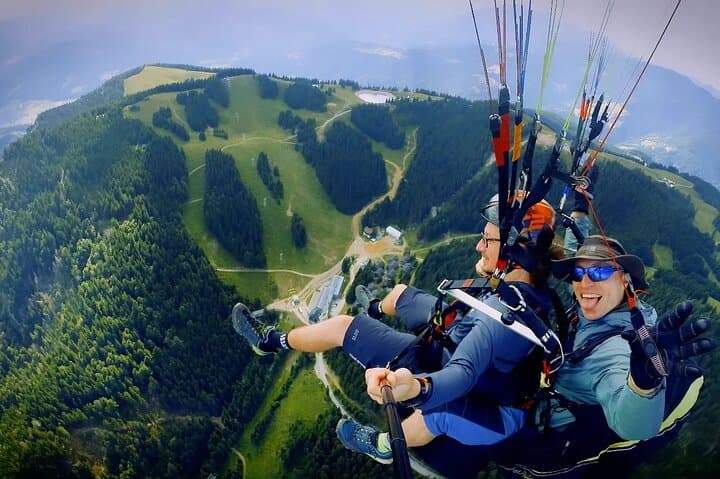
You step into wind that smells faintly of spruce and damp stone. The ridge at Golte breathes in and out beneath a low sun; the valley below folds like a green blanket—meadows, dark fir stands, and a ribbon of river that dares you to follow it. Nejc, your pilot, moves with the calm of someone who has trusted these thermals for decades. He clips your harness, does the checks—gentle, methodical—and for a moment the world is small and certain: breath, strap, run. Then the air lifts you, and Slovenia widens beneath you.
Tandem paragliding from Golte, near the village of Mozirje, is an exercise in perspective. From launch—on ridgelines roughly 1,200–1,400 meters above sea level—the Alps fold away to the northwest while the Logarska Valley, one of Europe’s most intact glacial troughs, sits like a carved jewel to the northeast. You move through air that tastes of altitude and growing fields; currents become cartographers, sketching paths through limestone ridges, past pastures where cattle graze as if on floating islands.
The flight is part adrenaline, part slow living. For the ninety-minute private flight advertised, most of that time is spent in the airy hush of extended glides, with a few brisk lifts where the wing pulls you up and the valley breathes beneath you. The experience is guided by Nejc, a pilot with 20 years in aerial sports—someone who reads winds the way others read maps. His local knowledge turns a one-off thrill into a thoughtful exploration: where to angle to see a cragged outcrop, when to drift for the best light on Logarska’s steep headwalls.
This landscape has stories under the trees. The Logarska Valley (Logarska dolina) was sculpted by alpine glaciers over millennia, leaving a U-shaped valley that is today part of a protected landscape park. The broader Savinja region played quiet roles in Slovenia’s rural history—alpine pasture culture, shepherding, and small mountain hamlets whose stone cottages and hayricks still punctuate the scenery. Slovenia itself is one of Europe’s most forested countries, and that density shows from above: the woods seem to move, a slow pulse that frames fields and villages.
Geology gives the flight drama. Karst and limestone cliffs throw shadows that shift by the hour; rocky spines channel wind into predictable updrafts that pilots use to stay aloft. Culture surfaces in quieter ways—the scent of smoke from a distant chimney, a mountain hut ringing with laughter at dusk, a patchwork of small farms where traditional cheeses are still made.
Why book this flight? For one thing, it is private and intimate. You are not a number in a crowded launch lineup; you share the wing with a single pilot who tailors the route to weather and to what you say you want—photography, long glides, or a quick shot of adrenaline. It’s also accessible: no license required and no complex skills to learn. That said, the environment is uncompromising enough to demand respect. Weather dictates the show—windows of calm thermals and clear light are what make a great flight.
Practicalities: the advertised tour is a 90-minute activity priced from about $165.6 per person. Most flights depart from Golte’s higher meadows near Mozirje; the nearest sizable town with lodging is Mozirje itself, while Celje—30–40 minutes by car—serves as a regional hub. The closest international airport is Ljubljana Jože Pučnik Airport (LJU), about a 1.5-hour drive depending on traffic.
How to prepare: dress in layers, bring a windproof shell, and wear sturdy shoes for the short walk to launch. Sun protection matters—altitude amplifies UV—and secure any loose items before takeoff. If you’re photographing, bring a small chest mount or a wrist strap; large DSLRs are cumbersome in flight. Most operators provide helmets and harnesses; the pilot will brief you thoroughly on the takeoff and landing routine.
Safety and sustainability are integral to the experience. Good pilots prioritize weather and airspace safety, and reputable outfits will cancel if conditions aren’t right. Respect local rules: use established launch sites, avoid noisy landings in private fields, and pack out what you bring. From the air, the valley’s fragility is obvious—erosion-prone slopes, bird nesting areas in cliffs—so follow your pilot’s advice about flight corridors.
When to go? Summer and early fall offer the most predictable flying windows, but spring can deliver dramatic thermals and clear-air visibility. Winters are possible only with specific conditions and likely won’t be offered as standard outings.
Back on the ground, the day often extends into local pleasures: a mountain hut lunch with homemade stews, a cellar-serving of local cheese, or a quiet beer in Mozirje’s small cafés—soft endings to an elevated day. Paragliding here is more than a singular moment; it’s a way of reading a landscape that rewards you for coming back.
If you want a flight that pairs instruction with scenery, a trusted pilot with deep local knowledge, and a private, adaptable itinerary, this Golte–Logarska tandem gives you all that and the steady, honest thrill of flying once and remembering it for years. The wind won’t wait, but that’s part of the point: the mountain and its updrafts are alive, and for a short time you’re part of their conversation.
Trail wisdom
Small choices, better day.
Dress in layers
Temperatures change with altitude—bring a windproof shell and warm mid-layer even on warm days.
Secure your camera
Use a wrist or chest mount; loose gear can fall or distract during takeoff and landing.
Stay hydrated and time your flight
Flights are best mid-morning to late afternoon—bring water and avoid heavy meals immediately before flying.
Listen to your pilot
Follow Nejc’s safety briefing closely—he reads wind and terrain, and his calls keep the flight smooth.
Local knowledge
Read the place, not just the route.
Watch for native species including Red deer, Golden eagle (occasionally seen riding thermals).
Keep an eye out for wildlife during the transition between areas and habitats. Respect distance guidelines.
Operators use established launch and landing sites to limit erosion and disturbance; visitors are encouraged to pack out waste and respect pasturelands.
Follow the guide's instructions on size limits, ethical handling, and leave-no-trace practices.
Early morning launch for soft golden light over Logarska Valley. Short hike to a Golte ridge viewpoint—great pre-flight warmup
Locally recommended viewpoints and quiet spots known best to local operators.
Logarska Valley is a classic glacial valley that became part of a protected landscape park in the 20th century, preserving traditional alpine pasture culture.
Maritime roots and regional tradition shape the waterways and working coasts.
Seasonal guide
Four versions of the same landscape.
Spring
Best forClear visibility · Blossoming meadows
ChallengesUnstable early thermals · Cooler temps at altitude
Spring brings green valleys and dramatic thermal activity; expect brisk mornings and rapidly changing conditions.
Summer
Best forReliable thermals · Long daylight hours
ChallengesAfternoon turbulence · Higher UV exposure
Summer offers the most consistent flying windows and warm weather, though afternoons can become choppy.
Fall
Best forStable air · Crisp visibility · Fewer crowds
ChallengesShorter days · Cool temperatures
Early fall often provides calm, clear flights with autumn light—ideal for photography and long glides.
Winter
Best forSnow-dusted landscapes (weather permitting)
ChallengesLimited operations · Cold, unpredictable weather
Winter flights are uncommon and require specific conditions; dress very warmly if available.
Operator details
What the booking data adds.
Included
- ✓Transport, video and paragliding flight
Good to know
- ✓Infants and small children can ride in a pram or stroller
- ✓Service animals allowed
- ✓Public transportation options are available nearby
- ✓Specialized infant seats are available
- ✓Not recommended for pregnant travelers
- ✓Not recommended for travelers with poor cardiovascular health
- ✓Suitable for all physical fitness levels
Pack with intention
What to bring.
Good to know
Common questions.
No—this is a tandem flight. The pilot handles the wing and controls; participants need only follow brief instructions for takeoff and landing.
Plan the edges
The details that make the day easier.
Logarska dolina is one of the best-preserved glacial valleys in the Alps and is part of Slovenia’s protected landscape parks.
After your flight, head to a nearby mountain hut or Mozirje’s town center for hearty Slovenian fare—think stews, local cheeses, and štruklji (rolled dumplings). For a post-flight beer, try a local brew in Celje or a farmhouse ale at a village inn.
- Closest airport
- Ljubljana Jože Pučnik (LJU) ~1.5 hours; Nearest town: Mozirje (local lodging); Driving from Celje: ~30–40 minutes; Cell service: generally good near launch but spotty in narrow valleys; Permits: none required for tandem flights—follow operator guidance.
Use established takeoff and landing zones to minimize erosion, avoid flying near nesting sites, and pack out all trash—small actions protect the valley’s sensitive habitats.
Explore by topic
Follow the threads.
Keep exploring
Make the story part of the trip.
 Related story
Less than two hours from Nairobi, Kereita Forest pairs hands-on canopy adventure with quiet montane trails and a sobering colonial history—perfect for families, teams, and curious travelers seeking a full-day pulse of nature.
Set out from Bass Harbor for a private, customizable day on Blue Hill Bay — lighthouses, puffins, seals, and the chance to feel Acadia from the water. Small groups, local captains, unforgettable views.
In four hours you can move from shaded canyon ferns to wind-scoured coastal ridgelines, guided by someone who knows where the light—and the hidden views—live. This private half-day hike on the Monterey Peninsula or Big Sur is compact, curated, and perfect for travelers who want depth without a multiday commitment.