
What the day feels like
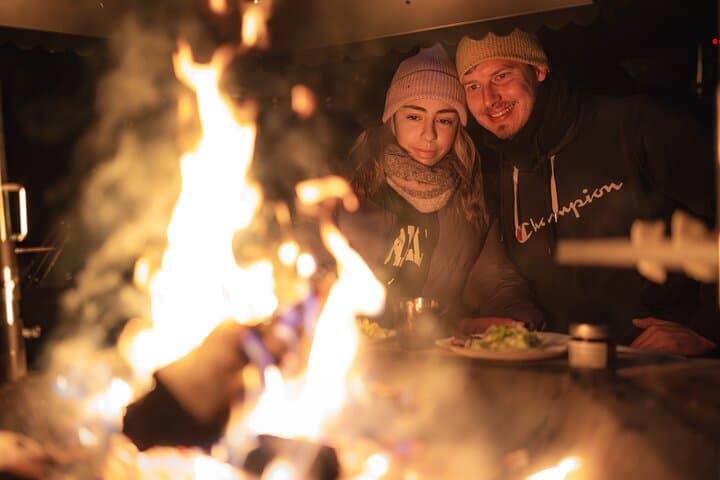
The road north of Rovaniemi narrows until the orange ribbon of town lights gives way to a clean, black Arctic expanse where stars seem closer and the air bites with the honesty of winter. You sit in a heated van, a professional guide scanning weather apps and the sky, while the driver eases onto a quiet forest service track. When the van stops, the world is already changed: a ring of white trees, the hush of snow, and a small cluster of glass-roof igloos glowing like exposed lanterns in the dark. Inside one of those igloos, an open-fire dinner waits. Outside, the sky is the real performance space—capricious, immense, and entirely possible to misunderstand until the aurora unfurls and rewrites everything above you. This two-hour outing pairs a guided aurora hunt with an intimate culinary pause inside a glass-roofed igloo and a short, mindful walk across a frozen lake to breathe the Arctic fully in.—The experience is short but concentrated, designed for travelers who want to maximize their chances of seeing the aurora without committing to a multi-night northern expedition. Your guide drives you away from urban light pollution to a chosen wilderness site, then settles you into the igloo where the roof becomes a private planetarium. Dinner—mostly traditional Lapland flavors like smoked fish and slow-cooked reindeer, depending on the provider—arrives from the open fire, warming hands and mood as much as stomachs. After dark, if conditions cooperate, you and the group step out onto the frozen lake. The ice holds firm underfoot; the only sound is snow or the distant whisper of cold wind. If the aurora appears, it moves like a living curtain: curtains ripple, then flare, then fold, casting green and purple light across snow and faces and the clear dome above the igloo. There’s no guarantee with the Northern Lights, but professional guides stack the odds by scouting cloud cover, checking KP indices, and knowing local microclimates that favor clear skies.—Rovaniemi sits on the southern edge of Finnish Lapland and has been a crossroads of Arctic cultures and post-war rebirth: the city was rebuilt after World War II with modernist influences and now balances tourism—Santa Claus Village, winter sports—with living Sámi culture in the surrounding region. Geologically, the landscape is a slow-motion cathedral of moraine and lake basins carved during the last Ice Age; the flat, treed tundra and frozen lakes make a stage on which the aurora performs with little obstruction. Northern Lights are charged particles from the sun interacting with Earth’s magnetosphere; here, directly under the auroral oval, those interactions are visible most nights across a long winter season if the sky cooperates.—Pragmatically, this is a low-exertion outing but a high-stakes gamble on weather. The tour listed is two hours long, includes hotel pickup and drop-off around Rovaniemi, and costs from about $226.53 per person. Confirmation is instant and many dates are marked likely to sell out—peak winter evenings can book fast. Expect to be outside multiple times: stepping into and out of the igloo to scan the sky, and walking on packed snow and a frozen lake for a short immersion after dinner. The experience is intimate and cozy but also cold; thermal integrity is the trip’s practical center. Bring a solid insulated parka and boots, your best camera setup, and a patient schedule—aurora hunting rewards those who wait and look in different directions. Guides can suggest camera settings (wide-angle lens, f/2.8–f/4, 5–15 second exposures, manual focus) and will monitor conditions, but the limits are meteorological not logistical.—If you’re curious about Sámi culture or longer wilderness itineraries, this short hunt is a good primer: it gives you the thrill of the aurora without the full cold-sleep commitment of a multi-night hut-to-hut trek. For photographers, the glass-roof igloo offers unique foreground opportunities—try framing the igloo edge with the aurora and use a tripod. For families, the setup is accessible and theatrical without being strenuous; confirm child policies with the operator. For travelers who’ve never seen the lights, the guide’s knowledge of local microclimates and timing makes the difference between a nice dinner and an unforgettable sky.—On the practical side: check historical cloud forecasts and the KP index before you leave, aim for nights around new moon if you want darker skies, dress in layered thermal clothing with windproof outer layers, and keep spare batteries warm in an inner pocket—cold drains battery life fast. Respect the landscape: stay on packed paths and only walk on frozen lakes where guides confirm stable ice. If you want to extend the experience, combine this evening hunt with daytime activities—snowshoeing, reindeer farm visits, or a morning at the Arktikum museum to add cultural context to the light show. In short, this Rovaniemi igloo dinner and aurora hunt condenses what many travelers come to Arctic Lapland for: a tactile, social, and photographic encounter with a rare sky, wrapped in a practical, warmth-first approach to Arctic conditions.
Trail wisdom
Small choices, better day.
Layer for Arctic cold
Wear a moisture-wicking base, insulating mid-layers, and a windproof outer shell; bring warm gloves and a hat—temperatures can plunge quickly after dark.
Protect camera batteries
Keep spare batteries in an inside pocket to prevent rapid drain in sub-zero temperatures and bring a sturdy tripod for long exposures.
Listen to your guide on ice safety
Only walk on frozen lakes when the guide says it’s safe; conditions can vary with currents and snow cover.
Choose nights with low moonlight
A darker sky improves aurora visibility—aim for dates around new moon when possible.
Local knowledge
Read the place, not just the route.
Watch for native species including Reindeer, Moose.
Keep an eye out for wildlife during the transition between areas and habitats. Respect distance guidelines.
Light pollution and off-trail walking can harm fragile tundra ecosystems—stick to packed paths, minimize artificial light, and pack out all waste.
Follow the guide's instructions on size limits, ethical handling, and leave-no-trace practices.
Ounasvaara’s quieter snowshoe loops for daytime views of Rovaniemi. Small local smokehouses offering traditional smoked fish tastes
Locally recommended viewpoints and quiet spots known best to local operators.
Rovaniemi was rebuilt after World War II and became a center for Arctic research and tourism, blending modernist design with Sámi cultural heritage.
Maritime roots and regional tradition shape the waterways and working coasts.
Seasonal guide
Four versions of the same landscape.
Spring
Best forLate-season aurora · Longer daylight for combined activities · Less extreme cold
ChallengesUnpredictable melt affecting ice · Variable weather with clouds
Late winter to early spring offers longer days and often clearer nights, but warming can affect ice safety and trail conditions.
Summer
Best forMidnight sun experiences · Hiking and fishing · Cultural festivals
ChallengesNo auroras due to continuous daylight · Many winter services closed
Summer in Lapland is spectacular but not suitable for aurora hunting—the midnight sun outshines the aurora until autumn.
Fall
Best forEarly aurora season · Fewer tourists · Colorful tundra landscapes
ChallengesUnsettled weather and early snow can be inconsistent · Shorter daylight complicates logistics
Autumn brings the first reliable aurora opportunities and fewer crowds, though weather can be changeable.
Winter
Best forPeak aurora viewing · Snow activities and igloo dining · Iconic Arctic ambiance
ChallengesExtreme cold requiring proper gear · Short daylight hours for daytime activities
Winter is the optimal season for aurora hunts and igloo dinners, with long nights and consistent snow—dress warmly and expect early evenings.
Operator details
What the booking data adds.
Included
- ✓All Fees and Taxes
- ✓Air-conditioned vehicle
- ✓Potato salad as a starter. Salmon grilled on fire (sausages for kids). Dessert Lapland cheese bread with cloudberry jam. Hot drink.
- ✓Northern Light Hunt on frozen lake
Good to know
- ✓Wheelchair accessible
- ✓Infants and small children can ride in a pram or stroller
- ✓Service animals allowed
- ✓Infants are required to sit on an adult’s lap
- ✓Specialized infant seats are available
- ✓Transportation options are wheelchair accessible
- ✓Suitable for all physical fitness levels
Pack with intention
What to bring.
Good to know
Common questions.
Guides increase the odds by choosing clear-sky microclimates and timing departures for peak auroral activity, but sightings can’t be guaranteed due to weather and solar conditions.
Plan the edges
The details that make the day easier.
Rovaniemi sits on the Arctic Circle and is internationally recognized as the official hometown of Santa Claus.
After the tour, warm up with traditional Lappish fare—smoked Arctic char, reindeer stew, and cloudberry desserts—at one of Rovaniemi’s local restaurants, then visit the Arktikum museum or a nearby Sámi craft shop to round out the cultural context.
- Closest airport
- Rovaniemi Airport (RVN). Typical driving distance from city center: 20–60 km depending on chosen wilderness site. Meeting: hotel pickup included. Cell service: reliable near town, variable in wilderness. Permits: none required for guided tours.
This tour minimizes disturbance by concentrating activity at durable sites; avoid unnecessary light use, stay on packed routes, and pack out all waste to protect sensitive Arctic habitats.
Explore by topic
Follow the threads.
Keep exploring
Make the story part of the trip.
Set out from Bass Harbor for a private, customizable day on Blue Hill Bay — lighthouses, puffins, seals, and the chance to feel Acadia from the water. Small groups, local captains, unforgettable views.
In four hours you can move from shaded canyon ferns to wind-scoured coastal ridgelines, guided by someone who knows where the light—and the hidden views—live. This private half-day hike on the Monterey Peninsula or Big Sur is compact, curated, and perfect for travelers who want depth without a multiday commitment.
 Related story
Beneath a sky of shifting light, Skaftafell’s ice reads like a map of time. This three-hour guided glacier hike mixes technical instruction with geology and culture: compact, safe, and unforgettable.