
What the day feels like
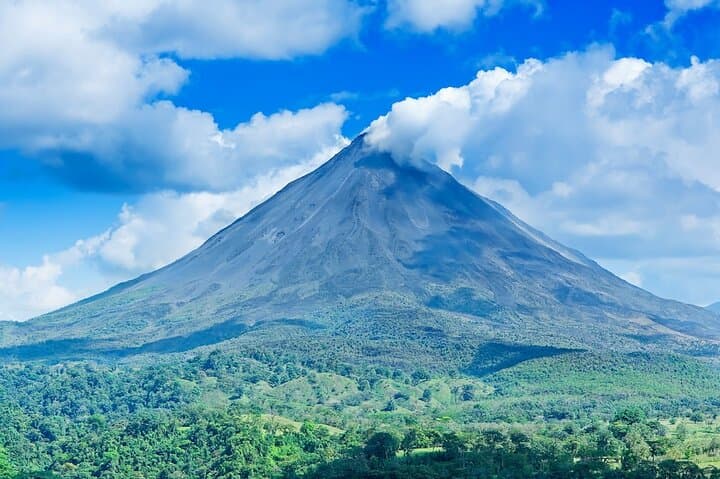
By the time the minivan hums past sugarcane fields and the road narrows into green walls of secondary rainforest, the volcano arrives in the scene like a patient giant—distant at first, then impossibly close. Arenal’s cone is a study in contrasts: perfect and symmetrical where erosion hasn’t nicked its sides, its slopes dressed in black lava scars and a thick green that seems to press up against the rock itself. You step out into humid air that smells of wet earth and coffee, lace your boots, and find a rhythm between two different kinds of motion—your feet on volcanic trail and your body preparing to fly.
This is a day that stitches two classic Costa Rican experiences into one: a geological classroom on a walking route around Arenal Volcano’s shoulders, and an aerial reckoning above rainforest canopy on a zipline circuit. Both deliver views—a slow, inquisitive panorama on the hike, and a pulse-quickening, bird’s-eye streak across the forest on the lines, where the world tilts and the river valleys take on a miniature quality.
Arenal’s modern life begins with catastrophe. In 1968 a powerful eruption reshaped the landscape, burying the original Chato cone and building the striking stratovolcano you see today. For nearby communities that eruption also marked a pivot—from small-scale agriculture to a tourism economy built on the volcano’s drama, its hot springs, and the region’s biodiversity. Geologically, Arenal is young, active in the late 20th century, and its soils are volcanic gold—fertile and planted in coffee, sugar cane and tropical fruit.
On the hike you’ll pass through secondary and primary forest patches, basalt fields and trails woven with roots. Expect 4–6 km (2.5–4 miles) of walking altogether with roughly 200–300 meters (650–1,000 feet) of cumulative elevation change, depending on which loop your guide chooses. Terrain is mixed: packed dirt, exposed lava rock, and mud after rain. Your guide will stop to point out lithological layers, recent flows, and tree species that have made peace with the volcanic soil. Birdsong punctuates explanations—motmots, tanagers and the occasional toucan—while the distant chorus of frogs and insects reminds you that this is a living, noisy ecosystem.
Then there’s the canopy. You clip in, you lean forward, and the forest does what forests do best: it surprises you. Lines here can reach speeds of up to 60 km/h (about 37 mph), as advertised, and they offer a sequence of perspectives—close-up leaves, distant valley, the volcano’s cone punctuating the skyline. For nearly everyone the zipline is a release: fear and curiosity negotiated together, framed by the smell of wet leaves and the mechanical hum of the pulleys.
Why go for this combo? It’s efficient for travelers based in Guanacaste who want a full-Arenal experience without changing hotels. You get geology and ecology, local storytelling from guides who live with the volcano, and the visceral satisfaction of flight. On a practical level, the tour is a private, guided experience lasting roughly 4–5 hours, with transportation often available from Playa Flamingo and other Guanacaste hubs; pricing starts around $240 per person.
Prepare like a pragmatic adventurer: bring sturdy shoes, a light rain jacket, and a camera with a strap. Hydrate well—tropical humidity makes exertion feel harder—and listen closely during safety briefings. The guides know the microclimates: trails that are dry in the morning can be slick by noon. Respect the environment and local communities—stay on marked trails, follow instructions on fauna encounters, and tip guides who share intimate local knowledge.
Culturally, the area around Arenal is a patchwork of agricultural settlements and tourism enclaves. After your day you’ll want a cold beer and a plate of casado—rice, beans, plantain, salad and protein—somewhere with a view of the volcano if you can find one. Many small family-run sodas and restaurants in La Fortuna and the roads leading toward Guanacaste reflect the region’s mix of indigenous, Spanish, and Afro-Caribbean culinary influences.
For photographers, the pairing of hike and canopy multiplies opportunities: soft morning light on the volcano’s slopes, saturated foliage after rain, and high-contrast shots from the ziplines that benefit from a fast shutter. For families and mixed-ability groups, the private-tour format lets guides adjust pacing and technical difficulty.
At its best this tour feels like a condensed crash course in Costa Rica’s appeal: volcanic power, rainforest intimacy, accessible thrills, and a local community that has adapted its life to a dramatic landscape. It’s not an easy day—there is walking and the mental work of running a zipline—but it’s do-able for most travelers who come in with reasonable fitness and a respect for the elements.
In short: lace up, pay attention, and be ready to look skyward. The volcano waits; the canopy dares you to fly.
Trail wisdom
Small choices, better day.
Start early
Morning hours are cooler, drier, and offer clearer views of the volcano before afternoon cloud build-up.
Bring straps for your camera
A tethered camera or phone strap prevents drops during zipline runs and fast descents.
Footwear matters
Wear closed-toe hiking shoes with good tread for lava rock and muddy trail sections.
Hydrate and snack
Bring at least 1–1.5 liters of water and an energy snack; humidity makes exertion feel more intense.
Local knowledge
Read the place, not just the route.
Watch for native species including Howler monkeys, Keel-billed toucan.
Keep an eye out for wildlife during the transition between areas and habitats. Respect distance guidelines.
The region balances conservation and tourism—stay on designated trails to protect regenerating forest on old lava flows, and choose operators who follow Leave No Trace and local hiring practices.
Follow the guide's instructions on size limits, ethical handling, and leave-no-trace practices.
A short detour to a local soda that serves grilled trout caught from nearby mountain streams. A viewpoint platform on a lesser-used trail that frames the volcano and a braided river valley—best at sunrise
Locally recommended viewpoints and quiet spots known best to local operators.
Arenal’s current cone was dramatically reshaped by a major eruption in 1968 that changed settlement patterns and spurred growth in tourism infrastructure focused on volcanic scenery and hot springs.
Maritime roots and regional tradition shape the waterways and working coasts.
Seasonal guide
Four versions of the same landscape.
Spring
Best forDry trails · Clear volcano views · Wildflower spotting
ChallengesWarmer midday temperatures · Higher tourist numbers
March–May is typically drier—good for hiking and clear photos—though pockets of rainforest can still produce quick showers.
Summer
Best forLush forest colors · Fewer tour crowds · Morning wildlife activity
ChallengesAfternoon rain showers · Muddy trail sections
June–August brings greener forests and frequent afternoon rains; go early and expect slick patches on trails.
Fall
Best forIntense green landscapes · Lower prices · Birding
ChallengesHeaviest rain months (September–October) · Limited visibility on stormy days
September–November is the wettest stretch—plan for rain gear and flexible scheduling. Many guides still run tours in drier windows.
Winter
Best forDry conditions · Stable skies · Hot-spring visits post-activity
ChallengesHigher peak-season demand · Elevated prices
December–February is the dry season; expect clearer volcano views and busier afternoons, especially around holidays.
Operator details
What the booking data adds.
Included
- ✓Hotel pickup and drop-off
- ✓Air-conditioned vehicle
- ✓All activities
Not included
- —Gratuities
- —Alcoholic Beverages
Good to know
- ✓Specialized infant seats are available
- ✓Not recommended for travelers with spinal injuries
- ✓Not recommended for travelers with poor cardiovascular health
- ✓Not recommended for pregnant travelers
- ✓Service animals allowed
- ✓Infants and small children can ride in a pram or stroller
- ✓Travelers should have at least a moderate level of physical fitness
- ✓If you are travelling with pets, we will appreciate you indicating in the comments of your reservation
Pack with intention
What to bring.
Good to know
Common questions.
The private tour lasts about 4–5 hours and typically includes transportation from Guanacaste pickup points (if booked), a guided volcano hike, canopy/zipline runs, safety equipment and briefings, and commentary on local geology and ecology.
Plan the edges
The details that make the day easier.
Arenal’s 1968 eruption rebuilt the volcano’s cone and ushered in decades of activity—this eruption also helped reshape local agriculture and led to the region’s modern tourism industry.
After the adventure head to La Fortuna for a hearty casado and a local beer, or relax at a nearby hot spring fed by volcanic activity; family-run sodas along the road serve fresh trout and tropical fruit juices for an authentic, post-hike meal.
- Closest airport
- Daniel Oduber Quirós International Airport (LIR) in Liberia. Driving distance: approx. 2.5–3 hours from Playa Flamingo
- most Guanacaste pick-up locations to Arenal area. Cell service
- intermittent on trails and canopy. Permits: none required for this guided tour; operator provides safety gear and training.
This area includes sensitive regenerating forests on old lava flows—stay on marked trails, avoid disturbing wildlife, and choose guides who minimize group sizes and follow waste-management best practices.
Explore by topic
Follow the threads.
Keep exploring
Make the story part of the trip.
 Related story
Less than two hours from Nairobi, Kereita Forest pairs hands-on canopy adventure with quiet montane trails and a sobering colonial history—perfect for families, teams, and curious travelers seeking a full-day pulse of nature.
Set out from Bass Harbor for a private, customizable day on Blue Hill Bay — lighthouses, puffins, seals, and the chance to feel Acadia from the water. Small groups, local captains, unforgettable views.
In four hours you can move from shaded canyon ferns to wind-scoured coastal ridgelines, guided by someone who knows where the light—and the hidden views—live. This private half-day hike on the Monterey Peninsula or Big Sur is compact, curated, and perfect for travelers who want depth without a multiday commitment.