
What the day feels like
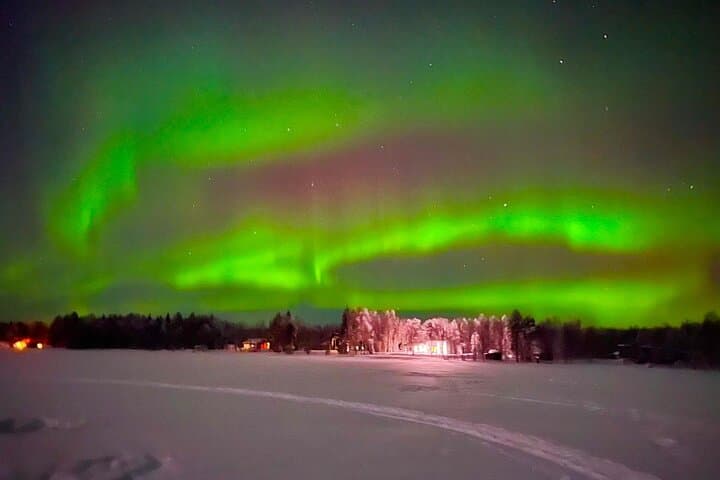
The wind that night carries a crispness like a promise. You step out of the van into a soundscape of silence—snow gnaws softly at boot soles, trees hold their breath—and a guide lights a campfire that immediately feels like an act of civilizing the Arctic dark. Above, the sky is a deep, oil-black theater. Then, as if someone leans in and brushes the curtain, a ribbon of pale green unfurls and shivers. It is not loud. It does not need to be. The aurora leans and folds, daring you to look closer.
This is Rovaniemi’s quieter choreography: a three-hour evening that trades neon-city hustle for a private patch of Lapland sky, a small hut with a stove, a hot drink in a mittened hand, and the kind of stillness that makes the lights feel like a secret you’re allowed to witness. The offering is simple—pickup from your accommodation, winter clothing when needed, a short drive to an attractively dark vantage point and, if fortune favors, an unforgettable aurora show while you warm up by the flames. It’s intimate rather than cinematic, a human-scale encounter with one of the planet’s most humbling phenomena.
The aurora you came to see has a story rooted in science and ancient myth. Scientifically, those curtains of light are charged particles from the sun, funneled by Earth’s magnetic field to the poles, where they race into the atmosphere and excite oxygen and nitrogen into luminous life. For the Sámi people—indigenous to Lapland—the lights hold more than physics. They have been woven into folklore for generations: respectful silence in the aurora’s presence was said to keep fortune close and mischief at bay. Today, modern guides blend this cultural respect with practical know-how, helping visitors read weather patterns and choose dark, low-horizon sites away from town light pollution.
Rovaniemi sits at the Arctic Circle, and that geography is part of the performance. The tilt of the Earth in winter extends long, clear nights; the interior location means less maritime cloud than coastal Finnish Lapland. Geology matters too: rolling, glaciated terrain keeps the skyline low and the northern horizon broad, increasing the odds of a full-sky spectacle.
This tour is more about sensibility than stamina. It’s for travelers who want to stand quietly in the cold, warmed by a fire and the company of a few fellow watchers, or who want to try slow photography of long exposures without the crush of a larger crowd. Guides typically provide insulated outerwear in a dressing room, so you’re not pinching your fingers while trying to work a camera. They also supply a snack and warm drink, turning the night into a social ritual rather than a rush to a photo medal.
Practicalities: the experience runs about three hours. Pickup is offered from most accommodations in Rovaniemi city, and the company advertises private, low-light locations chosen for aurora potential. Price starts around $129.96 per person. Tours are usually available from late autumn through early spring—peak aurora season is the heart of winter, but clear skies in February and March often offer the best blend of long nights and slightly milder weather.
A few straightforward tips will make the night better. Dress in layers and think of your extremities—fingers and toes lose heat fastest. Use a tripod for night photography and familiarize yourself with manual exposure beforehand; a remote shutter helps reduce shake. When the lights appear, resist the urge to overexpose—underexposed frames often capture the subtle colors more faithfully. Finally, patience wins: auroras can be sulky before they flare.
This is also an experience with a cultural seam. If your group has time earlier in the day, consider a short visit to Arktikum in Rovaniemi for context on Lapland’s history and Sámi culture; a little background makes the night feel more nuanced. Local guides will often pepper stories into the evening—small, respectful insights about old beliefs and modern life in the Arctic.
For planners: the tour’s small-group format and short duration make it easy to fold into a multi-day Lapland itinerary—pair it with a day of snowshoeing, a reindeer farm visit, or a short husky-sled ride. If you’re focused on photography, plan two nights; weather is variable and an extra evening increases your odds.
The cadence of the night matters. Guides monitor cloud cover, Kp-index forecasts, and local microclimates—sometimes the perfect sky is a 20-minute dash from town, sometimes it’s a settled patch only 10 minutes away. Being flexible with timing, and trusting the local knowledge, pays dividends.
This tour is not a guarantee of nonstop aurora theatrics—no honest operator makes that claim—but it is a reliable, comfortable way to maximize your chances while staying warm, fed, and informed. For travelers who want the drama of the sky without the logistical fuss, a campfire night outside Rovaniemi is a precise, human-scale way to meet the aurora on its terms.
Trail wisdom
Small choices, better day.
Layer for extremes
Temperatures can plummet—wear moisture-wicking base layers, an insulating midlayer, and the provided insulated outer shell for comfort during long sky watches.
Bring a tripod and remote
Long-exposure aurora shots need a steady base; a compact tripod and remote shutter make the difference between blur and clarity.
Protect your phone battery
Cold drains batteries quickly—keep spares in an inner pocket close to your body.
Listen to guides’ site calls
Guides choose vantage points based on local weather and horizon visibility—trusting their choices improves your chances of clear sky.
Local knowledge
Read the place, not just the route.
Watch for native species including Reindeer, Hares.
Keep an eye out for wildlife during the transition between areas and habitats. Respect distance guidelines.
Guides emphasize minimizing light pollution and staying on designated tracks; support local operators who follow leave-no-trace principles to protect fragile tundra.
Follow the guide's instructions on size limits, ethical handling, and leave-no-trace practices.
Small frozen lakes near Rovaniemi with reflective surfaces for aurora reflections. Arktikum museum for concise Arctic history and Sámi culture context
Locally recommended viewpoints and quiet spots known best to local operators.
Rovaniemi sits on the Arctic Circle and developed as a regional hub after WWII; it’s also internationally known as the official ‘hometown’ of Santa Claus.
Maritime roots and regional tradition shape the waterways and working coasts.
Seasonal guide
Four versions of the same landscape.
Spring
Best forLonger windows of clear nights · Easier road conditions
ChallengesUnpredictable snowpack · Some daylight returns reducing aurora hours
Late winter into spring (February–March) often brings clearer skies and slightly milder nights while still offering strong aurora activity.
Summer
Best forMidnight sun experiences · Daytime Arctic activities
ChallengesNo aurora due to continuous daylight · Tour not available
Summer in Rovaniemi features the midnight sun; aurora tours are not feasible because of constant daylight.
Fall
Best forEarly-season auroras · Fewer tourists
ChallengesUnsettled weather and increasing cloud cover · Shorter nights than mid-winter
Autumn brings the first truly dark nights and can produce strong auroras, but expect more variable weather.
Winter
Best forPeak aurora viewing · Classic Lapland conditions
ChallengesExtreme cold and limited daylight · Roads may be icy
Mid-winter (December–February) offers the longest nights and highest likelihood of sightings—dress for Arctic temperatures.
Operator details
What the booking data adds.
Included
- ✓Information about the Northern Lights
- ✓Pick-ups and drop-offs are included in the price in 10 km radius from Rovaniemi city center
- ✓Photos taken with your own device
- ✓Snack & Drinks by the campfire
- ✓Guide English (other possible request: Spanish French & Italian LIMITED AVAILABILITY OTHER LANGUAGES
- ✓Winter clothing (Adult & Child size), overalls, boots & gloves
- ✓Air conditioned car
Not included
- —Children under 13 years old must be accompanied by adults paying the full price
- —Infants must not sit on laps
- —Please be ready and wait in your hotel lobby 10 minutes prior to your scheduled pickup time
- —Product may be cancelled or rescheduled if the group size is smaller than 4 persons
- —Product may be cancelled or rescheduled in case of extreme weather conditions
Good to know
- ✓Specialized infant seats are available
- ✓Not recommended for travelers with poor cardiovascular health
- ✓Suitable for all physical fitness levels
Pack with intention
What to bring.
Good to know
Common questions.
No operator can guarantee auroras; this tour maximizes chances with local knowledge and dark sites, but sightings depend on solar activity and weather.
Plan the edges
The details that make the day easier.
Rovaniemi lies on the Arctic Circle and is internationally recognized as the official 'hometown' of Santa Claus—Arctic tourism developed strongly after WWII.
After the tour, warm up with a bowl of traditional reindeer stew or try local Arctic char in a Rovaniemi bistro; for dessert, sample pulla (Finnish sweet bread) and local berry jams. Finish the night with a craft beer at a cozy local pub or a visit to Arktikum to connect what you saw with regional history.
- Closest airport
- Rovaniemi Airport (RVN). Typical drive from city: 10–45 minutes depending on site. Cell service: available in town, limited in remote viewing spots. Permits: none for guided tours; dress warmly and expect small-group pickups.
Tours use low-impact sites and encourage guests to minimize light and noise; avoid trampling vegetation and pack out all waste to protect fragile Arctic ecosystems.
Explore by topic
Follow the threads.
Keep exploring
Make the story part of the trip.
Set out from Bass Harbor for a private, customizable day on Blue Hill Bay — lighthouses, puffins, seals, and the chance to feel Acadia from the water. Small groups, local captains, unforgettable views.
In four hours you can move from shaded canyon ferns to wind-scoured coastal ridgelines, guided by someone who knows where the light—and the hidden views—live. This private half-day hike on the Monterey Peninsula or Big Sur is compact, curated, and perfect for travelers who want depth without a multiday commitment.
 Related story
Beneath a sky of shifting light, Skaftafell’s ice reads like a map of time. This three-hour guided glacier hike mixes technical instruction with geology and culture: compact, safe, and unforgettable.