
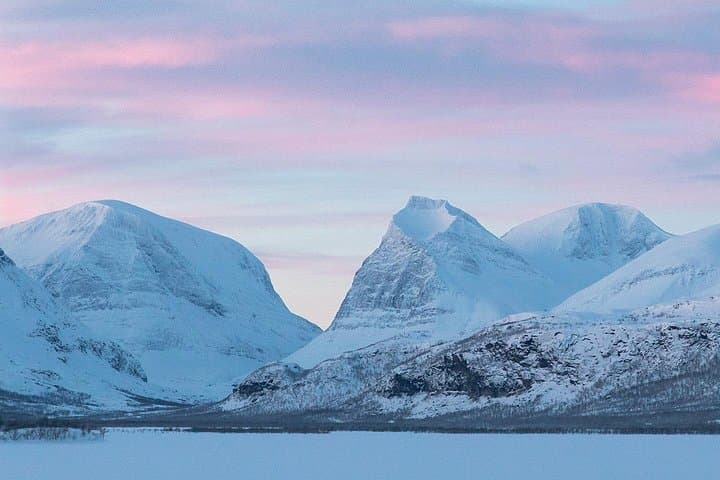
What the day feels like
The minibus nose-hinges its way out of Kiruna and the landscape opens into a high, spare country that seems built to make city thinking fall away. Pines stoop under snow, rivers narrow into glass, and the road threads a light between mountains that stand like patient shipwrecks. By the time the group transfers to snowmobiles, the sky has already begun to pulse—first a pale bruise, then fingers of green unfurling like silk. Your guide, a local Sami whose childhood sketches the map of these ridges, points to the ridgeline and smiles. He speaks softly so as not to startle the sky. The mountains lean in.
This is not a one-night sprint after the aurora; it’s a small expedition in reverse. Over roughly 48 hours you travel by minibus and snowmobile into the Kebnekaise area, trade stories and skills in a cozy mountain station, and lean into winter’s long night with a camera in hand. The tour includes photography instruction and loaner equipment—no need to bring a pro rig unless you want to—and a house meal that tastes of simmered root vegetables and game, the sort of dinner that repairs cold feet.
Kebnekaise, Sweden’s highest mountain, is granite and ice and a slow, visible experiment in climate. The southern glacier peak has thinned noticeably in the last decades; its changing face is an honest, quiet footnote to any trip here. Geologically, you are in Fennoscandia’s ancient bedrock—rocks older than much of Europe—carved by repeated glaciations into U-shaped valleys and knife-edged ridges. Culturally, the region is home to the Sami people. Your guide’s stories are woven through with reindeer herding rhythms, place names that map migration routes, and a pragmatic reverence for the weather.
Why go? Because the aurora is a performance with a strict, beautiful unpredictability. It hums with math—solar wind and magnetism—but shows up as will and gesture: curtains that peel away, a corona that punctures the sky, a green that feels like an inside joke with the night. Seeing it from the Kebnekaise station matters because you are away from light pollution, poised high on a ridge, with the mountain’s silhouette anchoring the spectacle. Add hands-on instruction: how to balance ISO, aperture, and long exposure; how to compose the sky above a lone birch; when to switch from tripod to handheld for catching transient motion. The result is more than photos; it’s a practiced, repeatable way to read the night.
Practicalities: the trip runs about 48 hours (two days, one night) and starts from Kiruna. It includes minibus and snowmobile transfers, an expert Sami photo guide, one night at the Kebnekaise mountain station with dinner and breakfast, and loaner camera gear for both northern lights and wildlife photography. Cost begins at about USD 779.63. The experience is best in deep winter when nights are long and skies are clear, typically between late November and March.
Preparation will define comfort here. Temperatures can plunge well below freezing; layered insulation, a windproof outer layer, and insulated boots are non-negotiable. Your guide will show you basic camera settings and hand you a tripod and instructions, but practice with a borrowed or personal camera helps—especially if you want to tweak composition during a thirty-second exposure. Don’t rely on cell service for navigation; batteries die faster in cold, so carry spares inside your jacket. Respect the land: the Kebnekaise area is also grazing land for reindeer, and tracks can cross at any time.
On the night itself, there’s an economy to movement. The aurora does not wait patiently for you to find the perfect rock. You learn to trust instinct, to read the horizon’s clarity, and to trust the guide’s soft nudges. When the lights arrive, the emotion is major but not theatrical—quiet awe leashed to practical tasks: open the shutter, check the histogram, warm your hands over brief slivers of movement. Between displays, the mountains exhale. The wind tells you when to retreat; the snow tramps your path back to the mountain station where a hot meal and a bed await.
Safety and stewardship are part of the itinerary. Snowmobile travel requires attention to trail conditions and reefers of thin ice; your guide carries the experience and the local knowledge to pick safe lines. The guides also share Sami cultural context—names of places, stories of seasonal migration, and the ethics of traveling through these landscapes—which makes the trip more than a chase for photos. It becomes a small, respectful immersion.
If you go: plan for two nights in Kiruna if your flights are uncertain, bring warm, technical layers, and keep energy bars and water accessible for the cold. Consider booking during February or March for clearer skies and more stable temperatures. And bring curiosity: the best souvenir isn’t a single image, it’s an updated set of instincts for reading arctic nights.
For those who want to leave with more than an Instagram post, this is a smart, deliberate way to meet the aurora—under guidance, lodged in a mountain station, and with the kind of knowledge that fosters better pictures and deeper respect. The lights will still be wild. But by the end of the night, you’ll have a steadier hand, clearer photos, and a sense of place that feels earned rather than borrowed.
Trail wisdom
Small choices, better day.
Layer with purpose
Bring a moisture-wicking base, insulating mid-layers, and a windproof, waterproof outer shell—temperatures and wind can change fast.
Protect your camera battery
Keep spare batteries warm in an inner pocket; cold drains lithium cells quickly, especially during long exposures.
Dress for stationary moments
Bring hand warmers and a heavy hat—standing still while shooting the aurora gets colder than you expect.
Listen to your guide
Guides know local ice and wind patterns; follow instructions on snowmobile use and safe shooting locations.
Local knowledge
Read the place, not just the route.
Watch for native species including Reindeer, Arctic fox (rare).
Keep an eye out for wildlife during the transition between areas and habitats. Respect distance guidelines.
This region is sensitive to climate change and fragile tundra—stay on established tracks, minimize campfire impacts, and respect reindeer grazing areas.
Follow the guide's instructions on size limits, ethical handling, and leave-no-trace practices.
Stargazing ridgeline above Kebnekaise mountain station for unobstructed horizons. Short daytime walk to see ancient glacial valleys and frozen waterfalls near the station
Locally recommended viewpoints and quiet spots known best to local operators.
The Kebnekaise area sits within traditional Sami lands and has long been a corridor for reindeer migration; local guides often share indigenous place names and herding history.
Maritime roots and regional tradition shape the waterways and working coasts.
Seasonal guide
Four versions of the same landscape.
Spring
Best forLingering aurora displays · Quieter trails · Transition light
ChallengesVariable melt and unstable snow · Shorter nights for aurora
Late winter-to-spring offers clearer skies at times and fewer tourists, but nights shorten and spring melt can change conditions.
Summer
Best forMidnight sun experiences · Hiking and day tours · Wildflower valleys
ChallengesNo aurora visibility · Inaccessible snowmobile travel
Summer transforms the region into continuous daylight—beautiful for trekking but not for aurora viewing.
Fall
Best forEarly aurora season · Crisp air and color · Fewer crowds
ChallengesUnpredictable weather · Cold nights before snowpack stabilizes
Autumn brings increasing chances of aurora as nights lengthen, but weather is changeable and early snow can arrive.
Winter
Best forPeak aurora viewing · Snowmobile access · Photographing night skies
ChallengesExtreme cold, polar night conditions · Limited daylight hours
Winter is the optimal season for northern lights tours—long nights and stable snow make for reliable access and viewing.
Pack with intention
What to bring.
Good to know
Common questions.
Winter months (late November–March) offer the longest nights and best conditions; February–March often have clearer skies for photography.
Plan the edges
The details that make the day easier.
Kiruna lies above the Arctic Circle and experiences polar night for several weeks each winter, when the sun does not rise above the horizon.
Return to Kiruna for Sami-inspired food—reindeer stews, smoked Arctic char, and small cafés serving warming soups. Many lodgings offer sauna culture; a hot sauna and local beer or herbal tea are perfect after a night outdoors.
- Closest airport
- Kiruna Airport (KRN); Driving time to trailhead
- mountain station
- ~1–1.5 hours from Kiruna; Cell service: intermittent outside town; Permits: none required for guided tours but respect Sami lands and reindeer grazing areas.
This tour operates in sensitive Arctic ecosystems and traditional Sami lands—stay on trails, pack out waste, avoid disturbing wildlife, and follow guide instructions to minimize impact.
Explore by topic
Follow the threads.
Keep exploring
Make the story part of the trip.
Set out from Bass Harbor for a private, customizable day on Blue Hill Bay — lighthouses, puffins, seals, and the chance to feel Acadia from the water. Small groups, local captains, unforgettable views.
In four hours you can move from shaded canyon ferns to wind-scoured coastal ridgelines, guided by someone who knows where the light—and the hidden views—live. This private half-day hike on the Monterey Peninsula or Big Sur is compact, curated, and perfect for travelers who want depth without a multiday commitment.
 Related story
Beneath a sky of shifting light, Skaftafell’s ice reads like a map of time. This three-hour guided glacier hike mixes technical instruction with geology and culture: compact, safe, and unforgettable.