
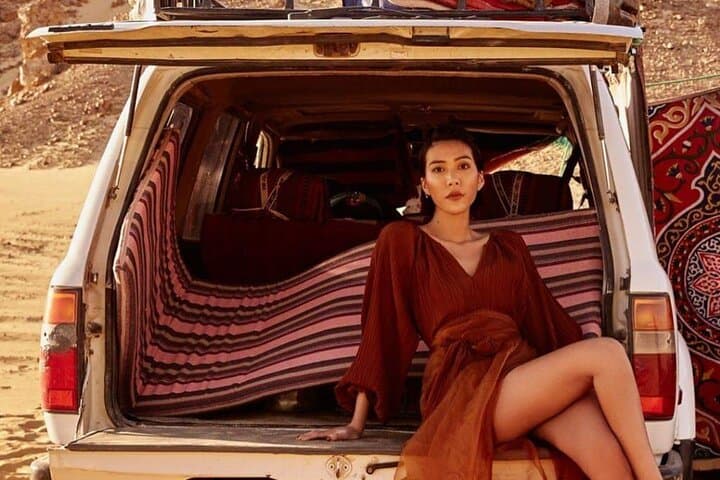
What the day feels like
On the first evening, the desert arrives quietly — a cool wind buttering the edges of a last-orange sun, and an armada of chalk mushrooms standing like an audience to the sky. You exchange the honk and blur of Cairo for another rhythm: the slow thrum of a 4x4 over gravel, the soft hiss of camp stoves, and a horizon that keeps stretching until the stars feel close enough to touch. Over 48 hours the landscape flips between raw limestone galleries and palm-crowned oases, from the otherworldly White Desert to the palm rings of Bahariya and the lake-fed wetlands of Wadi Al Rayan and El-Fayoum.
This is not a photographic novelty tour of Instagram-friendly rock shapes; it’s a condensed education in the Egyptian Western Desert. The White Desert National Park — a field of bleached chalk sculpted by millennia of wind — looks less like land and more like a sculptor’s studio where the elements carved columns, mushrooms and abstract figures. At Bahariya, palm groves and hot springs anchor a human history that moves from pharaonic burials to modern Bedouin life. Wadi Al Rayan, by contrast, is a surprise: cascading freshwater into broad lentic lakes, attracting migratory birds and offering reflective water-views that stand in deliberate contrast to the surrounding dunes.
Geology and archaeology thread through the trip. The chalk formations of the White Desert are Eocene and Cretaceous in origin, once marine deposits later exposed and shaped by wind. In Bahariya, archaeological digs have revealed the Valley of the Golden Mummies, an impressive Late Ptolemaic necropolis discovered in the 1990s that gives a human face to the region’s deep past. Paleontology fans will note the region’s fossil record — the Western Desert has yielded dinosaur and marine reptile remains — proof that these sands were once a vastly different environment.
Culturally the trip introduces travelers to oasis life: date palms, falaj irrigation, and the slow commerce of small Egyptian towns far from the Nile. Meals are straightforward and satisfying — thick stews, flatbreads, and dates picked from nearby groves. Guides are typically local, often Bedouin or oasis residents; their knowledge of campcraft, stars, and water sources is part of the tour’s appeal.
Practicalities don’t get in the way of delight: they enable it. Expect long driving stretches in a well-equipped 4x4 (roads are a mix of paved highway and desert track), short hikes across packed sand, and an overnight campsite beneath a wide sky. Terrain is flat to rolling; elevation gains are modest but footing can be loose. Temperatures swing dramatically — hot by day, cold at night — so packing is about extremes, not subtlety.
Why go? For the visual contrast (chalk white to palm green), the solitude, and the immediate sense of remoteness that’s still reachable from Cairo in a long day. It’s a do-able micro-expedition if you want to sample the Sahara without committing to a week-long trek. For photographers it’s a jackpot: sunrise and sunset soften the chalk into warm tones, while night-sky conditions away from light pollution are exceptional. For the culturally curious, the oasis towns and Fayoum’s lake communities give a sense of continuity between desert and Nile-worlds.
What to expect logistically: most departures are private and include hotel pickup in Cairo. The driving window is the largest chunk of the itinerary — expect three to six hours each way depending on which sites you prioritize — and the itinerary typically covers the White Desert formations, an overnight camp, then a second day visiting Wadi Al Rayan and El-Fayoum sights. Guides usually handle permits and park fees, and camps are simple but comfortable, with sleeping mats and basic shelter.
Safety is straightforward: stay hydrated, protect your head and skin from sun exposure, and respect the desert’s pace. Nights get cold; hypothermia risk is low but uncomfortable shivering is avoidable with a warm layer. Bring a small medical kit, and keep electronics in sealed bags; sand gets where it’s not invited.
If you want the compact, high-return desert experience — dramatic geology, small treasures of culture, and the uncanny quiet of the Sahara — a two-day Cairo adventure that reaches the White Desert, Bahariya Oasis and Wadi Al Rayan is one of the most efficient, evocative ways to get it. You’ll return to Cairo with sand in your shoes and a clearer sense of how broad and varied Egypt is beyond the Pharaohs’ monuments.
Trail wisdom
Small choices, better day.
Carry 3–4 liters of water
Desert heat is relentless; bring insulated bottles and drink small amounts regularly.
Layer for temperature swings
Days are hot and nights can be cold — pack a lightweight down or fleece.
Protect against grit
Zip electronics into dry bags and keep lenses capped to prevent sand damage.
Follow your guide’s route
Tracks can be confusing and fragile habitats exist — stay with the vehicle and guide.
Local knowledge
Read the place, not just the route.
Watch for native species including Greater Flamingo (seasonal), Fennec fox (rare, nocturnal).
Keep an eye out for wildlife during the transition between areas and habitats. Respect distance guidelines.
White Desert is a protected national park — avoid collecting stones, camp only in designated areas, and follow your guide’s guidance to minimize impact.
Follow the guide's instructions on size limits, ethical handling, and leave-no-trace practices.
Hot springs near Bahariya Oasis for a quick soak. The small pottery and date stalls in Bahariya town for local crafts
Locally recommended viewpoints and quiet spots known best to local operators.
Bahariya Oasis is home to the Valley of the Golden Mummies, a large Ptolemaic burial site discovered in the 1990s that sheds light on Greco-Roman-era Egypt.
Maritime roots and regional tradition shape the waterways and working coasts.
Seasonal guide
Four versions of the same landscape.
Spring
Best forMild daytime temperatures · Birdwatching in Wadi Al Rayan
ChallengesOccasional sandstorms · Cool nights
Spring brings comfortable daytime temps and active birdlife, but watch for windy periods that stir sand.
Summer
Best forExtended daylight for photography · Dry, clear skies
ChallengesExtreme daytime heat · Limited morning comfort
Summer is very hot — early starts and strict hydration are essential; avoid midday exertion.
Fall
Best forStable weather · Warm days and cool nights
ChallengesShorter daylight than summer · Potential for dust
Fall is ideal for most travelers: pleasant days, cool evenings and steady conditions for camping.
Winter
Best forCold-night stargazing · Comfortable hiking temperatures
ChallengesVery cold nights · Occasional rain in Fayoum
Winter offers comfortable daytime temperatures and superb night skies, but bring warm sleeping layers.
Operator details
What the booking data adds.
Included
- ✓All taxes & service charge.
- ✓Private Tour Guide
- ✓Meals as mentioned in the itinerary.
- ✓Shopping tours in Cairo.
- ✓Lunch
- ✓Entrance fees to all the mentioned sites.
- ✓Pick up services from your hotel & return.
- ✓Bottled water during your trip.
- ✓All transfers by a private air-conditioned vehicle.
Not included
- —Any extras not mentioned in the itinerary.
- —Hotel Accommodation.
- —Tipping.
- —beverages and water during lunch
Good to know
- ✓Wheelchair accessible
- ✓Specialized infant seats are available
- ✓Suitable for all physical fitness levels
Pack with intention
What to bring.
Good to know
Common questions.
Driving distances vary by route, but expect roughly 4–6 hours by road to reach Bahariya/White Desert from central Cairo.
Plan the edges
The details that make the day easier.
The Valley of the Golden Mummies in Bahariya was discovered in 1996 and revealed hundreds of mummified remains and artifacts from the Ptolemaic period.
After the desert night, head back toward Cairo or to Fayoum for authentic comfort food: try koshary or a fava-bean ful for breakfast; in the oasis towns look for fresh dates and simple stews served at family-run eateries.
- Closest airport
- Cairo International (CAI). Typical drive from Cairo to Bahariya
- White Desert
- ~4–6 hours (370–450 km). Cell service: patchy to none in remote desert; Wi‑Fi available in major hotels only. Permits: park entrance fees may apply and are usually arranged by the tour operator.
These desert and wetland habitats are fragile—pack out all trash, avoid removing geological or archaeological specimens, and camp only in sites approved by local guides.
Explore by topic
Follow the threads.
Keep exploring
Make the story part of the trip.
Set out from Bass Harbor for a private, customizable day on Blue Hill Bay — lighthouses, puffins, seals, and the chance to feel Acadia from the water. Small groups, local captains, unforgettable views.
In four hours you can move from shaded canyon ferns to wind-scoured coastal ridgelines, guided by someone who knows where the light—and the hidden views—live. This private half-day hike on the Monterey Peninsula or Big Sur is compact, curated, and perfect for travelers who want depth without a multiday commitment.
 Related story
Beneath a sky of shifting light, Skaftafell’s ice reads like a map of time. This three-hour guided glacier hike mixes technical instruction with geology and culture: compact, safe, and unforgettable.