
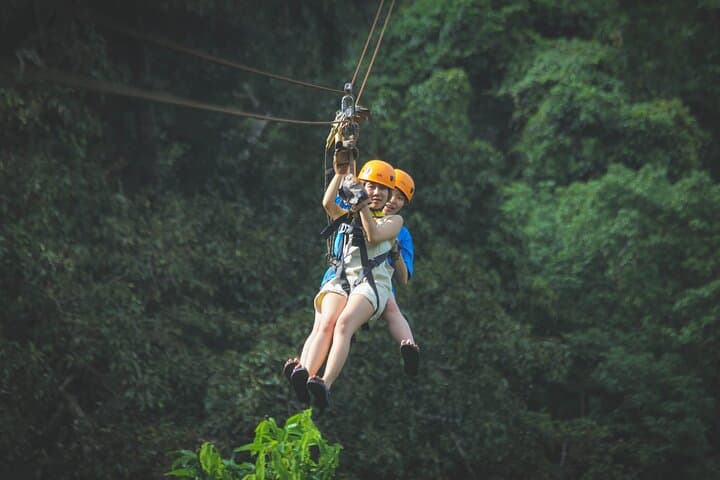
What the day feels like
You step off the last platform and the island exhales. Below, the rainforest unrolls in a quilt of glossy palms and ferns; beyond that, the Gulf of Thailand glints the color of a polished coin. For sixty minutes you’ve been a guest of the canopy — clipped into steel, negotiating speed and wind, riding a series of nine cables that thread you through treetops, skirt waterfalls, and unload you into views that make the engine of everyday life feel very far away.
The Samui Zipline 9 Platforms Adventure Tour is compact by intention: a roughly one-hour guided circuit of high cables and aerial bridges that delivers an intense, curated taste of Koh Samui’s wild side. It’s not the longest zipline in Southeast Asia, but its sequence — zip, scramble across a suspended bridge, rappel a short drop, then launch again — creates a rhythm that matches the island’s loping, humid pulse. Guides include round-trip hotel transfers, modern harnesses and helmets, and a standard safety briefing that replaces bravado with clear procedure; this is an adventure made for travelers who want an adrenaline shot without the logistics headache.
Koh Samui didn’t grow up as a playground for zipliners. For generations the island’s identity was coconut groves and fishing villages — a patchwork of small communities clustered around bays. Tourism surged in the 1980s and 90s, drawing bungalows, beach bars, and eventually adventure operators who learned how to use the island’s existing assets: steep, forested interior ridges, short waterfalls, and a shoreline that rewards any high vantage point with instant postcard views. The zipline experience threads together those elements: it’s a way of seeing the island that respects its verticality and its slow reclamation by jungle.
Geologically, Samui’s interior is gentle rather than alpine. The land rises in low, jungle-clad hills rather than dramatic peaks, and the rainforest here is secondary growth in places — dense, humid, and alive with insect chatter. From the heights, you can make out the pattern of agriculture: narrow terraces and groves where coconuts still matter economically, alongside newer tourism infrastructure. There’s a cultural contrast visible from the cables: on one side, a temple spire or a cluster of tin-roofed houses; on the other, the cobalt sweep of the sea.
The zipline’s nine platforms span roughly 1,500 meters of cable in total. That distance is short enough to feel continuous and long enough to deliver variety: some lines are low and technical, asking you to lean into speed; others are wide and windy, offering slow, panoramic floats. Waterfalls peek through the foliage — one section nudges a cascade close enough that you can hear it washing stone, a reminder that this is still a living watershed. Birds, lizards, and the occasional monkey will sometimes punctuate a ride: wildlife that observes but rarely interrupts.
Why go? Because it compresses a day’s worth of scenic improvisation into a compact, accessible adventure. Families can share the thrill; couples can snag a private moment dangling over a ridge; solo travelers get to trade stories with guides who know the island’s off-menu corners. And because the whole operation is done with a professional veneer — certified gear, guided transfers, pre-set departure times — it’s one of the easiest high-adrenaline excursions on Koh Samui.
Practicalities anchor the romance. The tour runs in three playtimes to suit early birds and those who prefer a calmer, late-afternoon sky. Mornings are cooler and offer crisper views; late afternoons can throw dramatic light across the sea but risk short, sharp tropical showers. Dress in active, quick-drying clothing; closed-toe shoes are mandatory. Bring a small daypack, sunscreen, and a reusable water bottle — hydration matters far more in humidity than gradient.
Safety isn’t a slogan here; it’s a sequence. Guides run a step-by-step kit check, explain braking techniques, and offer short practice zips to build confidence. If you’re nervous with heights, ask for a tandem or lower-speed line — operators on Samui are used to tailoring experiences for different comfort levels.
Beyond the thrill, the zipline is a launchpad for broader island exploration. After your circuit, consider heading to Fisherman’s Village in Bophut for seafood and a chilled beer, or to Chaweng if you prefer a livelier stretch of beach bars. If your curiosity is botanical, ask your guide about edible plants and the coconut economy that still shapes much of Samui life. The canopy trip is short enough that it slots neatly into a half-day plan: hotel pickup, zipline, lunch at a local eatery, and an afternoon at the beach.
For photographers, the lines are an opportunity and a challenge: compositions are dynamic and the best frames require quick reflexes. Use a wrist-straped mirrorless or a small action camera; big DSLRs will be cumbersome. Early light is kinder to faces and colors; midday highlights can blow out the sea unless you underexpose with intent.
The Samui Zipline 9 Platforms Adventure Tour is not about conquering nature. It’s about negotiating a relationship with it — moving through the treetops with curiosity and care. The steel of the cables is visible, the platforms are deliberately human, and the guides will remind you to keep your voice low near nesting spots. That combination — engineered safety and raw scenery — is exactly what makes Samui’s zipline experience feel like the island’s best short story: punchy, scenic, and easy to retell.
If you go, carry a modest sense of adventure and a strong respect for the local environment. The canopy will do the rest.
Trail wisdom
Small choices, better day.
Book a morning slot
Early departures offer cooler temperatures, clearer light, and less chance of afternoon showers.
Wear closed-toe shoes
Sneakers with good grip are mandatory on platforms and for any short treks between lines.
Secure small items
Use a wrist strap or leave loose items at base; phones and sunglasses can easily get lost at speed.
Hydrate before you go
Humidity and adrenaline make you sweat; drink water beforedeparture and bring a small reusable bottle.
Local knowledge
Read the place, not just the route.
Watch for native species including Long-tailed macaque, Tropical hornbill and various kingfishers.
Keep an eye out for wildlife during the transition between areas and habitats. Respect distance guidelines.
Operators on Samui increasingly emphasize low-impact practices — limit noise near nesting sites, avoid single-use plastics, and stay on marked trails to protect sensitive vegetation.
Follow the guide's instructions on size limits, ethical handling, and leave-no-trace practices.
Bophut’s Fisherman’s Village night market for fresh seafood and local crafts. Laem Sor Pagoda viewpoint for sunset with fewer crowds than Chaweng beach
Locally recommended viewpoints and quiet spots known best to local operators.
Koh Samui grew from a coconut-farming and fishing economy into a tourism destination in the late 20th century; its villages still reflect the island’s pre-tourism rhythms.
Maritime roots and regional tradition shape the waterways and working coasts.
Seasonal guide
Four versions of the same landscape.
Spring
Best forFewer tourists · Warm mornings · Good birdwatching
ChallengesRising humidity · Occasional short showers
Spring brings increasing warmth and lush vegetation — mornings are best for clear skies and comfortable temps.
Summer
Best forLush jungle vistas · Long daylight hours · Vibrant wildlife
ChallengesMonsoon downpours · High heat and humidity
Summer is dramatic and green but can be interrupted by heavy tropical rains; schedule earlier in the day.
Fall
Best forStable weather · Lower humidity · Good visibility
ChallengesTourist shoulder-season crowds in some months
Fall offers a balance of comfortable conditions and strong visibility, ideal for photos.
Winter
Best forDry, cool weather · Calm seas · Peak visibility
ChallengesHigher tourist demand · Slightly cooler mornings
Thailand’s cool, dry ‘winter’ is the most reliable season for stable weather and sharp views.
Operator details
What the booking data adds.
Included
- ✓Highly trained staff
- ✓Drinking water
- ✓Coffee, tea, fresh fruits, snack
- ✓Roundtrip transfer from Choengmon, Bangrak, Chaweng, Bophut, Maenam, Lamai, Lipa Noi
- ✓Standard Insurance
- ✓All High-quality safety Zipline equipment
Not included
- —Non-zipline guests joining the shuttle are charged THB 400 per person.
- —Photography and VDO service
- —Tips and gratuities
Good to know
- ✓Not recommended for travelers with spinal injuries
- ✓Public transportation options are available nearby
- ✓Suitable for all physical fitness levels
- ✓This activity is not suitable for guests arriving by cruise ship or large boat.
- ✓This activity is suitable for participants aged 6 to 60 years.
- ✓This activity is not recommended for pregnant woman, people with hypertension, asthma, infectious diseases.
- ✓This activity is not recommended for people with surgical history less than 6 months.
- ✓Participants must weigh no more than 100 kg.
- ✓Participants are required to wear closed-toe shoes at all times.
- ✓Please leave your valuable belongings at your hotel, we will not take responsibility for any loss or damage.
- ✓On the rare occasion that we should be required to cancel a tour, we will inform you in advance and offer a different tour date, an alternative tour or provide a full refund.
Pack with intention
What to bring.
Good to know
Common questions.
The entire guided circuit covers about 1,500 meters of cable across nine platforms and takes roughly 60 minutes including briefings and transfers between lines.
Plan the edges
The details that make the day easier.
Koh Samui is Thailand’s second-largest island after Phuket and its economy was historically dominated by coconut plantations before tourism expanded in the late 20th century.
After the zipline, head to Fisherman’s Village in Bophut for grilled seafood and coconut-based desserts, or try a local café in Chaweng for Thai iced coffee; many operators will drop you near good lunch spots so you can soak in village life post-ride.
- trailhead
- Samui Airport (USM)
- central Koh Samui pickup. Driving distance from Chaweng
- typically 20–40 minutes depending on operator and traffic. Cell service: intermittent in interior ridges. Permits: none required for standard commercial tours.
Choose operators that follow waste-reduction practices, avoid single-use plastics, and operate on established platforms to minimize forest disturbance.
Explore by topic
Follow the threads.
Keep exploring
Make the story part of the trip.
Set out from Bass Harbor for a private, customizable day on Blue Hill Bay — lighthouses, puffins, seals, and the chance to feel Acadia from the water. Small groups, local captains, unforgettable views.
In four hours you can move from shaded canyon ferns to wind-scoured coastal ridgelines, guided by someone who knows where the light—and the hidden views—live. This private half-day hike on the Monterey Peninsula or Big Sur is compact, curated, and perfect for travelers who want depth without a multiday commitment.
 Related story
Beneath a sky of shifting light, Skaftafell’s ice reads like a map of time. This three-hour guided glacier hike mixes technical instruction with geology and culture: compact, safe, and unforgettable.