
What the day feels like
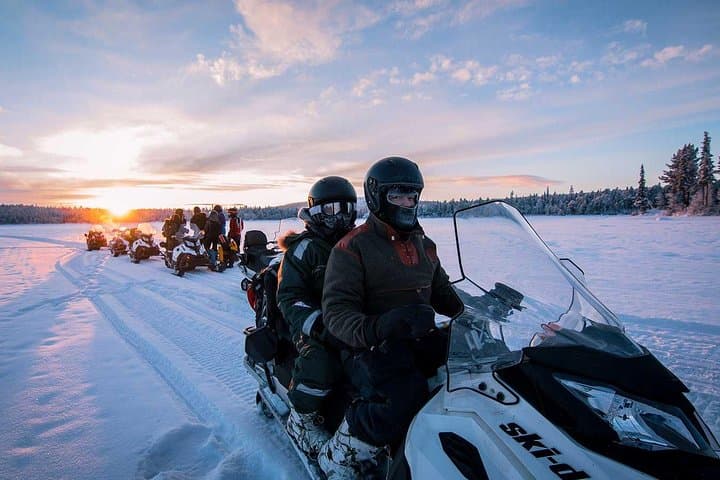
You pop the throttle and the world rearranges itself: the forest hush deepens into a mechanical tenor, snow sprays like silver dust from the sled's tracks, and the horizon opens into a flat expanse of lake ice and high, winter light. For four hours you are alternately in control and at the mercy of the Arctic — steering between birch trunks, slicing across glass-like ice, and letting the river’s frozen channel dictate a silver ribbon of route. The sky is a hard, pale blue; the air smells like pine and petrol; and every time the sled hums, the landscape seems to lean forward.
This is the Snowmobile Arctic Adventure out of Kiruna, a clear, efficient introduction to winter driving in one of Europe’s most northern landscapes. The itinerary is straightforward: shared or single-driver snowmobiles, a guide who reads weather and terrain like a map, and a lunch around an open fire in a forest hut where salted fish, reindeer, or stews remind you that this is a working Arctic, not a postcard.
Geology and human history sit close to the trail. You ride over the frozen Torne River — a watercourse that traces the borderlands between Swedish and Finnish Lapland — and glide across lakes that were sculpted by glaciers and millennia of freeze-thaw cycles. The ground beneath the snow is tundra and thin soils, and the region’s iron-rich bedrock is the reason Kiruna exists at all: the town was founded on an enormous iron ore deposit that still drives the economy, and you’ll often glimpse mining infrastructure on the distant skyline. At the same time, the land has been home to the Sami people for centuries; their culture and reindeer herding rhythms still mark the seasons, even as snowmobiles redraw the routes.
Practically speaking, expect to cover roughly 35–60 kilometers during the four-hour outing, depending on weather and the route the guide chooses. Elevation change is minimal — the ride is mostly flat to gently rolling — but technical demands come from the speed, the cold, and the variable surface (packed trail, fresh powder, lake ice). Guides take their own tracks through forest, along the frozen Torne River, and over lakes; they know when to cut speed and when to open up the throttle.
The social dynamic is part of the appeal: you can share driving with a friend, swapping controls at scenic points, or opt for the single-driver upgrade to keep the sled to yourself. Regardless, bring a valid driver's license if you plan to pilot the machines; operators usually check credentials for single-driver upgrades. Cameras are a must, but batteries die quickly in arctic cold — bring spare batteries warmly stashed against your body. The tour includes a forest-hut lunch, where local delicacies are laid out and the guides will gladly hold your hot coffee while you take a photo of the silvered landscape.
Safety and etiquette matter. Snowmobiles are thirsty machines; fuel is handled by the operator, but do your part to avoid unnecessary idling and keep a respectful distance from wildlife and reindeer herding operations. The guides will brief you on safe following distance, passing protocols, and navigation signals; listen closely — a sudden gust or thin ice on a lake can change plans in minutes.
If you’re planning this as part of a longer Arctic trip, the activity pairs well with nights in Kiruna or a day trip to the nearby Jukkasjärvi Icehotel. The experience is accessible for a wide range of travelers: casual outdoors people will find the speed addictive, while seasoned winter-sports types can appreciate the technical finesse of steering a loaded sled across variable surfaces.
For bookings and more details, the operator’s page spells out upgrade options, and route notes: <a href="https://app.advcollective.com/local-experts/explore-the-arctic-wilderness-on-a-snowmobile-adventure-in-kiruna">explore the Arctic wilderness on a snowmobile adventure in Kiruna</a>. If you want to compare dates, pricing, or single-driver availability, the same link is the best place to start: <a href="https://app.advcollective.com/local-experts/explore-the-arctic-wilderness-on-a-snowmobile-adventure-in-kiruna">Snowmobile Arctic Adventure</a>.
Why go? Because few experiences compress the Arctic’s contradictions — silence and speed, modern iron mining and ancient herding, hair-raising cold and warming fireside food — into a neat half-day. You leave with hands tingling from cold, a camera full of light-soaked photos, and the clean satisfaction of having covered ground that, in summer, would be lakes and marsh. It is an efficient, high-adrenaline way to understand this part of northern Sweden.
Timing tips: start mid-morning for the best balance of light and daytime warmth, and expect the guides to tweak the route based on visibility, wind, and ice conditions. Come prepared, listen to the briefing, and the Arctic will feel like an open highway — demanding, generous, and unforgettable.
Trail wisdom
Small choices, better day.
Bring a Valid Driver’s License
If you plan to be the single driver, bring your license — operators often require it for solo upgrades.
Protect Camera Batteries
Carry spare camera batteries against your body; cold robs capacity quickly.
Layer for Wind
Windproof outer layers and a warm mid-layer make throttle time comfortable; avoid cotton.
Follow Guide Signals
Maintain assigned following distance and obey hand signals to keep the group safe across lakes and trails.
Local knowledge
Read the place, not just the route.
Watch for native species including Reindeer, Ptarmigan.
Keep an eye out for wildlife during the transition between areas and habitats. Respect distance guidelines.
Stick to guided routes to protect fragile tundra vegetation and lichen beds; minimize idling and leave no trace at forest huts.
Follow the guide's instructions on size limits, ethical handling, and leave-no-trace practices.
Stop at a quiet inlet on the frozen Torne River for reflected sky photos. Ask the guide to pull into a birch clearing for close-up snow-laden tree shots
Locally recommended viewpoints and quiet spots known best to local operators.
Kiruna grew around one of the world’s largest iron ore deposits; the town is in the process of relocating parts of itself because of mine subsidence.
Maritime roots and regional tradition shape the waterways and working coasts.
Seasonal guide
Four versions of the same landscape.
Spring
Best forLonger daylight hours · Softer snow traction
ChallengesVariable ice conditions · Slushy late-season snow
Late winter to early spring offers extended daylight and milder temperatures, but expect patchy ice and changing snowpack.
Summer
Best forN/A for snowmobiling · Scenic road travel nearby
ChallengesNo snow; activity unavailable · Different set of outdoor options
Snowmobile tours are not available in summer; use the time to explore hiking, river trips, or the Icehotel museum.
Fall
Best forEarly snow windows · Northern lights season starting
ChallengesUnpredictable snowfall · Cold nights
Early winter’s approach can offer snow, but schedules remain weather-dependent; northern lights may begin to appear.
Winter
Best forSnowmobiling · Arctic photography · Aurora viewing
ChallengesExtreme cold · Short daylight in mid-winter
Peak winter delivers the best snowmobile conditions; dress for subzero temps and plan around limited daylight.
Operator details
What the booking data adds.
Included
- ✓2/p per snowmobile ( if uneven number you need to add single driver fee or sitt in a sled)
- ✓Snow overall, boots, wool socks, gloves, balaclava, helmet
- ✓Please advise food allergies in advance
Not included
- —Hotel transfers (can be booked separately)
Good to know
- ✓Public transportation options are available nearby
- ✓Not recommended for travelers with spinal injuries
- ✓Not recommended for pregnant travelers
- ✓Not recommended for travelers with poor cardiovascular health
- ✓Suitable for all physical fitness levels
- ✓Wearing glasses not recommended as they fog up (please wear contacts)
Pack with intention
What to bring.
Good to know
Common questions.
You can share driving with a friend without a license, but a valid driver’s license is typically required if you book the single-driver upgrade.
Plan the edges
The details that make the day easier.
Kiruna is undergoing an ongoing, deliberate relocation of part of the town to protect it from mine-induced subsidence—a rare example of an entire town being moved for mining operations.
After the ride, warm up in Kiruna or nearby Jukkasjärvi with a bowl of reindeer stew (suovas) or smoked Arctic char, then visit the Icehotel’s bar for locally distilled cloudberry liqueur and talk to Sami artisans about traditional crafts.
- trailhead
- Kiruna Airport (KRN)
- ~15–40 km to common meeting points; Driving distance from Kiruna center
- 15–40 minutes; Cell service: generally available near town, spotty on lakes; Permits: none typically required for guided tours; Language: Swedish and English.
Respect marked routes and the fragile tundra — avoid off-trail riding, carry out all trash, and follow guides’ instructions to minimize disturbance to reindeer and lichen.
Explore by topic
Follow the threads.
Keep exploring
Make the story part of the trip.
Set out from Bass Harbor for a private, customizable day on Blue Hill Bay — lighthouses, puffins, seals, and the chance to feel Acadia from the water. Small groups, local captains, unforgettable views.
In four hours you can move from shaded canyon ferns to wind-scoured coastal ridgelines, guided by someone who knows where the light—and the hidden views—live. This private half-day hike on the Monterey Peninsula or Big Sur is compact, curated, and perfect for travelers who want depth without a multiday commitment.
 Related story
Beneath a sky of shifting light, Skaftafell’s ice reads like a map of time. This three-hour guided glacier hike mixes technical instruction with geology and culture: compact, safe, and unforgettable.