
What the day feels like
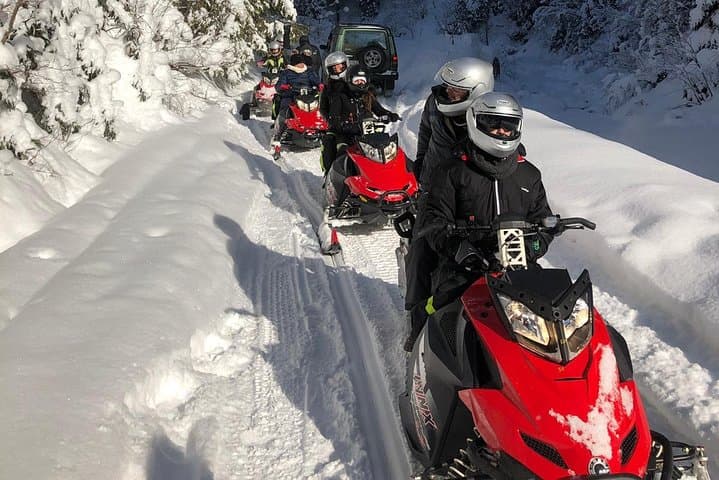
You wake before dawn in Brașov, and the town still sleeps under a thin crust of frost. By the time a minivan pulls up to your hotel the sky is paling to blue and the road north nods through fir and beech — a familiar, patient audience. After an hour the asphalt ends and the mountains take over: snowy ridgelines, terraces of slate and glacier-polish rock, and the soft hush that only a winter landscape can keep. A guide hands you a helmet and a pair of gloves, explains the controls, and you feel the machine beneath you like a beast that can be trusted and taught. At the first sweep of trail the Carpathians respond: wind that cuts fresh lines across the pines, a valley that exhales steam from a distant village. Snowmobiling here is equal parts transport and theater.
This day trip, a roughly nine-hour outing that departs from the Brașov region, is designed for people who want speed without sacrifice: long, purposeful runs across ridge lines and forest corridors with stops for views and a steaming roadside lunch. The route threads through parts of Transylvania that once marked the borderlands of medieval principalities and now host ski resorts, shepherd huts, and jagged folds of geology that tell of an ocean long gone. Those folds are the Carpathians' signature — uplifted layers of sediment and metamorphic rock shaped over tens of millions of years. The living landscape here is equally storied: a mosaic of spruce forest, alpine meadow, and human settlement that still practices seasonal wood cutting and pastoralism.
If you come for adrenaline, you’ll find it. If you come for context, you'll get a history lesson delivered in natural language: shepherds' corrals still line high pastures, Orthodox chapels nestle beneath cliffs, and many place names are German, Hungarian, or Romanian, a testament to Transylvania’s multiethnic past. Guides often point out the telltale stone platforms shepherds used to salt and dry meat, and the old logging roads now repurposed into groomed snowmobile tracks. Wildlife is part of the draw too — the region hosts one of Europe’s densest populations of brown bears, as well as lynx and red deer — though you’re more likely to see tracks than animals when you’re on a loud machine.
Practical notes are simple: this tour is a full-day experience (approximately 9 hours) with instant confirmation and free cancellation. Expect to spend most of the day in the vehicle and on the sled; operators typically provide protective helmets and instruction, but not heavy outerwear. The activity price starts from USD 226.89, and groups are kept small enough that the pace is social but lively. Safety briefings are standard and the guides are typically bilingual (Romanian and English). For first-time drivers, an easy introduction ride is included before you take a longer loop.
Why this beats renting a snowmobile elsewhere: the Carpathians combine dramatic views with long, consistent winter snow. Trails wind between alpine bowls and dense fir stands, so runs alternate between exposed ridge-top speed and technical, tree-lined riding. Snow conditions in midwinter are often dry and fast; later in the season you might ride on a base of consolidated piste.
If you plan to book, timing matters. Early morning departures capture the crispest tracks and the clearest air, and late afternoons bring the light that makes the forests glow orange before dusk. Layers are non-negotiable: a waterproof outer shell, an insulating midlayer, and a vigorous base layer. Gloves rated for cold and a balaclava will keep your face comfortable at speed. Footwear should be warm and waterproof.
For culture and comfort after your ride, drive back to Brașov’s cobbled center. Eat slow — sarmale (cabbage rolls) and polenta at a local guesthouse, or try papanasi, a fried dough dessert with jam and sour cream. There’s craft beer in town and small coffee shops where you can defrost and trade stories of who hit the most drift. If you’d like to book this exact route and read details from local experts, check out this <a href='https://app.advcollective.com/local-experts/thrilling-snowmobile-adventure-through-romanias-carpathian-mountains'>thrilling snowmobile adventure through Romania's Carpathian mountains</a>.
How to make the day better: arrive rested and hydrated, let the guide set a comfortable pace for your skill level, and take the designated stops — the views are the payoff and the deep-snow silence is rare in our connected world. Respect the machine: throttle control matters on slopes, and a smooth hand keeps the group together. Most operators build in a village lunch stop, which is as much a cultural interlude as a refuel.
For photographers, the best light comes early and late; a fast shutter freezes flying snow and a wide lens captures the sense of scale. If you’re trying to capture wildlife, keep a long lens stowed and ask the guide for likely sightings while stationary. Above all, enjoy the rare combination of speed, solitude, and soft white landscape — the Carpathians are a big, patient range, and riding through them feels like borrowing that patience for a few thrilling hours.
Trail wisdom
Small choices, better day.
Layer for changing conditions
Start with a moisture-wicking base, add an insulating midlayer and a waterproof shell — temperatures swing quickly at altitude.
Practice throttle control
Use smooth, steady throttle movements downhill and on turns to keep the machine stable and conserve fuel.
Protect face and extremities
Bring a balaclava and thin glove liners—exposed skin will freeze at speed.
Follow the guide’s line
Guides know local avalanche and terrain hazards; stay in their tracks for safety and to protect fragile zones.
Local knowledge
Read the place, not just the route.
Watch for native species including Brown bear, Red deer.
Keep an eye out for wildlife during the transition between areas and habitats. Respect distance guidelines.
Stay on designated tracks to avoid damaging winter-forage areas; support local guides who adhere to low-impact practices.
Follow the guide's instructions on size limits, ethical handling, and leave-no-trace practices.
Early-morning lookout points above Poiana Brașov for valley light. A small shepherd’s chapel along the lower approaches — ask your guide to stop
Locally recommended viewpoints and quiet spots known best to local operators.
Transylvania’s mountain routes once connected pastoral communities and timber mills; many trails follow old shepherd and logging roads.
Maritime roots and regional tradition shape the waterways and working coasts.
Seasonal guide
Four versions of the same landscape.
Spring
Best forQuieter trails · Mixed snowpack riding
ChallengesVariable melt and wet snow · Shorter daylight
Late winter into early spring offers softer light and quieter trails but expect heavier, wetter snow and potential melt-freeze cycles.
Summer
Best forOff-season sight-seeing · Hiking alternatives
ChallengesNo snow for snowmobiles · Different activity options required
Summer is great for exploring the same valleys on foot or by MTB, but snowmobile tours do not operate without consistent snow.
Fall
Best forCrisp alpine air · Pre-winter solitude
ChallengesUnpredictable early snow · Cold nights
Autumn shows the mountains' color palette and is ideal for planning; operators prepare for winter but tours depend on reliable snow cover.
Winter
Best forSnowmobiling · Powder conditions
ChallengesCold and wind · Short daylight hours
Winter is prime: consistent snow, groomed tracks, and a high chance of deep, fast conditions — bring full cold-weather gear.
Operator details
What the booking data adds.
Included
- ✓Bottled water
- ✓Air-conditioned vehicle
Not included
- —Cable Car
- —Lunch
Good to know
- ✓Wheelchair accessible
- ✓Infants and small children can ride in a pram or stroller
- ✓Service animals allowed
- ✓Public transportation options are available nearby
- ✓Specialized infant seats are available
- ✓Transportation options are wheelchair accessible
- ✓Not recommended for travelers with spinal injuries
- ✓Not recommended for pregnant travelers
- ✓Not recommended for travelers with poor cardiovascular health
- ✓Suitable for all physical fitness levels
Pack with intention
What to bring.
Good to know
Common questions.
No — most tours provide a short training session; guides will pair beginners with experienced riders when appropriate.
Plan the edges
The details that make the day easier.
The Carpathian Mountains host one of Europe’s largest populations of brown bears, with several thousand individuals distributed across Romania's forests.
After the ride, return to Brașov’s Old Town for hearty Romanian fare — try sarmale and polenta, pair with local craft beer, and stroll Council Square for dessert and atmosphere.
- Closest airports
- Bucharest Henri Coandă (OTP) or Brașov-Ghimbav (BBU); Driving from Bucharest ~170 km
Stick to groomed tracks to protect winter forage and habitat, pack out all trash, and choose local guides who demonstrate low-impact practices to preserve these fragile mountain ecosystems.
Explore by topic
Follow the threads.
Keep exploring
Make the story part of the trip.
Set out from Bass Harbor for a private, customizable day on Blue Hill Bay — lighthouses, puffins, seals, and the chance to feel Acadia from the water. Small groups, local captains, unforgettable views.
In four hours you can move from shaded canyon ferns to wind-scoured coastal ridgelines, guided by someone who knows where the light—and the hidden views—live. This private half-day hike on the Monterey Peninsula or Big Sur is compact, curated, and perfect for travelers who want depth without a multiday commitment.
 Related story
Beneath a sky of shifting light, Skaftafell’s ice reads like a map of time. This three-hour guided glacier hike mixes technical instruction with geology and culture: compact, safe, and unforgettable.