
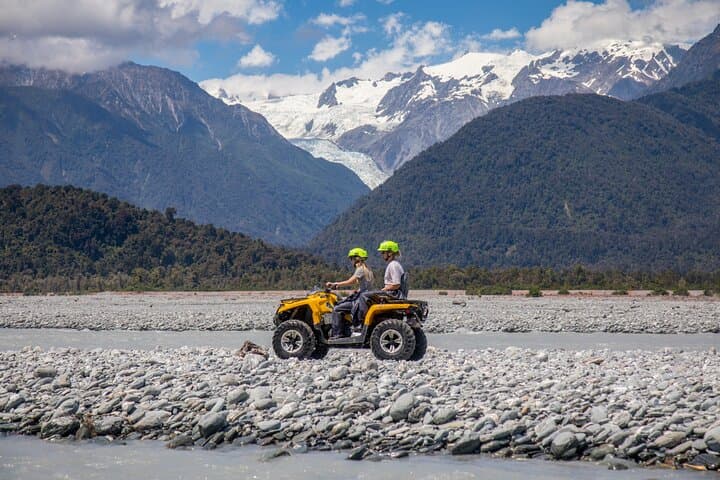
What the day feels like
The machine breathes under your hands—a compact growl that promises dirt and speed. You throttle forward and the forest answers: wet ferns blur, trunks streak by, and a braided river dares you to find a line through its gravel bars. High above, the Southern Alps hold a smudge of blue ice, the remnant throat of a glacier that carved these valleys long before anyone put rubber to soil. For two hours, the ride threads the edge of Westland Tai Poutini National Park, a place where temperate rainforest tumbles toward the Tasman Sea and the land still remembers its glacial past.
This is Franz Josef off-road, but it isn’t just a joyride. The tracks follow paths that creeks and ancient ice once took—ridges smoothed, valleys gouged, and river systems braided into the single plate of the West Coast. Julius von Haast named the ice mass after Emperor Franz Joseph I in the 19th century; before that, Māori knew this place intimately, with names and stories tied to the glacier now called Kā Roimata o Hine Hukatere (the tears of Hine Hukatere). That cultural and geological layering is part of the ride: you’re bumping along routes that are simultaneously young and extremely old.
The terrain varies quickly. Expect gravel and clay tracks, river-lapped flats, and the occasional root-tussle under the canopy. The rainforest here has personality—tūī and fantail chatter like passengers, and mist curls through silver ferns. The rivers act like living things: braids shift after heavy rain, channels find new beds, and for the rider, decision-making is immediate. The guide points to a sweep of basalt and says, simply, “That used to be ice.” You can feel the history through your tires.
Why do this rather than a glacier walk or scenic flight? For one, it’s immediate. You’re in the landscape, not above it. The quad levels the playing field for people who want movement and variety without the physical commitment of multi-hour hikes or the cost of helicopter lifts. It’s also an efficient way to see the mosaic of Westland—rainforest, river systems, and glacial valley—from a single, kinetic vantage.
Practicalities are straightforward. The tour runs approximately two hours and is suitable for most adults in reasonable health. Expect a mix of slow technical sections and quicker flats—this is not a racetrack. Operators typically supply helmets and safety briefing; still, bring a base layer and waterproof shells because West Coast weather can flip in an hour. The region’s signature rain is part of the character: it keeps the rainforest emerald and the rivers mobile, but it also turns tracks sticky and vision patchy, so goggles or a visor are worth their weight in comfort.
Safety and sustainability go hand-in-hand on these rides. Stick to the route; operator guides choose paths to avoid sensitive habitats and to limit erosion. You’ll be asked to follow instructions tightly—quad bikes are forgiving, but braided rivers and loose gravels aren’t. Expect a short briefing on handling, a weight/height limit for passengers, and a route tailored to conditions that day. In high water or heavy rain, tours can change or be canceled; that’s a feature, not a bug—the rivers here don’t take orders.
What you’ll remember is a layered impression: the smell of wet earth under cut grass, the staccato of your tires on gravel, the sudden clearing that gives you a view up-valley toward rock and distant blue ice. For photography, a helmet-mounted action cam gives you motion while a handheld camera with a fast shutter catches birds and river geometry. Keep straps secure—this is a moving, occasionally bouncy stage.
Getting there is part of the trip. Franz Josef village is the practical hub: a compact base with cafes, gear shops, and the famous hot pools for a soak afterward. The nearest major airports are Hokitika (about two hours’ drive) or Christchurch for a longer drive. Summer is the most predictable time weather-wise, but spring and autumn offer fewer crowds and crisp light. Winter narrows the window due to rivers and cold.
Who should sign up? The tour suits anyone who wants low-tech adventure with an adrenaline edge—families with older kids, couples, and solo travelers comfortable on an all-terrain vehicle. It’s not for people who need a fully accessible route or those who prefer long, quiet hikes. If you want speed, voice that to your guide; there are sections where the pace opens up. If you want detail—birdlife, geology, Māori place names—ask. Good local guides layer practical riding tips with context that makes the gravel bars feel like a classroom.
A few final, useful rules: dress for rain, expect to get a bit dirty, and leave no trace. The West Coast’s temperate rainforest is resilient but finite; operators work within the park framework and with local iwi to keep impacts low. After the ride, the village offers immediate comforts—hot showers, pies, and a hot pool where you can feel the shudder of the day leave your bones.
This quad tour is kinetic, honest, and immediate. It’s not the glacier itself; it’s the skin of the landscape—the ribs of a place shaped by ice and water—riding past at a speed that makes you present. If you want an adventure that delivers access, narrative, and a little mud on your boots, thumb the throttle and let the West Coast tell you a few of its stories.
Trail wisdom
Small choices, better day.
Dress for wet weather
The West Coast turns on rain quickly—waterproof outer layers and quick-dry baselayers keep you comfortable.
Secure your camera
Use a chest mount or wrist strap for handheld cameras; dust and vibration are constant.
Wear sturdy closed-toe shoes
Gravel, mud, and river bars demand good tread and ankle support.
Follow the guide’s line
Guides choose routes to minimize environmental impact and maximize safety—stay behind them.
Local knowledge
Read the place, not just the route.
Watch for native species including Tūī, Fantail (pīwakawaka).
Keep an eye out for wildlife during the transition between areas and habitats. Respect distance guidelines.
The tour operates on the edges of Westland Tai Poutini National Park, part of the Te Wāhipounamu World Heritage Area—stick to designated tracks and pack out waste.
Follow the guide's instructions on size limits, ethical handling, and leave-no-trace practices.
Lake Mapourika — a calm, reflective lake with mountain views and a chance to see tūī and kererū. Okarito Lagoon — a short drive south for quiet waterways and birding, especially for white herons
Locally recommended viewpoints and quiet spots known best to local operators.
The glacier was named Franz Josef by Julius von Haast in the 19th century; Māori name Kā Roimata o Hine Hukatere reflects local ancestral stories.
Maritime roots and regional tradition shape the waterways and working coasts.
Seasonal guide
Four versions of the same landscape.
Spring
Best forFewer crowds · Wildflower season
ChallengesUnpredictable rain · Higher river flows after snowmelt
Spring brings fresh green growth and quieter trails but can be wet from snowmelt and changeable weather—be prepared for slick conditions.
Summer
Best forStable weather windows · Longer daylight hours
ChallengesBusier with tourists · Occasional heavy summer storms
Summer is the most reliable season for consistent tour availability and milder temperatures; book ahead for peak weeks.
Fall
Best forCrisp light for photos · Fewer crowds than summer
ChallengesShortening days · Cooler nights
Autumn offers dramatic skies and quieter trails; temperatures dip and evenings cool quickly—layer up.
Winter
Best forSnow-capped alpine backdrops · Low-season rates
ChallengesCold, wet conditions · Potential route changes or cancellations
Winter can be spectacular but harsh; operators may alter or cancel tours depending on river levels and access.
Operator details
What the booking data adds.
Included
- ✓Gumboots
- ✓Free Photos
- ✓Helmet
- ✓Wet weather gear
Good to know
- ✓Public transportation options are available nearby
- ✓Not recommended for travelers with spinal injuries
- ✓Not recommended for pregnant travelers
- ✓Suitable for all physical fitness levels
Pack with intention
What to bring.
Good to know
Common questions.
No — guides give a safety briefing and basic handling instructions; this tour is designed for beginners and confident first-timers.
Plan the edges
The details that make the day easier.
Franz Josef Glacier is one of the world's rare temperate glaciers that descends from the alpine ice into rainforest—historically it could move up to two meters per day.
After the ride, warm up at the Franz Josef Glacier Hot Pools or grab a hearty meal and a coffee at the beloved Alice May Cafe in town; sample West Coast whitebait or fresh seafood at local eateries.
- Closest airport
- Hokitika (2-hour drive); Major airport: Christchurch (5–6 hours); Tour departs from Franz Josef village (short drive to trails); Cell service: patchy outside town; Permits: none required for this commercial tour; Price from USD 99.66; Duration: ~2 hours
This tour operates on the margin of a national park and World Heritage Site—respect track boundaries, avoid feeding wildlife, and carry out all rubbish to reduce impact.
Explore by topic
Follow the threads.
Keep exploring
Make the story part of the trip.
Set out from Bass Harbor for a private, customizable day on Blue Hill Bay — lighthouses, puffins, seals, and the chance to feel Acadia from the water. Small groups, local captains, unforgettable views.
In four hours you can move from shaded canyon ferns to wind-scoured coastal ridgelines, guided by someone who knows where the light—and the hidden views—live. This private half-day hike on the Monterey Peninsula or Big Sur is compact, curated, and perfect for travelers who want depth without a multiday commitment.
 Related story
Beneath a sky of shifting light, Skaftafell’s ice reads like a map of time. This three-hour guided glacier hike mixes technical instruction with geology and culture: compact, safe, and unforgettable.