
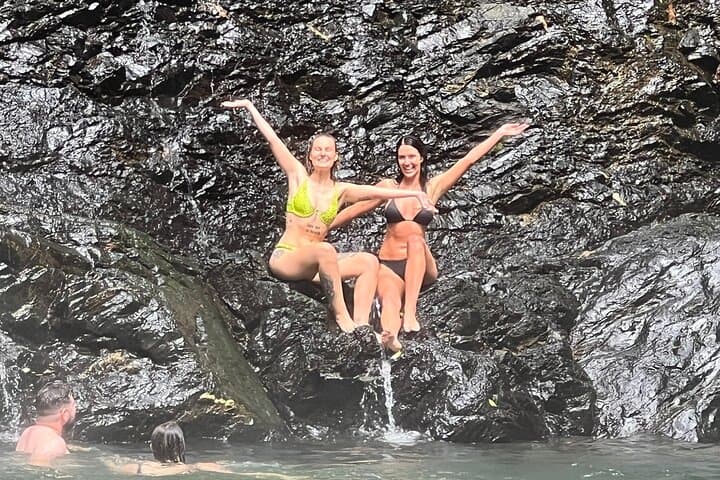
What the day feels like
The engine settles into a steady growl and the rainforest seems to lean closer—palms and ancient ferns pressing around the narrow track as the UTV eats a line through red soil and braided creeks. You pay attention to the rhythm: the fan of spray on the windshield, the clack of gravel beneath treads, the guide’s voice calling out a narrow seam between trees. Two hours later you step out barefoot into a pool whose water is so clear you can see fish nudge at your ankles. Cassowary Falls has a way of making the rest of the world feel both distant and irrelevant.
This is a small-group, private-property adventure that compresses a lot into roughly 2.5 hours: an all-action UTV crossing creeks and rivers, an old Army truck ride through deeper rainforest, a short interpretive walk with a local guide, and that central time at Cassowary Falls—the kind of freshwater hole where the trees crowd right down to the waterline and turtles glide like living coins. The operator emphasizes safety: this is one of the few swimming spots in the Daintree free from crocodiles, so you can actually dive in and let the current pull you under the canopy’s moving light.
The Daintree itself reads like natural history. You’re not in some new-growth plantation; you’re inside the Wet Tropics of Queensland—a World Heritage landscape that’s often cited as one of the oldest surviving tropical rainforests on Earth. Geologically the region is a quilt of ancient soils and volcanic flows, coastal lowlands backed by steep escarpments. Flora and fauna here are survivors—plants and animals with evolutionary stories that predate many modern continents. That’s visible in the understorey: litter made of leathery leaves, orchids hitching themselves to strangler figs, and the unmistakable footprint of the cassowary—this tour’s namesake bird—whose presence links the land to Indigenous stories and current conservation efforts.
Speaking of people, the Daintree sits on the traditional lands of the Kuku Yalanji. Local guides often weave cultural context into the tour—pointing out traditional food sources, explaining the spiritual value of certain trees, or recounting why particular waterways have been protected for generations. The fact that this tour takes place on private property gives the guide more freedom to stop, show, and share in a way that larger national-park circuits sometimes cannot. It also means the company managing access has a stewardship role: responsible visitors will notice efforts to limit group sizes, avoid trampling riparian banks, and discourage feeding wildlife.
The ride itself is immediate and tactile. UTVs are unforgiving in the best way: you feel every crest, bank, and rut, and the vehicle invites small, repeated commitments—lean slightly into a berm, feather the throttle across creek entrances, take the plunge through a shallow ford. The Army truck segment is a contrast—slower, higher vantage, the rainforest opening into valley views that remind you just how much green is contained in this narrow strip between mountain and reef.
Cassowary Falls is the pay-off and the reset. The pool collects cold spring water and the cascade is compact—one of those refreshingly simple places where the water does most of the work. It’s also family-friendly: guides will point out native turtles and small fish, and the property’s management emphasizes that the site is safe for swimmers. Don’t expect pristine beach-style facilities—this is rainforest bathing; bring what you need, leave nothing behind, and accept that your towel will smell like eucalyptus and mud when you’re done.
Practical edges: the whole excursion runs about 150 minutes. Expect a mix of standing and riding; wear footwear you don’t mind getting wet, and bring a change of clothes. The tour includes transfers to and from Daintree Village, making logistics simpler for visitors based in Port Douglas or Daintree. Pricing starts around USD 121.61 per person, and the small-group approach keeps the numbers low enough to feel personal.
Why go? Because this trip compresses three Australian travel currencies into one short experience: a taste of raw off-road adventure; a close, safe swim in a rainforest pool; and genuine interpretive time that connects natural history and local culture. The Daintree can be logistically sprawling, but this experience puts you right in the thick of it without a full-day commitment. For families, active travelers, and anyone who wants a quick, wet reset from the reefside towns, it’s a tidy, unforgettable mash-up.
If you’re planning it: prioritize the dry season months for clearer tracks and fewer flies; arrive with quick-dry layers and waterproof phone protection; listen to the guide about where to step in the water (slippery rocks are a thing); and bring a reusable bottle to refill—guides will usually have water, but minimizing plastic is part of the point when you’re in World Heritage country. Above all, slow down when you’re in the falls: in the rainforest, sound and light move differently. The sunlight is a slow traveler through the canopy, and the water offers a calm counterpoint to the machine’s earlier rumble.
This is not an expedition; it’s a concentrated relationship with a place that has been living on its own terms for milions of years. You’ll leave with wet hair, dirty boots, and better questions about an ecosystem that is older than most maps. That, more than selfies or checklists, is the kind of souvenir this trip tends to leave behind.
Trail wisdom
Small choices, better day.
Wear quick-dry footwear
Water shoes or sturdy sandals that drain quickly will keep you comfortable for creek crossings and the swim at Cassowary Falls.
Pack a waterproof phone case
You’ll want photos during the ride and at the falls—protect electronics from spray and mud.
Bring reef-safe sunscreen and insect repellent
Protect skin from sun on exposed sections and from midges in the rainforest; choose eco-friendly formulations.
Follow guide safety briefings
UTV handling and river entries have local rules—obey the guide to keep the experience safe for everyone.
Local knowledge
Read the place, not just the route.
Watch for native species including Southern Cassowary (signs and sometimes sightings), Freshwater turtles and small native fish in the pools.
Keep an eye out for wildlife during the transition between areas and habitats. Respect distance guidelines.
Visitors should stick to designated tracks, avoid feeding wildlife, and support operators who limit group size and practice low-impact access to sensitive riparian zones.
Follow the guide's instructions on size limits, ethical handling, and leave-no-trace practices.
Small freshwater cascades upstream of the main pool that have deeper pools for quieter swims. Valley lookout on the Army truck route with sweeping views of rainforest ridges
Locally recommended viewpoints and quiet spots known best to local operators.
The Daintree forms part of the Wet Tropics of Queensland World Heritage Area; the land has sustained Indigenous communities for thousands of years and features flora and fauna with ancient lineages.
Maritime roots and regional tradition shape the waterways and working coasts.
Seasonal guide
Four versions of the same landscape.
Spring
Best forLush vegetation · Water clarity after early rains · Birdwatching
ChallengesMore humidity · Higher insect activity
Spring brings rapid plant growth and active wildlife; expect warm, humid conditions and vivid green scenery.
Summer
Best forWarm water swims · Long daylight hours · Fewer crowds on weekdays
ChallengesTropical storms and heavy rain · Higher humidity and flies
Summer is hot and wet—good for splashing in waterfalls but expect slippery tracks and potential weather delays.
Fall
Best forStable weather · Clearing skies · Good off-road traction
ChallengesResidual heat early in season · Variable river levels
Autumn balances warm days with improving track conditions, making for comfortable rides and clear water.
Winter
Best forCool, dry days · Lower humidity · Best visibility
ChallengesCooler pool temperatures · Strong sun on exposed sections
Australian winter (June–August) is the most pleasant for most visitors: dry tracks, fewer insects, and crisp air in the canopy.
Operator details
What the booking data adds.
Included
- ✓Exclusive private waterfall access and swim
- ✓ATV ride with professional guide
Not included
- —Snacks
Good to know
- ✓Service animals allowed
- ✓Specialized infant seats are available
- ✓Not recommended for travelers with spinal injuries
- ✓Not recommended for travelers with poor cardiovascular health
- ✓Suitable for all physical fitness levels
Pack with intention
What to bring.
Good to know
Common questions.
Yes — the falls on this private property are known to be crocodile-free and are managed for safe swimming; guides will advise safe entry points.
Plan the edges
The details that make the day easier.
The Daintree Rainforest is part of the Wet Tropics of Queensland World Heritage Area and contains plant lineages that date back approximately 180 million years.
After the tour, head to nearby Daintree Village for simple cafes selling tropical fruit, or drive back to Port Douglas for seafood at the marina; consider visiting Mossman Gorge for a complementary cultural walk led by Kuku Yalanji guides.
- Closest airport
- Cairns Airport (CNS). Driving distance: Port Douglas ~1 hour to Daintree Village; tour includes transfers to
- from Daintree Village. Cell service
- patchy in deeper rainforest valleys. Permits: none required for this private-property tour; operator handles site access.
This tour operates inside the Wet Tropics—minimize impact by staying on trails, packing out rubbish, using reef-safe sunscreen, and supporting operators who limit group sizes and protect riparian habitats.
Explore by topic
Follow the threads.
Keep exploring
Make the story part of the trip.
Set out from Bass Harbor for a private, customizable day on Blue Hill Bay — lighthouses, puffins, seals, and the chance to feel Acadia from the water. Small groups, local captains, unforgettable views.
In four hours you can move from shaded canyon ferns to wind-scoured coastal ridgelines, guided by someone who knows where the light—and the hidden views—live. This private half-day hike on the Monterey Peninsula or Big Sur is compact, curated, and perfect for travelers who want depth without a multiday commitment.
 Related story
Beneath a sky of shifting light, Skaftafell’s ice reads like a map of time. This three-hour guided glacier hike mixes technical instruction with geology and culture: compact, safe, and unforgettable.