
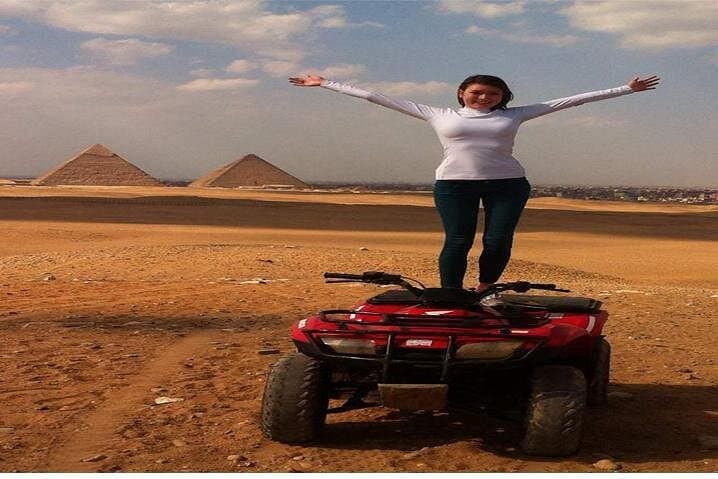
What the day feels like
You pull on the gloves and sunlight slants across limestone like a dare. Sand bites at boot soles; wind scours the plateau and carries the faint, constant hum of Cairo far behind you. Ahead, the pyramids rise—huge, silent machines of stone—while the Sphinx watches with a patient, weathered half-smile. This is not the postcard moment with a camel and a camel-driver offering staged shots. It is the plateau felt through the handlebars of an ATV: vibration under your palms, the brief blur of scrub brush and ancient rock at your periphery, and the slow, inevitable return to the jaw-dropping geometry of monuments older than most civilizations’ histories.
Quad-bike tours on the Giza Plateau are an odd and energizing way to experience an ancient landscape. They are kinetic—desert becomes playground—and intimate: routes that carve close to the base of the pyramids reveal angles and shadow planes you don’t get from the paved parking lot. A typical booking lasts about four hours, long enough for instruction, a warm-up loop across packed sand and small dunes, and a measured circuit that pauses for photos and sunlight-cooled water. At roughly 4 hours total time, the tour balances adrenaline and archaeology: part motorsport, part outdoor walking tour when you stop to stretch and let the quiet soak in.
The geology here is straightforward but compelling. The Giza Plateau is a raised shelf of limestone and bedrock—firm underfoot in some patches, loose in others. Where wind has picked up surface sand, tracks can deepen and demand steadier throttle and a lower center of gravity. Expect a mix of hard-packed tracks, sandy stretches and a few shallow ridges; no steep elevation gains, but the terrain rewards attention and good throttle control. The plateau’s sparse vegetation—scrubby shrubs and hardy grasses—gives the desert texture and a sense of movement when the wind passes.
History is always at arm’s reach. The Great Pyramid of Khufu, the Sphinx and their companion tombs are roughly 4,500 years old; they loom not just as monuments but as lived landscapes that have been places of labor, reverence and commerce for millennia. Modern Giza is a layered place: from Bedouin tent encampments to mid-20th-century hotels and rooftop cafés that trade on views of the stones. Quad tours of the plateau are, in a way, a contemporary chapter in the plateau’s long biography—motorized machines tracing routes across a land that once echoed only with the sound of human hands and hooves.
Practically speaking, this is a do-able day adventure for most travelers. The package typically includes all equipment and a quick safety briefing so even beginners can ride confidently. The price point is accessible—around USD 50 for a four-hour private or small-group tour—and many operators offer free cancellation and private options for those who prefer a focused experience. Meeting points are usually near the official parking zones for the Giza complex or at hotels in Giza; many participants combine the ride with a guided visit to the pyramid complex, a stop at a rooftop restaurant for a post-ride view, or a visit to Cairo’s museums.
Timing matters. Morning and late afternoon rides are quietest and most comfortable: temperatures are lower, the light is cleaner for photographs, and the wind that makes midday sand sting is gentler. Early rides can greet you with a clear, cool air that sharpens the lines of the pyramids; late rides let the sun lower the contrast and give the stones a warm patina. Bring sunglasses or goggles, sun protection and a water plan—dust will find the smallest gaps.
Safety and local etiquette are straightforward but important. Stay on the routes designated by your tour guide and never attempt to drive up onto protected or fenced areas; those stone bounds may be ancient, but the modern protections exist to preserve fragile archaeology. Carry ID and small local currency for tips; guides and staff in Egypt often rely on cash tips for daily income. Be mindful of photographing local people; a polite ask is the right protocol.
For longer-term planning, pair this ride with Cairo’s cultural highlights. Spend a morning in the Egyptian Museum for context on the artifacts unearthed from the valley, or head to the Khan el-Khalili market for a late-afternoon wander after you wash off the desert grit. Local flavors—koshari, grilled kofta, strong black tea—are close at hand; rooftop cafés in Giza and Mena House hotels give you an elegant counterpoint to the rawness of the plateau.
Why go? Because the ride makes the landscape personal. The pyramids are undeniably grand from any angle, but there is something clarifying about approaching them under your own momentum: the world narrows to the managed roar of the engine, the grainy surface of the sand, and the sudden, humbling size of human-made stone. It is a short, intense way to connect with one of the planet’s oldest stages—and to leave with a story that feels both modern and deeply rooted in place.
Trail wisdom
Small choices, better day.
Ride at golden hour
Book early morning or late afternoon to avoid heat, reduce dust and get the best light for photos.
Wear protective eyewear
Goggles or wraparound sunglasses keep sand and wind out of your eyes while maintaining visibility.
Listen to the briefing
Follow the guide’s instructions on speed, braking and where to park for photos—this keeps you and the monuments safe.
Bring small cash for tips
Local staff rely on cash tips; bring small denominations in Egyptian pounds.
Local knowledge
Read the place, not just the route.
Watch for native species including Desert larks and small passerines, Occasional desert fox traces or small reptiles in scrub.
Keep an eye out for wildlife during the transition between areas and habitats. Respect distance guidelines.
Stick to designated tracks to prevent erosion and disturbance; avoid driving into fenced or archaeologically sensitive areas and take all trash with you.
Follow the guide's instructions on size limits, ethical handling, and leave-no-trace practices.
Rooftop cafés in Giza with pyramid views at sunset. Short street-food detours for koshari and fresh tea in nearby neighborhoods
Locally recommended viewpoints and quiet spots known best to local operators.
The Giza Plateau holds the Great Pyramid of Khufu and the Sphinx, built around 2560 BCE; the stones you ride beside were quarried and transported by laborers over millennia ago.
Maritime roots and regional tradition shape the waterways and working coasts.
Seasonal guide
Four versions of the same landscape.
Spring
Best formild temperatures · clear skies · wildflower flashes after winter rains
Challengeswindy afternoons · occasional sand gusts
Spring balances comfortable riding conditions with clearer visibility; expect breezy afternoons that can stir up surface sand.
Summer
Best forlong daylight hours · sunlit photo opportunities
Challengeshigh heat · strong midday sun · more dust
Summer can be intense—plan morning or late rides, wear sun protection and carry extra water to manage desert heat.
Fall
Best forcooler temps · stable weather · excellent visibility
Challengesshorter days · sporadic wind
Fall mirrors spring in offering pleasant temperatures and excellent light for photography—an ideal time for full four-hour experiences.
Winter
Best forcoolest riding conditions · clear skies · comfortable all-day outings
Challengeschilly mornings · possible occasional rain
Winter is the most comfortable season for longer rides, with cool mornings and minimal heat stress—layer for temperature swings.
Operator details
What the booking data adds.
Included
- ✓Hotel pickup and drop-off
- ✓All taxes
- ✓Qualified Egyptologist guide
- ✓Transport by private vehicle
Not included
- —Tipping
Good to know
- ✓Suitable for all physical fitness levels
- ✓Dress code is smart casual
Pack with intention
What to bring.
Good to know
Common questions.
No—operators provide a briefing and basic instruction, and tours are designed for beginners and intermediate riders.
Plan the edges
The details that make the day easier.
The Great Pyramid at Giza was constructed around 2560 BCE for Pharaoh Khufu and remained the tallest man-made structure in the world for over 3,800 years.
After the ride, wash off at a nearby hotel and head to a rooftop café for a view of the pyramids with mint tea; try koshari or grilled kofta from a local eatery and wander the nearby Khan el-Khalili market for spices and handmade souvenirs.
- Closest airport
- Cairo International Airport (CAI) ~30–45 minutes by car to Giza depending on traffic; Driving distance from central Giza: under 10 km to plateau parking; Cell service: reliable around Giza but expect intermittent spots on the plateau; Permits: no special permits for quad tours, but entry to the official pyramid complex requires tickets if you plan to enter fenced areas.
Respect protected areas by staying on sanctioned routes, avoid littering, and do not drive onto archeological features; choose operators committed to low-impact practices.
Explore by topic
Follow the threads.
Keep exploring
Make the story part of the trip.
Set out from Bass Harbor for a private, customizable day on Blue Hill Bay — lighthouses, puffins, seals, and the chance to feel Acadia from the water. Small groups, local captains, unforgettable views.
In four hours you can move from shaded canyon ferns to wind-scoured coastal ridgelines, guided by someone who knows where the light—and the hidden views—live. This private half-day hike on the Monterey Peninsula or Big Sur is compact, curated, and perfect for travelers who want depth without a multiday commitment.
 Related story
Beneath a sky of shifting light, Skaftafell’s ice reads like a map of time. This three-hour guided glacier hike mixes technical instruction with geology and culture: compact, safe, and unforgettable.