
What the day feels like
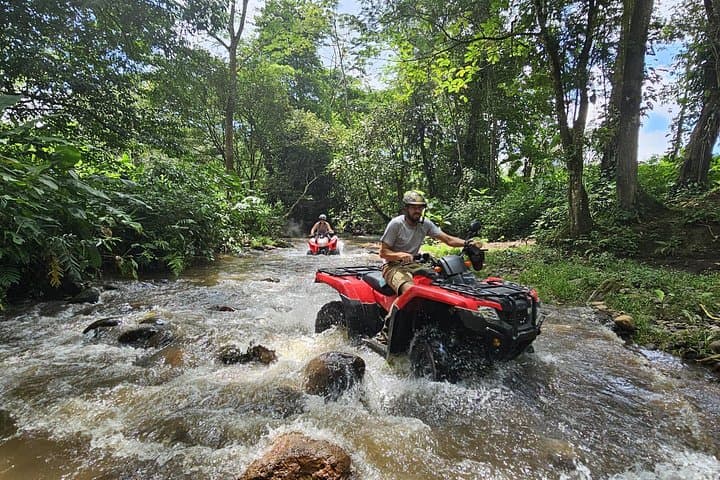
The engine settles into a steady growl and the forest leans in. You feel the machine respond beneath you — not a blunt instrument but a willing animal — as the narrow track peels away from La Fortuna’s quiet roadside and drops into green. Sunlight filters through the canopy in slashes; the air smells like wet earth and fresh-cut cassava. Within minutes the dirt changes character, from hard-packed lane to rutted stream crossing, and the guide calls a quick hand signal: slow, line up, pick your line. The ATV answers, tires clawing, water daring you to misjudge it.
This two- to three-hour loop is a concentrated primer on Arenal country: primary and secondary rainforest, small-scale agriculture, a river that alternates between reflective pools and insistent rapids, and the kind of human history that’s visible in plain sight — a roadside cemetery, the first one in Fortuna, sitting under a growth of ceiba trees on the property where you stop for a talk. Guides here double as interpreters: they’ll point out medicinal plants and peccary trails, explain how cassava shaped local diets, and recount the 1968 eruption of Arenal that rerouted livelihoods and tourism alike.
Geology is never far away. Though you don’t climb the volcano on this tour, Arenal’s shadow is part of the topography: lava flows and ash-sediment mixtures formed terraces and redirected rivers, creating the mosaic of habitats you ride through. The Fortuna River — patient and insistent — plays a starring role. Guides time a pause at its natural pools for a quick swim; the current teases, the pools hold, and the water returns you to a simpler rhythm.
What sets this ATV tour apart from a straight thrill-ride is the balance of speed and story. It’s designed for people who want to feel the machine but also to come away with a clearer sense of place. You’ll cross streams, blast through tight singletrack carved by rain and tires, and roll past cassava plots where roots are still laid out to dry. At the cemetery stop, a guide offers context: early settlers, family plots, and how the eruption changed settlement patterns. It’s a small cultural lesson tucked into an otherwise kinetic morning.
Practicalities are tidy. The operator provides 250cc Honda machines for solo riders and 420cc two-up ATVs, along with helmets and hydration; pick-up is free from most areas in and around La Fortuna. The advertised window is 2–3 hours — enough time to cover the variety of terrain without exhausting first-timers. Expect group sizes to be small (reviews are modest, with an average rating around four stars), and guides to be conversational and safety-focused.
For planning: this is best as a morning or late-afternoon activity to avoid midday heat and the heaviest traffic on shared farm tracks. Dress for mud and sun — light, quick-dry layers that you can hose off back at town. Bring a small dry bag for your phone and essentials, and waterproof shoes that can get saturated. Hydrate before you mount; even though bottled water is provided, the combination of sun and vibration pulls moisture fast.
Safety is straightforward but non-negotiable: listen to the orientation, wear your helmet properly, and don’t attempt technical lines beyond your comfort zone. The guides tailor instruction to rider ability and will steer you around the gnarlier obstacles. If you’re new to ATVs, the 250cc is forgiving; experienced riders will appreciate the 420cc stability for tandem runs.
Beyond the ride itself, the trip plugs into broader experiences in La Fortuna. Hot springs, local sodas (small eateries), and craft shops are minutes from the meeting point; a post-ride lunch of casado — rice, beans, plantain, salad, and a protein — feels earned and authentic. For photographers, early light through the forest or the reflective pools after a stream crossing will reward a patient frame.
Who this tour suits: travelers who want a hands-on, kinetic way to cover a lot of ground quickly; couples or friends who want an easy tandem option; families with older teens who meet height and safety criteria; and anyone looking to balance adrenaline with cultural context. The price point starts around $105 USD, which includes the vehicle, fuel, helmets, hydration, and most logistics — a reasonable exchange for a guided, curated experience in Arenal’s accessible wildlands.
If you go, treat the landscape with respect: stay on marked tracks, avoid tearing new lines through fragile soil, and leave the cassava plots as you found them. The river will forgive a careful crossing but not careless behavior. Do this right and you’ll come away with mud under your nails, a clearer picture of how Arenal shaped the local economy, and a short list of places in La Fortuna worth returning to for longer hikes and swims.
Trail wisdom
Small choices, better day.
Mind the Lines
Pick a riding line that matches your skill; guides will point out safer alternatives for beginners.
Footwear That Gets Wet
Wear sturdy, quick-dry shoes — your feet will likely get wet during stream crossings.
Hydrate Beforehand
Drink water before the ride; sun and vibration dehydrate faster than you think.
Protect Your Phone
Use a small dry bag or leave electronics with the guide to avoid water damage during crossings.
Local knowledge
Read the place, not just the route.
Watch for native species including Toucan, White-faced capuchin.
Keep an eye out for wildlife during the transition between areas and habitats. Respect distance guidelines.
Operators favor established tracks to limit erosion; visitors are asked to stay on trails, avoid disturbing riverbanks, and use biodegradable sunscreens to protect aquatic life.
Follow the guide's instructions on size limits, ethical handling, and leave-no-trace practices.
Early morning visit to lesser-known Tabacón viewpoint for sunrise over Arenal. Small roadside soda serving cassava specialties about 10 minutes from the meeting point
Locally recommended viewpoints and quiet spots known best to local operators.
Arenal’s catastrophic eruption in 1968 reshaped settlement patterns and led to the modern development of La Fortuna as a tourism hub.
Maritime roots and regional tradition shape the waterways and working coasts.
Seasonal guide
Four versions of the same landscape.
Spring
Best forlusher forest photography · fewer tourists
Challengesintermittent rain · slicker trails
March–May brings the shoulder into the rainy season: the forest is greenest but trails can be muddy after showers.
Summer
Best fordramatic waterfalls · wildlife activity
Challengesheavier rain afternoons · higher river flows
June–August sees more persistent rains — expect wet crossings and potential schedule shifts for safety.
Fall
Best forintense green landscapes · fewer crowds
Challengespeaks of the wet season · erosion on tracks
September–November is often the wettest; operators may alter routes to avoid damaged trails.
Winter
Best fordry, firm trails · sunny riding days
Challengesstrong sun in mid-day · higher demand
December–February is the dry season: ideal for stable surfaces and predictable river levels.
Operator details
What the booking data adds.
Included
- ✓Local guide
- ✓Hotel pickup and drop-off*
- ✓Snacks
Not included
- —Souvenir photos
- —Transportation outside La Fortuna Downtown
Good to know
- ✓Not recommended for pregnant travelers
- ✓Not recommended for travelers with spinal injuries
- ✓Not recommended for travelers with poor cardiovascular health
- ✓Suitable for all physical fitness levels
- ✓A minimum of 2 people per booking is required
- ✓NOTES: Single: Minimum age to drive is 16 years old. Double: Minimum age requirement for passengers is 8 years old, it is necessary that you pay the extra people.
- ✓Recommendations:Wear comfortable clothing, long pants, sneakers, sunblock, bring a raincoat and extra money for additional expenses.
Pack with intention
What to bring.
Good to know
Common questions.
No — guides give a safety briefing and basic instruction; beginners are paired with appropriate machines and briefed on safe lines.
Plan the edges
The details that make the day easier.
Arenal Volcano erupted in 1968 after being dormant for centuries; that eruption dramatically altered river courses and local settlements around La Fortuna.
After the ride, head into town for a casado at a local soda, then try a craft beer or fresh fruit juice near the central park; for a splurge, book an evening at one of La Fortuna’s hot springs to soak sore muscles.
- Closest major airport
- Juan Santamaría (SJO) ~2.5–3 hours drive; Driving distance from La Fortuna town: 15–30 minutes (operators offer pick-up); Cell service: reliable on roads, patchy in deep forest; Permits: none required — tour operator handles access.
Stick to the established tracks, avoid creating new tire lines, pack out all trash, and use reef- and river-safe sunscreen; these practices reduce erosion and protect aquatic habitats.
Explore by topic
Follow the threads.
Keep exploring
Make the story part of the trip.
Set out from Bass Harbor for a private, customizable day on Blue Hill Bay — lighthouses, puffins, seals, and the chance to feel Acadia from the water. Small groups, local captains, unforgettable views.
In four hours you can move from shaded canyon ferns to wind-scoured coastal ridgelines, guided by someone who knows where the light—and the hidden views—live. This private half-day hike on the Monterey Peninsula or Big Sur is compact, curated, and perfect for travelers who want depth without a multiday commitment.
 Related story
Beneath a sky of shifting light, Skaftafell’s ice reads like a map of time. This three-hour guided glacier hike mixes technical instruction with geology and culture: compact, safe, and unforgettable.