
What the day feels like
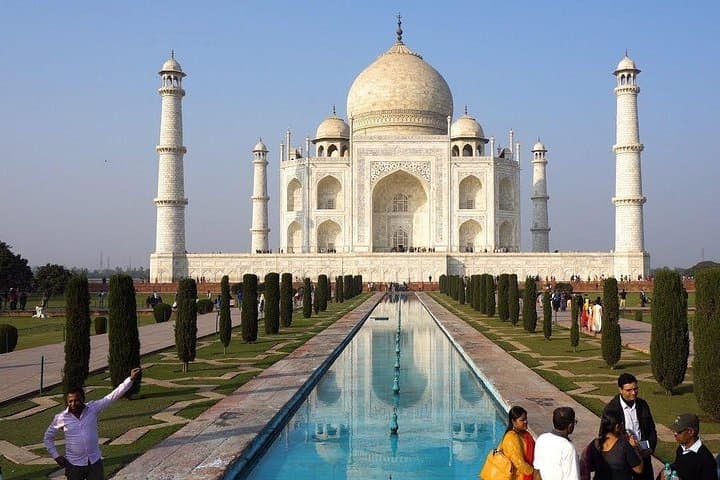
You step off the air-conditioned car into a courtyard that smells faintly of jasmine and diesel. A low dawn mist hangs over the Yamuna, and the Taj Mahal — pale, patient, impossibly symmetrical — appears as if it were waiting for your breath to fog its outline. The marble seems to inhale and exhale with the sky: ivory in the early light, flushed pink as the sun climbs, and a buttery gold if clouds drift across the river. On this private day trip from New Delhi, the monument feels less like a postcard and more like a thing that continues to do work on the world: a mausoleum, a mirror, a magnet for memory.
The mechanics of the tour are straightforward — a round-trip drive of roughly 3.5 to 4 hours each way from New Delhi, guided visits to the Taj Mahal, Agra Fort, and the Tomb of Itmad-ud-Daulah (the so-called Baby Taj), plus a restaurant lunch and the reassurance of skip-the-line access. But the reason travelers keep making the pilgrimage is not logistics; it’s the architecture and the stories pressed into every face of the place. Shah Jahan commissioned the Taj in 1632 for Mumtaz Mahal; Makrana marble from Rajasthan was quarried, carved, and inlaid with semiprecious stones. You’ll see pietra dura — floral and geometric inlay — so intricate it reads like filigree worked into stone.
Geology and empire intersect here. The gleaming white of the Taj is not merely a style choice; it’s a statement of material and power. Makrana marble resists weathering, which is why these surfaces still hold their crispness after nearly four centuries, though modern air pollution has required ongoing conservation work. Across the river, Mehtab Bagh — the moonlit garden — offers the classic frame for photography, a reminder that the Mughal landscape tradition always designed views as much as buildings.
Culture in Agra is tactile: sellers unfurl pashmina and leather, vendors offer steaming samosas and the famously sugary petha, and markets hum with a cadence that reorients you from Delhi’s frenetic pulse. Your guide will explain the etiquette of entering the mausoleum (no open bags; shoe coverings or removal required; limited items allowed inside) and narrate the human drama — love, loss, patronage — that made the skyline.
Practicalities matter here nearly as much as wonder. Morning light is the most flattering for photography and the coolest time for walking; summer afternoons can be punishing. The Taj's security is tight: large bags, tripods, and drones are restricted; pockets and devices are scanned before entry. A private tour with skip-the-line access collapses waiting time and gives you the most measured, undistracted experience at the monument.
The walk through the gardens is deliberate. The broad water channels and alleys were designed to divide the view into frames, and your guide will lead you to the precise spots that tell different stories — the symmetry of the main gate, the optical compression of the charbagh (fourfold garden), the elevated cenotaph chamber where marble lattices soften the light. In Agra Fort, the red sandstone walls let the sun write warm notes across courtyards and halls. At the Baby Taj, delicate pietra dura and a more intimate scale make the architecture read almost like a manuscript.
Travelers should approach the day with curiosity and a few practical goals: pick the time of day you most want to savor (sunrise is quietest; late afternoon is warm and golden), plan for at least 10 hours round-trip from Delhi, and leave room to wander the bazaar if you want spices, textiles, or the sugar-sweet confectionary that’s an Agra specialty.
Why go with this exact tour? The private format means your guide can linger on the details that matter to you — art and architecture, Mughal history, photography angles — and the vehicle makes transit efficient. For photographers or travelers invested in history, skipping the ticket lines is not a small convenience; it’s an invitation to see the monument in a less rushed way.
If you want to keep it low-stress: wear comfortable, breathable clothing and shoes that are easy to remove; bring a small daypack because large bags are often turned away; hydrate frequently; and set expectations for crowds. Even with skip-the-line access, the Taj is a magnet, and the experience balances composition and patience — moments of silence between waves of visitors are part of the rhythm.
Leaving the complex, the city feels immediate again — carts of petha, the chatter of bargaining in Kinari Bazaar, the clack of rickshaw drivers — and it’s worth taking a moment to taste the place: a plate of kebabs, a narrow lane of shops, a rooftop café with a final look back at the domes.
On a practical level, this tour is an excellent fit for travelers who want a tightly managed day: clear timing, expert interpretation, and the small luxuries of a private guide and vehicle. But the real return is the intimacy you can carve out inside a site built for spectacle: when the light hits the central dome just right, the Taj will stop being a photograph and start being an event.
Whether you’re a photographer chasing morning glow, a cultural traveler tracing the arc of Mughal architecture, or someone who wants to cross an item off the bucket list with clarity and context, this is a day that rewards preparation and a willingness to look closely.
Trail wisdom
Small choices, better day.
Aim for sunrise or late afternoon
Early morning light is cooler and less crowded; late afternoon offers warmer tones but more visitors—plan accordingly.
Pack a small daypack
Large bags are frequently not allowed inside the monuments; keep essentials in a compact bag for security checks.
Footwear strategy
Bring shoes that are easy to remove—shoe covers or removal are required to enter the Taj's inner chamber.
Hydrate and sun-protect
Carry water, a hat, and sunscreen—North Indian plains can be intensely sunny, especially in spring and summer.
Local knowledge
Read the place, not just the route.
Watch for native species including Rhesus macaque (monkeys near entry areas), Peafowl occasionally seen in gardens.
Keep an eye out for wildlife during the transition between areas and habitats. Respect distance guidelines.
Air pollution and tourism pressures have required ongoing conservation efforts; visitors are asked to follow rules, avoid touching façades, and minimize waste.
Follow the guide's instructions on size limits, ethical handling, and leave-no-trace practices.
Mehtab Bagh across the Yamuna for framed sunset/sunrise views. Chini Ka Rauza – a lesser-known tile-adorned mausoleum showcasing regional craftsmanship
Locally recommended viewpoints and quiet spots known best to local operators.
The Taj Mahal was commissioned by Mughal emperor Shah Jahan in 1632 and largely completed by 1653; Agra Fort predates it and served as imperial residence.
Maritime roots and regional tradition shape the waterways and working coasts.
Seasonal guide
Four versions of the same landscape.
Spring
Best forMild temperatures · Clear skies for photos
ChallengesOccasional dust storms · Variable crowds during holidays
Spring brings comfortable weather and good light, though winds can kick up dust; mornings are your best bet.
Summer
Best forLong daylight hours · Fewer international tourists
ChallengesHigh heat and humidity · Midday closures or slow sightseeing pace
Summer is hot—expect early starts and slowed midday activity; prioritize shaded breaks and water.
Fall
Best forPleasant temperatures · Crisp, clear skies
ChallengesFestival crowds at times · Variable air quality in the region
Autumn offers some of the most comfortable touring weather with crisp light ideal for photography.
Winter
Best forCool, dry weather · Sunrises with clearer visibility
ChallengesChilly mornings and fog some days · Higher tourist volume in December–January
Winter is the peak visiting season—cool air and excellent visibility make it ideal for early visits and long walks.
Pack with intention
What to bring.
Good to know
Common questions.
Yes—this private tour includes skip-the-line entry so you spend less time waiting and more time inside the monuments.
Plan the edges
The details that make the day easier.
The Taj Mahal was completed in 1653 after about 22 years of construction and was designated a UNESCO World Heritage Site in 1983.
After the monuments, seek out Mughlai classics in Agra—try kebabs and biryani at a reputable restaurant or hunt down petha (a local sugar treat) in Kinari Bazaar; for a refined meal with a view, Esphahan at The Oberoi offers both ambiance and regional dishes.
- Closest airport
- Indira Gandhi International Airport (DEL)
- Typical driving distance
- ~210–230 km from central New Delhi to Agra
- Cell service
- generally good along the route, patchy inside some historic structures
- Permits & passes
- Taj entry ticket required (included with tour's skip-the-line access)
The Taj is sensitive to air pollution and visitor impact—use refillable water bottles, avoid single-use plastics, and do not touch or lean on carved surfaces to help preserve the marble.
Explore by topic
Follow the threads.
Keep exploring
Make the story part of the trip.
Set out from Bass Harbor for a private, customizable day on Blue Hill Bay — lighthouses, puffins, seals, and the chance to feel Acadia from the water. Small groups, local captains, unforgettable views.
In four hours you can move from shaded canyon ferns to wind-scoured coastal ridgelines, guided by someone who knows where the light—and the hidden views—live. This private half-day hike on the Monterey Peninsula or Big Sur is compact, curated, and perfect for travelers who want depth without a multiday commitment.
 Related story
Beneath a sky of shifting light, Skaftafell’s ice reads like a map of time. This three-hour guided glacier hike mixes technical instruction with geology and culture: compact, safe, and unforgettable.