
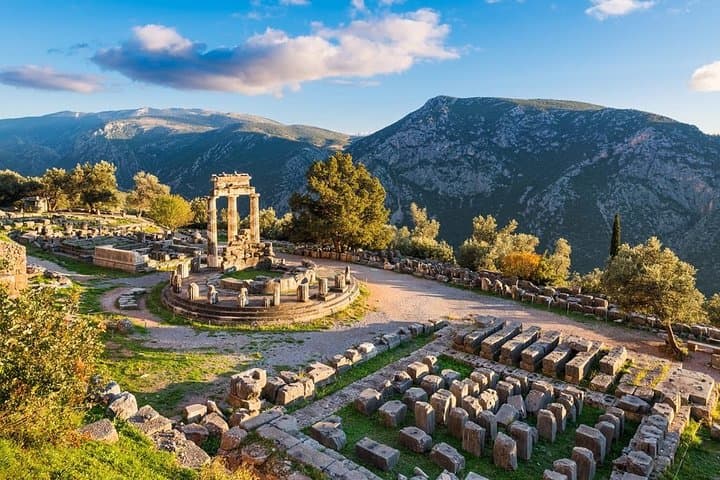
What the day feels like
The bus peels away from Athens while the city’s concrete grid thins into olive groves and folded hills. The highway heads northwest, and as the air cools you can feel the map of myth rearranging itself beneath your feet. By midmorning the silhouette of Mount Parnassus rises, not as a single peak but a serrated spine that keeps watch over a place people once called the center of the world. Delphi never announces itself with neon; it arrives the way old things do—by fitting into the quiet between one breath and the next.
A private day tour like this trades the rote list of monuments for a pace that feels like curiosity: a local driver and guide who know which switchback frames the valley best, where to pull for a coffee in Arachova, and how to read a ruined column like a sentence from an ancient hand. If you book a <a href="https://app.advcollective.com/local-experts/delphi-private-day-tour-from-athens-explore-the-oracle-of-apollo">Delphi private day tour from Athens</a> you’ll travel through Livadeia and past terraces of vines and thyme-scented scrub, arriving with time to climb the archaeological site, explore the museum, and sit on the stone steps where pilgrims once waited to hear the Pythia.
Delphi is a layered story. Geologically, it sits on the lower slopes of Parnassus, where fault lines and uplifted limestone created natural amphitheaters and deep ravines—ideal settings for shrines and secrecy. Historically, Delphi’s oracle was a transactional power; the priestess’s trances shaped colonial decisions, war councils, and temple dedications across the Greek world. By the Roman era, Delphi was a ceremonial hub, and later, the site fell silent—preserved beneath centuries of dust until modern archaeology pulled its stones like pages from a book.
Visiting feels less like touring and more like triangulating moments: the theater that could seat thousands, the chiseled marble of the Temple of Apollo, the omphalos stone that the Greeks marked as the navel of the earth. The on-site museum collects votive offerings—bronze athletes, delicate figurines—that make the trade of faith tangible. Between stops the guide will tuck in local notes: where Arachova’s craftsmen still salt and age Formaela cheese, where the tavern serves roast lamb with thyme and village wine, and which mountain tracks climb up to pastoral plateaus above the site.
This private format is practical. The day takes about eight hours: don’t overbook the morning or expect to sprint. Timing is one of those invisible competencies—arrive midmorning to avoid the hottest sun and the biggest bus crowds, and give yourself a slow hour in the museum to let artifacts anchor the ruins. Bring a pair of comfortable shoes; the paths are cobbled and can be uneven. Hydration isn’t glamorous but it matters: water, a light lunch in Arachova, and an afternoon espresso make a long day feel human-sized.
Culturally, Delphi is both local and universal. The modern town of Delphi and the nearby resort-like Arachova are small hubs where shepherding traditions meet tourism. Sellers still trade in local crafts—woven rugs, pottery, and mountain cheeses—and the rhythm of service is measured, hospitable. Your private guide will be the translator between eras, showing how a carved dedication from 2,500 years ago fits into a modern landscape of taverna tables and scooters.
Practical notes: the archaeological site has uneven steps and exposed sun; a hat, sunscreen, and layers are non-negotiable. Photography is generous—sunrise and late afternoon soften the marble—but inside the museum, light is controlled to preserve fragile metals, so pack a camera that handles low light if you want detail shots. If you’re traveling from Athens, expect approximately 2.5–3 hours of roundtrip driving with stops; the value of a private tour is the ability to bend that time to your interests.
Why choose a private experience? For one, context. A guide can link a fragment of column to the civic life that produced it, explain the oracle’s role in seafaring decisions, or point out the geological reasons this valley felt spiritual. Two, logistics: private pickups from the port or your Athens hotel trim waiting and make the day frictionless. Three, pace: archaeology rewards unhurried attention; private tours give you the freedom to linger over a stone inscription or stay longer for the valley light to change.
There’s a humility to the place that’s disarming. Standing where citizens once sought counsel from inhaled vapors and cryptic pronouncements, you’re reminded that the landscape shaped belief as surely as belief shaped monuments. Back in Arachova, a tavern bench feels like the modern continuation of that exchange: people gathering to decide, argue, and laugh.
If your interest is history, geology, or simply being somewhere that feels consequential, a private day to Delphi hands you a concentrated lesson in why places continue to mean things across millennia. Book a <a href="https://app.advcollective.com/local-experts/delphi-private-day-tour-from-athens-explore-the-oracle-of-apollo">Delphi private day tour from Athens</a> and expect a day that is part walk, part lecture, and part quiet—the kind of travel that returns as a better question than an answer.
Trail wisdom
Small choices, better day.
Time your visit
Start mid-morning to avoid the heat and the largest coach crowds; afternoons bring warmer light for photos.
Footing matters
Wear sturdy shoes—cobbled paths and marble steps are uneven and can be slippery when wet.
Respect the ruins
Stay on marked paths and avoid touching carved surfaces; oils from hands accelerate wear.
Hydrate and snack
Carry water and a light snack for the walk between the museum and the temple area where services are limited.
Local knowledge
Read the place, not just the route.
Watch for native species including Eurasian hare, Golden eagle (in higher Parnassus ridges).
Keep an eye out for wildlife during the transition between areas and habitats. Respect distance guidelines.
The site is protected under Greek cultural heritage law and UNESCO designation; visitors are asked to stay on paths, avoid climbing ruins, and carry out litter.
Follow the guide's instructions on size limits, ethical handling, and leave-no-trace practices.
The hilltop chapel of Agios Nikolaos above Arachova for sunset views. A small olive-oil mill near Livadeia that occasionally opens for tastings
Locally recommended viewpoints and quiet spots known best to local operators.
Delphi was a major Panhellenic sanctuary and seat of the Oracle of Apollo; city-states consulted the Pythia for decisions spanning colonization to warfare.
Maritime roots and regional tradition shape the waterways and working coasts.
Seasonal guide
Four versions of the same landscape.
Spring
Best forWildflower viewing · Mild hiking · Photography of softened light
ChallengesOccasional rain · Cool mornings
Spring is ideal—temperatures are comfortable and hillsides bloom, making walks between sites pleasant.
Summer
Best forLong daylight hours · Combine with beach trips · Festival atmosphere in nearby towns
ChallengesHigh heat · Peak tourist crowds
Summer offers the sunniest conditions but bring sun protection and plan early starts to beat the heat.
Fall
Best forCrisp air for hiking · Fewer crowds · Harvest flavors in local tavernas
ChallengesCooler evenings · Shorter daylight
Autumn balances mild days with vibrant local food—ideal for combining ruins with culinary stops.
Winter
Best forSnow-dusted vistas on Parnassus · Quieter sites · Off-season value
ChallengesSnow on higher tracks · Reduced services in Arachova
Winter is quiet and atmospheric; road conditions can be changeable, especially higher on Parnassus.
Operator details
What the booking data adds.
Included
- ✓All fees and taxes
- ✓Transportation in an air-conditioned vehicle
- ✓Pick-up and drop-off
- ✓Professional licensed guide
- ✓Skip-the-line entrance tickets
Not included
- —Food and drinks
Good to know
- ✓Suitable for all physical fitness levels
Pack with intention
What to bring.
Good to know
Common questions.
Expect about 2–2.5 hours one way depending on traffic; private tours often include stops that make the round trip roughly 8 hours.
Plan the edges
The details that make the day easier.
The ancient Greeks believed Delphi’s omphalos stone marked the 'navel' of the earth; Delphi became a UNESCO World Heritage Site in 1987.
After the site, head to Arachova for hearty mountain fare—try local Formaela cheese, grilled lamb, and a glass of Retsina or regional red; cafés line the central square for a slow coffee and people-watching.
- Closest airport
- Athens (ATH). Driving distance: ~180 km
- 2–2.5 hours each way. Cell service
- generally good on the highway; intermittent at the archaeological site. Permits: Entrance tickets required for the Delphi Archaeological Site and Museum (confirm if included with tour).
Delphi is a protected archaeological zone—pack out all trash, stay on designated paths, and avoid touching or leaning on ancient structures to help preserve them.
Explore by topic
Follow the threads.
Keep exploring
Make the story part of the trip.
Set out from Bass Harbor for a private, customizable day on Blue Hill Bay — lighthouses, puffins, seals, and the chance to feel Acadia from the water. Small groups, local captains, unforgettable views.
In four hours you can move from shaded canyon ferns to wind-scoured coastal ridgelines, guided by someone who knows where the light—and the hidden views—live. This private half-day hike on the Monterey Peninsula or Big Sur is compact, curated, and perfect for travelers who want depth without a multiday commitment.
 Related story
Beneath a sky of shifting light, Skaftafell’s ice reads like a map of time. This three-hour guided glacier hike mixes technical instruction with geology and culture: compact, safe, and unforgettable.