
What the day feels like
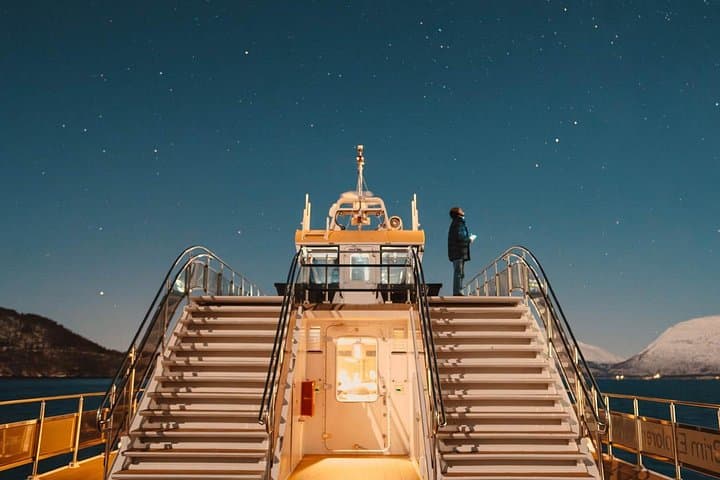
Night comes early in Tromsø in winter, and when it does it pulls a velvet curtain across the fjords. On a cold evening you step from the quay into a hush: the town’s harbor lights blur into the water, gulls settle on bobbing buoys, and the crew welcomes you aboard an electric boat designed to slip quietly through the dark. For three and a half hours the vessel becomes both observatory and escape—heated lounges inside offer shelter and warmth, while the deck opens to a sky that might, with luck, begin to dance.
The chase is intentional and gentle. Crews study weather windows and head toward Kvaløya, Ramfjorden, or the southern stretches of Kvaløya where cloud gaps are likeliest. There’s an element of theater to it—a patient, practiced hunt for clear sky. Guides share the science behind the aurora, its charged-particle origins, and the folklore that has wrapped this light in myth for millennia. And because the boat is electric, the trip feels quieter; there is less engine noise and fewer local lights, both of which improve your chances of spotting faint curtains of green, purple, or red.
Tromsø sits well above the Arctic Circle and has long been a hub for polar exploration, whale fisheries, and northern trade. The fjords here are carved of old ice and harder rock; glaciers and ancient sea-level changes left deep, sheltered channels that now act as sky mirrors. Local culture still carries echoes of that seafaring past: small boat-building traditions, fish-smoking techniques, and pubs where long-ago trappers and modern adventurers swap stories over a beer. A northern lights cruise is a continuation of that maritime life—only now the aim is celestial.
Why take an electric northern lights cruise rather than a bus or a snowmobile? The boat introduces a different relationship to the elements. Water has personality: it pushes and cushions, holds reflections, and tests your footing on deck. Fjords open toward broader horizons where light can appear without the interference of town glow. For photographers, the moving vantage point creates compositions that land-based viewing can’t replicate—reflections, silhouetted ridgelines, and the occasional ice-capped peak for scale.
Practicalities matter. This trip is listed as roughly 210 minutes—about 3.5 hours—departing from Tromsø’s harbor and priced from approximately $121 USD. Expect a small-group setting with instant confirmation and free cancellation options. The vessel’s heated lounges are a welcome refuge but you’ll want to step outside when aurora appear; nights can be frigid and windy even when the sky is clear. The aurora is never guaranteed—solar activity and cloud cover decide when lady Aurora chooses to dance—so success is part skill and part patience.
Packing and planning should be deliberate. Layer base, mid, and outer garments with a windproof shell on top. Bring insulated boots and gloves, and consider a hat and neck gaiter. For photography: a sturdy tripod, a wide-aperture lens, and spare batteries are essential—the cold drains energy fast. If you’re prone to motion sickness, consider medication in advance; fjord crossings can be smooth one night and bumpy the next.
Timing matters, too. The best months for northern light hunts stretch from late autumn into early spring, with dark, clear nights most common from late-October to March. March often strikes the balance many travelers seek: long nights, clearer skies, and slightly milder temperatures compared with midwinter. But the crew’s local knowledge is the trip’s real advantage; they pivot toward clearer pockets of sky, sometimes sailing just out of a cloud blanket and finding an expanse of stars beyond.
Local etiquette is simple. Keep lights low—phones and headlamps dimmed—so others can see the sky. Respect the crew’s instructions about when to go outside; icy decks and safety rails are there for a reason. And if the trip notes the electric boat’s low-emission profile, support that choice: it reduces noise and light pollution and is better for wildlife.
If you want to make the most of the experience, arrive with realistic expectations and a spirit of curiosity. Learn a bit of aurora science before you go so the subtle displays don’t feel like misses; enjoy the quiet, the reflections, the warmth of the lounge, and the simple thrill of standing under an Arctic sky. For those who come with cameras, remember that long exposures are your friend. For those who come simply to watch, let the dark do its work—the fjords are patient hosts.
Book locally where possible and look for operators that prioritize sustainability. The electric cruise from Tromsø is a clear example of how modern gear and traditional navigation can combine to produce a quieter, lower-impact way of being under the northern sky. Whether you leave with vivid photographs or just the memory of a low, shimmering arc, the experience rewires how you think about cold, dark places—they can be full of slow, luminous wonder.
Learn more and reserve a departure from Tromsø through the local operator here: <a href="https://app.advcollective.com/local-experts/tromso-electric-northern-lights-cruise-silent-aurora-chase-on-the-fjords">Tromso Electric Northern Lights Cruise</a>. For photographers and pragmatic travelers, additional pre-trip reading on technique and gear choices is available from the operator’s guide: <a href="https://app.advcollective.com/local-experts/tromso-electric-northern-lights-cruise-silent-aurora-chase-on-the-fjords">Aurora photography tips</a>. And if you want to support lower-impact voyages, look for the electric option when you book: <a href="https://app.advcollective.com/local-experts/tromso-electric-northern-lights-cruise-silent-aurora-chase-on-the-fjords">book an electric northern lights cruise</a>.
Trail wisdom
Small choices, better day.
Layer Strategically
Wear moisture-wicking base layers, an insulating mid-layer, and a windproof shell—temperatures can feel much colder on deck.
Bring a Tripod
Long-exposure aurora shots require a sturdy tripod and spare batteries—the cold saps battery life quickly.
Prep for Motion
If you’re prone to seasickness, take preventative medication before boarding; fjord conditions can change with little warning.
Respect Low-Light Etiquette
Keep phone and headlamp use to a minimum to preserve night vision and reduce light pollution for others.
Local knowledge
Read the place, not just the route.
Watch for native species including White-tailed sea eagle, Harbor seal.
Keep an eye out for wildlife during the transition between areas and habitats. Respect distance guidelines.
This cruise uses an electric vessel to reduce emissions and noise; guests are encouraged to minimize light use and avoid disturbing marine life.
Follow the guide's instructions on size limits, ethical handling, and leave-no-trace practices.
Ersfjordbotn—an intimate fjord with excellent dark-sky views. Sommarøy—an island west of Tromsø with dramatic seascapes and fewer lights
Locally recommended viewpoints and quiet spots known best to local operators.
Tromsø long served as a gateway for Arctic expeditions and was a center for Norwegian winter fisheries and polar science.
Maritime roots and regional tradition shape the waterways and working coasts.
Seasonal guide
Four versions of the same landscape.
Spring
Best forClearer skies · Longer nights with milder temps · Photography
ChallengesVariable ice on deck · Late-season storms
March–April offers a sweet spot: long nights and generally clearer skies with temperatures easing from midwinter extremes.
Summer
Best forFjord scenery · Birdlife and whale watching · Long days
ChallengesNo aurora visibility during midnight sun · Short nights
Summer cruises focus on daylight fjord scenery and wildlife rather than aurora—midnight sun means no northern lights.
Fall
Best forAurora season starting · Less crowded tours · Dynamic weather
ChallengesUnpredictable storms · Cooling temperatures
September–November sees aurora season kick off; clouds and storms increase, so operators hunt for clearer pockets of sky.
Winter
Best forLongest nights for aurora · Polar night experiences · High auroral activity
ChallengesExtreme cold · Potentially rough seas
December–February delivers the darkest nights and highest auroral chances, but dress for serious cold and dress in windproof layers.
Operator details
What the booking data adds.
Included
- ✓WiFi on board
- ✓All Fees and Taxes
- ✓A soup is included
- ✓Restroom on board
Good to know
- ✓Wheelchair accessible
- ✓Infants and small children can ride in a pram or stroller
- ✓Service animals allowed
- ✓Public transportation options are available nearby
- ✓Transportation options are wheelchair accessible
- ✓Suitable for all physical fitness levels
Pack with intention
What to bring.
Good to know
Common questions.
No—aurora visibility depends on solar activity and cloud cover; operators chase clear skies but cannot guarantee sightings.
Plan the edges
The details that make the day easier.
Tromsø lies above the Arctic Circle and experiences the polar night—when the sun does not rise—roughly from late November to mid-January.
After the cruise, warm up with local seafood at Fiskekompaniet or Emmas Drømmekjøkken, grab a beer at Ølhallen—the city’s oldest pub—or visit the Polar Museum to learn about Tromsø’s seafaring past.
- Closest airport
- Tromsø Airport (TOS). Departure: Tromsø harbor (walking distance from city center). Driving distance from town: 0–10 minutes to pier. Cell service: Good in town, patchy on the fjords. Permits: None required.
This electric cruise reduces engine noise and emissions—minimize light use, stay on designated areas of the vessel, and avoid disturbing marine life.
Explore by topic
Follow the threads.
Keep exploring
Make the story part of the trip.
Set out from Bass Harbor for a private, customizable day on Blue Hill Bay — lighthouses, puffins, seals, and the chance to feel Acadia from the water. Small groups, local captains, unforgettable views.
In four hours you can move from shaded canyon ferns to wind-scoured coastal ridgelines, guided by someone who knows where the light—and the hidden views—live. This private half-day hike on the Monterey Peninsula or Big Sur is compact, curated, and perfect for travelers who want depth without a multiday commitment.
 Related story
Beneath a sky of shifting light, Skaftafell’s ice reads like a map of time. This three-hour guided glacier hike mixes technical instruction with geology and culture: compact, safe, and unforgettable.