
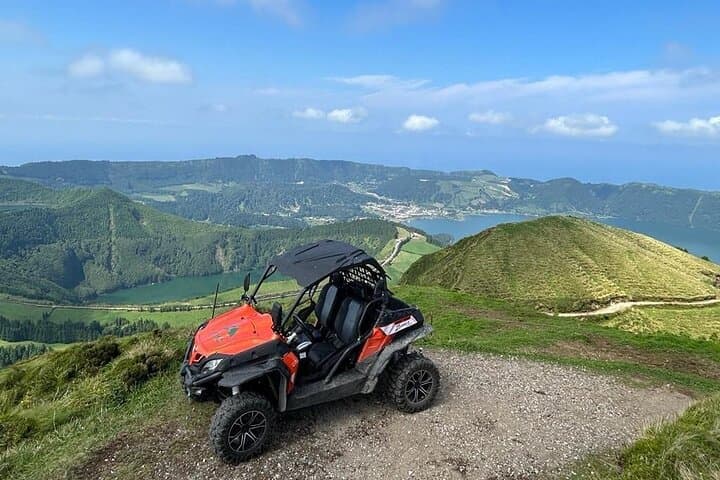
What the day feels like
You crest the rim and the world hushes into two lakes. One is the color of bruised sky, the other an emerald caught in sunlight; between them, the valley breathes like a living thing. Dust lifts from the buggy's tires, the wind throws salt and peat at your face, and a guide points to a far slope where basalt ribs hold back the Atlantic. For four hours you move along that edge — a patchwork of single-track, dirt roads, and open moorland — chasing views that are part geological diary, part Portuguese fable. This is Sete Cidades: a caldera that dares you to look closely, to listen, and to keep going.
On São Miguel, the Azores' largest island, Sete Cidades is both a postcard and a landscape that keeps its secrets. The twin lakes at the caldera floor, Lagoa Azul and Lagoa Verde, have names as vivid as their tones; they were carved by volcanic tantrums over tens of thousands of years, and later folded into local legend. One telling holds that a princess and a shepherd cried for each other so long that their tears formed the two lakes, forever linked but differently hued. The land keeps both origin stories—the raw physics of eruptions and the softer human stories—side by side.
Geology here is tactile. You can see layers of lava flows, pyroclastic deposits, and the caldera rim that collapsed as the magma chamber emptied. The buggy tour threads routes that were once inaccessible, letting you stand on bluffs above the lakes and peer into fumarolic folds, peat bogs, and carved terraces. Your guide will tell you which fields were reclaimed, which slopes hide sheep tracks, and where the soil still steams in wet months. The island's climate—ocean-moderated, often capricious—paints the scene in shifting light. One minute the lakes shimmer blue as a promise; the next, mist tightens around the rim and the world simplifies to sound and immediate footing.
This is a motorized way to meet an old landscape. The experience balances the thrill of off-road travel with measured cultural context. Stops are paced: a coffee at a tiny roadside kiosk, a walk down into the village of Sete Cidades to check the little painted church and the black pebble shore, a scramble up to a viewpoint where sheep splay on the grass like warm stones. Guides will point out endemic plants, and if you listen you might hear a kestrel calling from a basalt cliff or spot a wading bird hunting near the lake edge. These are not zoo encounters but soft, everyday presences that remind you this landscape is lived-in.
Practicality is part of the appeal. This particular tour runs about four hours, uses buggies or UTVs to reach remote stretches with comfortable but open cabins, and is priced from about $95 per person. You don’t need technical skills, but you will want to prepare: bring sturdy closed-toe shoes, windproof layers, sunscreen, and a secure place for your camera. The roads range from gravel to rough trail; expect occasional bumps, a little mud after rain, and stretches where the vehicle works harder than the view does. Early morning and late afternoon tours give you better light and fewer crowds on the main viewpoints.
Where culture and cuisine meet the day, Ponta Delgada is an easy base. After the ride, a plate of fresh fish or a bowl of caldeirada (the island's fish stew) and a local cheese will feel earned. The island's small bakeries keep sheltered sweets and breakfast sandwiches that are ideal for travel days. And while Sete Cidades is famous, portions of the rim see fewer visitors; your buggy brings you there without the multi-hour hike.
Safety and sustainability are straightforward. Tours are guided, vehicles are maintained to standards, and operators typically brief you on behavior around farmland and fragile moor. The Azores have protected landscapes and sensitive habitats; staying on marked routes, not disturbing livestock, and packing out any waste are practical courtesies that keep these routes open.
If you want to widen the trip, pair a buggy morning with a coastal hike later in the day, or a visit to a tea plantation and a thermal pool elsewhere on the island. The Azores are best experienced slowly: pace your days, follow the weather, and leave room to let the landscape change your expectations.
In the end, a Sete Cidades buggy tour is simple to explain and hard to forget. It’s kinetic: the vehicle throws you into edges, the wind reminds you that islands are always at the mercy of the sea and sky, and the lakes below hold an invitation to slow down. For travelers who want scenery without the long approach, geology with a human story, and a little speed mixed with a lot of space, it’s an efficient, memorable way to read one of the Azores’ most dramatic pages.
Trail wisdom
Small choices, better day.
Dress in layers
Wind and sun change quickly on the rim; a lightweight windbreaker and a warm midlayer keep you comfortable.
Secure loose items
Use zip pockets or a small dry bag for cameras and phones; bumpy tracks will jostle unsecured gear.
Bring a refillable water bottle
Tire of salty wind and peat-scented air is real; hydrate before and during the tour.
Choose closed-toe shoes
Sturdy sneakers or light hiking shoes protect your feet when you step out for viewpoints or short walks.
Local knowledge
Read the place, not just the route.
Watch for native species including Common Kestrel, Azores Chaffinch.
Keep an eye out for wildlife during the transition between areas and habitats. Respect distance guidelines.
Large parts of São Miguel are protected and managed for biodiversity and agriculture; stay on designated routes, respect livestock, and pack out trash to reduce impact.
Follow the guide's instructions on size limits, ethical handling, and leave-no-trace practices.
Pico do Carvão rim viewpoints for quieter panoramas. The village of Sete Cidades' lakeshore and painted church for low-key charm
Locally recommended viewpoints and quiet spots known best to local operators.
Sete Cidades sits inside a collapsed volcanic caldera that shaped much of western São Miguel; Portuguese settlers arrived in the 15th century and wove local legends into the landscape.
Maritime roots and regional tradition shape the waterways and working coasts.
Seasonal guide
Four versions of the same landscape.
Spring
Best forwildflowers · mild temperatures · fewer crowds
Challengesunpredictable showers · muddy trails
Spring brings blooming heather and softer greens; expect occasional rain and some mud on the trails.
Summer
Best forstable weather · longer daylight · clear views
Challengesmore tourists · bright midday sun
Summer is peak weather for visibility and warmer conditions, but plan for crowds at the most famous viewpoints.
Fall
Best forgolden light · cooler temperatures · good photo conditions
Challengesshortening days · occasional storms
Fall tightens the light and reduces crowds; choose afternoon tours for the best color on the lakes.
Winter
Best formoody landscapes · lower prices · dramatic clouds
Challengesstrong winds · more rain · spotty visibility
Winter brings dramatic skies and variable conditions; tours run but expect wetter trails and limited views at times.
Operator details
What the booking data adds.
Included
- ✓All Fees and Taxes
Good to know
- ✓Public transportation options are available nearby
- ✓Infants are required to sit on an adult’s lap
- ✓Not recommended for travelers with spinal injuries
- ✓Not recommended for pregnant travelers
- ✓Not recommended for travelers with poor cardiovascular health
- ✓Suitable for all physical fitness levels
- ✓Children under 8 years old not allowed
Pack with intention
What to bring.
Good to know
Common questions.
Most guided buggy tours include a driver; if self-drive is offered, operators will inform you in advance about license requirements.
Plan the edges
The details that make the day easier.
The two lakes in Sete Cidades are locally known as Lagoa Azul and Lagoa Verde, and local legend says their different colors came from the tears of a separated couple.
After the tour, head back to Ponta Delgada for seafood stews, locally produced cheese, and a glass of Azorean wine or a craft beer at a laid-back tavern along the marina.
- Closest airport
- João Paulo II Airport (PDL). Driving from Ponta Delgada: ~25–35 minutes. Cell service: generally good in town, intermittent on the caldera rim. Permits: none for guided tours; stay on marked routes.
The Sete Cidades area is part of protected landscapes; keep to trails, avoid disturbing plants and livestock, and carry out all waste to protect fragile habitats.
Explore by topic
Follow the threads.
Keep exploring
Make the story part of the trip.
Set out from Bass Harbor for a private, customizable day on Blue Hill Bay — lighthouses, puffins, seals, and the chance to feel Acadia from the water. Small groups, local captains, unforgettable views.
In four hours you can move from shaded canyon ferns to wind-scoured coastal ridgelines, guided by someone who knows where the light—and the hidden views—live. This private half-day hike on the Monterey Peninsula or Big Sur is compact, curated, and perfect for travelers who want depth without a multiday commitment.
 Related story
Beneath a sky of shifting light, Skaftafell’s ice reads like a map of time. This three-hour guided glacier hike mixes technical instruction with geology and culture: compact, safe, and unforgettable.