
What the day feels like
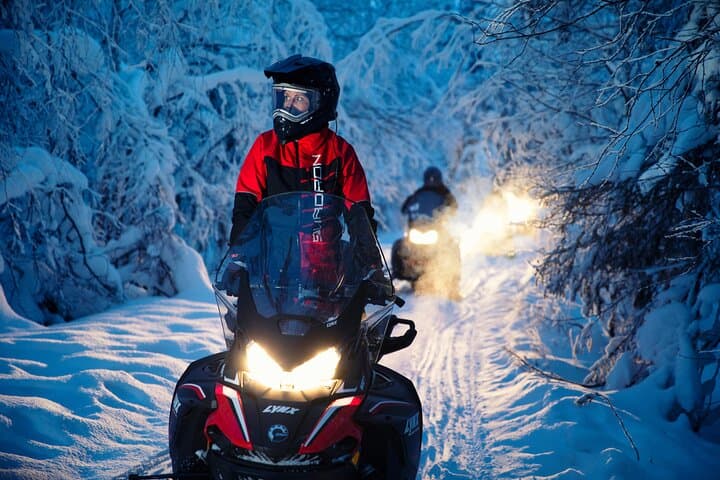
A half hour after dusk the world simplifies into tones of black and blue. Headlights carve twin ribbons through a forest that hushes under fresh snow; trees lean in like curious witnesses. The speed is polite at first—your guide talking through hand signals, the engine’s breath a steady companion—but the real motion is something else: the slow, electric shift of the sky. High above, thin curtains of green begin to unfurl, then curl and deepen into bands that move like living weather. On this Northern Lights Snowmobile Tour, the machines give you access—the raw, mechanical pulse to reach places the city never sees—and the night gives you the prize.
This is not neon tourism; it’s winter travel pared back to elemental exchange. Rovaniemi, the capital of Finnish Lapland, sits near the Arctic Circle at roughly 66.5°N, and that latitude matters. Long polar nights concentrate darkness into deep, clean canvases for auroral displays. Geology matters too: the low rolling hills, frozen rivers and birch-sparse forests create open sightlines where the sky feels closer. Add a moonlit plain and your camera frame fills with layered contrast: powdered foreground, dark timber, and the aurora sliding over it all.
The relationship between this landscape and people has deep roots. The Sámi—indigenous to this region—have moved reindeer across these same grounds for millennia, reading seasons and sky in a way that modern itineraries try to mimic. During the 20th century the area around Rovaniemi transformed rapidly—World War II reshaped communities and post-war reconstruction modernized infrastructure—but the winter rhythms and the northern sky remained constant. Today, local guides balance that continuity with the practicalities of tourism; they are custodians of routes and weather lore as much as drivers.
Geographically, Lapland is a quiet tectonic stage. The bedrock is old and worn; glaciers long past carved the gentle topography and left broad river valleys that freeze into plain runways in winter. Those frozen rivers and tundra plateaus are what let a snowmobile cut clean lines through the night, and they are why operators route away from artificial light—a crucial ingredient for aurora visibility. Culturally, visitors can fold in museum stops, Sámi craft markets, and the odd Santa Claus Village for contrast: a night of wilderness followed by the gentle, human-scale authenticity of local food and storytelling.
Practically: this is a four-hour experience of evening and night. Expect about two hours of transit on snow in the wilderness, bookended by a briefing, safety checks, and time to warm up. Guides issue helmets and basic thermal cover when needed, and they teach throttle, braking and what to do if the machine stalls in extreme cold. You do not need advanced driving experience—most tours design for first-timers—but you will share a machine with a partner unless you opt for a single-rider upgrade. Temperatures can drop hard after sunset; the physics of cold is part of the experience, not an aside. Hands, feet and faces become thresholds—protect them, and you’ll remember the ride for the auroras, not the discomfort.
Why go? Because travel experiences that combine motion, remoteness and the northern sky are rare. A snowmobile tour hands you access and agency: you leave light pollution behind within a short ride and arrive somewhere quiet and vast. For photographers and casual viewers alike the aurora appears more like weather than spectacle—unpredictable, intimate and immediate.
Book with an eye for timing and logistics. Peak aurora months stretch from late September through March; the sweet spot for snowmobiles and reasonable daylight is January through March. Demand is seasonal and constrained; the listed price here reflects a well-produced, small-group outing with instant confirmation and free cancellation—valuable for planning in winter weather. Ask your operator about single-rider availability, what cold-weather kit they provide, and how they evaluate aurora probability on the night you ride.
Safety and sustainability are part of the conversation. Snowmobiles emit noise and exhaust, so choose operators who concentrate routes, minimize disturbance to wildlife, and brief guests on respecting reindeer herding areas. Bring certified cold-weather clothing, follow the guide’s instructions at all times, and treat the night with humility: the Arctic is generous but indifferent.
When you return to civilization, the warmth of a wooden longhouse-style restaurant and a bowl of poronkäristys (sautéed reindeer) will feel like ritual. Pair it with local beers or a warming berry schnapps and trade stories with other travelers or guides—these are the social moments that translate a good night into a remembered trip.
If you want to prioritize success: plan several nights in the region rather than a single attempt; auroras reward patience. Combine a snowmobile outing with daytime activities like a visit to Arktikum (for local history and science) or Ounasvaara hill (for easy hiking and vistas) so you experience the north in daylight and dark.
At its best, a night on a snowmobile is kinetic, practical wonder. The machines push you forward; the forest leans away; the aurora dares you to look up. It’s not a quiet cathedral—it’s a dynamic conversation between speed, silence, and sky—and if you come prepared, it will be one of the most immediate ways to taste Lapland’s north.
Length & Logistics Snapshot: 4 hours; instant confirmation; price from USD 220.57; meeting point in or near Rovaniemi. Who this is for: curious outdoor travelers, photographers seeking auroras, and people who want a bit of mechanized adventure combined with wilderness. Bring layered insulation, respect the land, and let the night show you why the Arctic feels larger than maps.
Trail wisdom
Small choices, better day.
Dress in layers
Use moisture-wicking base layers, a warm mid-layer, and a windproof outer shell to stay comfortable during long stops or slow riding.
Protect extremities
Bring insulated, waterproof boots and thermal gloves—hand warmers are a small investment that pay off immediately.
Bring a spare battery
Cold drains batteries fast—carry a fully charged spare or a battery pack for phones and cameras.
Listen and follow your guide
Guides know route safety, wildlife sensitivities, and how to read weather; follow their briefings closely.
Local knowledge
Read the place, not just the route.
Watch for native species including Reindeer, Moose (elk).
Keep an eye out for wildlife during the transition between areas and habitats. Respect distance guidelines.
Snowmobiling impacts noise and emissions; pick operators who concentrate routes, avoid sensitive herding areas, and brief guests on minimizing disturbance.
Follow the guide's instructions on size limits, ethical handling, and leave-no-trace practices.
Ounasvaara hill for sunset vistas and easy trails close to Rovaniemi. Ranua Wildlife Park for a daytime look at Arctic fauna (about 1 hour drive)
Locally recommended viewpoints and quiet spots known best to local operators.
Rovaniemi was heavily rebuilt after World War II and today blends modern Finnish design with Sámi cultural history—Arktikum museum offers an accessible primer.
Maritime roots and regional tradition shape the waterways and working coasts.
Seasonal guide
Four versions of the same landscape.
Spring
Best forLonger daylight for mixed activities · Still-good snow cover in early spring
ChallengesVariable snowpack · Thawing trails later in season
Early spring offers lingering snow and milder nights for comfortable layering, but conditions can shift quickly as thaw begins.
Summer
Best forMidnight sun activities · Hiking and river trips
ChallengesNo snow for snowmobiling · No aurora viewing in June
Summer is excellent for day hiking and cultural visits, but snowmobile-aurora combos are not possible without snow cover.
Fall
Best forNorthern Lights emergence · Fewer tourists
ChallengesUnpredictable early snow · Colder nights and shorter days
Fall ushers in aurora season—early snow can allow rides later in autumn, but conditions are more variable.
Winter
Best forSnowmobiling · Aurora viewing · Classic Lapland experiences
ChallengesExtreme cold · Short daylight hours
Winter is peak season for snowmobile aurora tours—dress for serious cold and allow flexible scheduling for weather.
Operator details
What the booking data adds.
Included
- ✓Thermal overall, boots, gloves, helmet and balaclava
- ✓Campfire barbecue and warm drinks
- ✓The prices include all described activities, services and equipment
Good to know
- ✓Public transportation options are available nearby
- ✓Not recommended for travelers with spinal injuries
- ✓Not recommended for pregnant travelers
- ✓Not recommended for travelers with poor cardiovascular health
- ✓Suitable for all physical fitness levels
Pack with intention
What to bring.
Good to know
Common questions.
Regulations vary by operator and country—many tours require a valid driver's license to be the sole operator of a machine; participants can typically ride tandem without a license.
Plan the edges
The details that make the day easier.
Rovaniemi lies on the Arctic Circle (about 66.5°N) and serves as the administrative capital of Finnish Lapland—its latitude and clear winter nights make it a prime place to view the aurora.
After the ride, head back to Rovaniemi for Lappish flavors—Nili Restaurant serves traditional reindeer and smoke-cured fish, Arktikum offers a cultural context for what you saw under the aurora, and local bars and microbreweries in town are pleasant places to warm up and compare photos.
- Closest airport
- Rovaniemi Airport (RVN). Driving distance from downtown Rovaniemi: 10–30 minutes to meeting point. Cell service: good near town, intermittent in deep wilderness. Permits: none required for typical tours; follow guide and respect reindeer herding zones.
Snowmobiles produce noise and emissions—support operators who minimize route lengths, avoid sensitive habitats, and brief guests on wildlife disturbance; pack out all waste and stay on designated trails.
Explore by topic
Follow the threads.
Keep exploring
Make the story part of the trip.
Set out from Bass Harbor for a private, customizable day on Blue Hill Bay — lighthouses, puffins, seals, and the chance to feel Acadia from the water. Small groups, local captains, unforgettable views.
In four hours you can move from shaded canyon ferns to wind-scoured coastal ridgelines, guided by someone who knows where the light—and the hidden views—live. This private half-day hike on the Monterey Peninsula or Big Sur is compact, curated, and perfect for travelers who want depth without a multiday commitment.
 Related story
Beneath a sky of shifting light, Skaftafell’s ice reads like a map of time. This three-hour guided glacier hike mixes technical instruction with geology and culture: compact, safe, and unforgettable.