
What the day feels like
We meet before sunrise in a quiet Milan street; the city hums low and indifferent while a private driver unfolds the day ahead. The road out of town curves, opens onto the glassy shoulder of Lake Como and, in an hour, the countryside begins to climb—vineyards folding into orchards, villas blinking in the morning light. There is an expectancy to a day that begins with a road and ends on a rail that climbs the Alps: the Bernina Express is not merely a train, it’s a vertical ribbon of engineering that dares you to look up.
This full-day private tour trades the hurried box of transit for a softer, more cinematic ascent. From Milan you’re driven along the lake’s shore to Tirano, a tidy border town where the Bernina line begins its 61-kilometer crawl into the high country. The coaches are the familiar vivid red of the Rhaetian Railway, panoramic windows stretching toward the sky. Once the train moves, the cadence changes: the town dissolves into meadows, meadows into forests, then into a sculpted alpine world—shale, glacier-worn cirques, and the brusque geometry of stone. Sections of the line climb with a near-mathematical grace, passing hairpin turns and spiral viaducts designed to gain altitude without brute force.
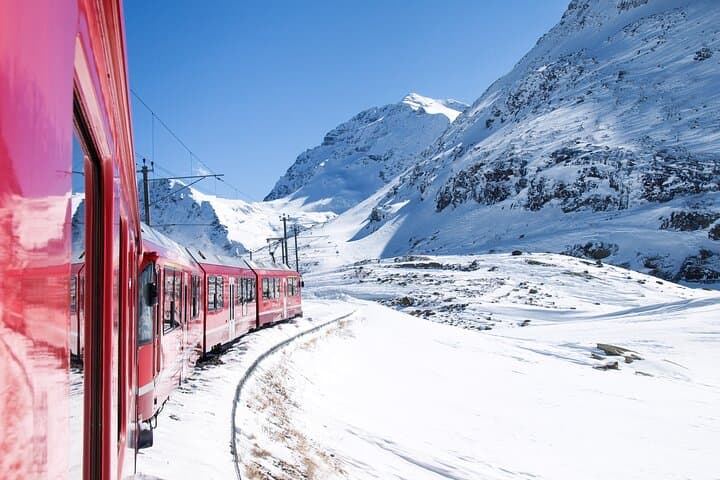
The rail itself is a story: completed in the early 20th century, the Albula/Bernina lines are a UNESCO World Heritage Site, and with good reason. You cross the Brusio spiral viaduct, feel the subtle tilt as the train negotiates the curve, and in the upper reaches you pass Ospizio Bernina, the line’s highest point at roughly 2,253 meters. From there, glaciers and high-alpine lakes open like photographs. The red cars of the Bernina Express punctuate white fields in winter and green seas in summer—nature’s counterpoint to the precise human geometry of tracks and bridges.
St. Moritz is your alpine punctuation: a lakeside town known more for its elegant boutiques and hotel terraces than for backcountry solitude. Here the tour pauses for a leisurely lunch and a walk: windows open to brisk alpine air, and the blend of Italian pragmaticism and Swiss precision becomes tangible in the pastry shops and pastry-wrappers of the old town. The return to Milan is comfortable—your private driver reappears, and a reflective mood settles over a day that has delivered both spectacle and quiet.
Practicality threads through the romance. The tour lasts roughly 11 hours, with private hotel pick-up and drop-off in Milan and the option of Bernina Express or an alternative Bernina Red train ticket if full. It’s a private group experience—no strangers to negotiate—priced from approximately USD 1,187.84. What you’re paying for is time, both the time saved by private transfers and the unhurried seat on one of the Alps’ most scenic railways.
Why book this rather than assembling the trip yourself? For many travelers the value is logistical clarity: cross-border train tickets, timed transfers, and a driver who knows exactly where to place you to make the most of the day. For photographers and slow-travelers, the private angle buys flexibility—longer stops in Tirano, an unhurried lunch in St. Moritz, and the comfort of a guaranteed return.
Tips that change the day: bring your passport—this trip crosses the Italy–Switzerland border and you may be asked for ID. Carry a small amount of Swiss francs for espresso or a pastry in St. Moritz (cards work widely, but small vendors appreciate cash). Layered clothing is essential: temperatures swing with altitude and can be dramatically cooler on the Bernina pass than in Milan. A light, rainproof shell and comfortable walking shoes are all you need for short town strolls and station viewpoints.
The train’s big windows make for excellent images, but they also create reflections; a polarizing filter or keeping the lens close to the glass improves results. If you want the full drama of spiral viaducts and cliffside curves, stand near the middle of the panoramic carriage where the perspective stabilizes and the view is least distorted. For those seeking deeper encounters, ask your driver about a short stop in Tirano to see the local sanctuary or to take a quick lakeside detour before boarding.
The Bernina Express asks nothing of you physically beyond a full day, but it gives a lot: alpine geology written in stone and ice, a rail journey that reads like a small epic, and the chance to fold two countries into a single, seamless adventure. It’s travel that moves you vertically and emotionally—there are few better introductions to the high Alps than a window seat and a good translation of light on rock.
If you want to lean into the trip, consider pairing the ride with an overnight in St. Moritz or a day on the shores of Lake Como beforehand; both extend the mood of mountain and water that this route so elegantly stitches together. For travelers short on time but high on appetite for big views, this tour is a precise, accessible distillation of Alpine grandeur with the comfort of private logistics.
In short: come for the red train and the UNESCO scenery; stay for the shock of altitude and the small pleasures—a perfectly timed espresso in a Swiss square, a tidal wave of alpine light at Ospizio Bernina, and the slow satisfaction of a day well traveled.
Trail wisdom
Small choices, better day.
Bring Your Passport
The tour crosses the Italy–Switzerland border—carry ID because you may be asked to present it at stations or by officials.
Layer for Altitude
Temperatures can drop dramatically at Ospizio Bernina—pack a warm layer and a light shell even in summer.
Seat Selection
Panoramic windows are the point—arrive early for the best vantage in the panoramic coaches or ask your guide which side frames the viaducts.
Cash for Small Purchases
Cards are widely accepted, but small cafes and market stalls in Tirano and St. Moritz may prefer cash (small Swiss francs bills/coins).
Local knowledge
Read the place, not just the route.
Watch for native species including Alpine marmot, Chamois.
Keep an eye out for wildlife during the transition between areas and habitats. Respect distance guidelines.
The route traverses fragile alpine environments—stick to station paths, avoid disturbing wildlife, and favor public transport; using the train helps reduce private car journeys in the region.
Follow the guide's instructions on size limits, ethical handling, and leave-no-trace practices.
Brusio Spiral Viaduct viewpoint (excellent photo stop). Alp Grüm station viewpoint—immediate access to high-alpine panoramas
Locally recommended viewpoints and quiet spots known best to local operators.
The Rhaetian Railway’s Albula/Bernina lines date to the early 20th century and were inscribed as a UNESCO World Heritage Site in 2008 for their outstanding alpine engineering.
Maritime roots and regional tradition shape the waterways and working coasts.
Seasonal guide
Four versions of the same landscape.
Spring
Best forWildflower meadows · Clear low-angle light
ChallengesLate snow at higher elevations · Unpredictable weather
Spring brings warming valleys and lingering snow on the pass—expect dramatic contrasts and cool temps at altitude.
Summer
Best forStable weather · Lush alpine meadows
ChallengesHigher visitor numbers · Strong sun at high altitude
Summer is the most accessible season with long daylight hours and clear views—pack sun protection and expect crowds during peak months.
Fall
Best forAutumn color in larch forests · Crisp clarity for photography
ChallengesEarly snow possible · Shorter daylight hours
Fall offers golden larches and fewer tourists—timing around the color peak yields stunning contrasts on the route.
Winter
Best forSnow-clad vistas · Atmospheric low light
ChallengesCold temperatures · Possible service adjustments
Winter transforms the line into a snow landscape—spectacular but colder and occasionally subject to timetable changes.
Operator details
What the booking data adds.
Included
- ✓Private professional driver
- ✓Bernina Red Train Tickets, if the Bernina Express is not available
- ✓Transport by Mercedes sedan or minivan
- ✓2° class Bernina Express train tickets (1°st class available for an additional price)
- ✓Hotel pick-up and drop-off
Not included
- —Lunch
- —Gratuities
Good to know
- ✓Infants and small children can ride in a pram or stroller
- ✓Specialized infant seats are available
- ✓Not recommended for travelers with spinal injuries
- ✓Not recommended for pregnant travelers
- ✓Not recommended for travelers with poor cardiovascular health
- ✓Suitable for all physical fitness levels
- ✓All travelers must have their passports with them on the day of the tour, as they will be crossing the border between Italy and Switzerland.
- ✓It is recommended to dress in layers, as the weather conditions are variable
- ✓Comfortable walking shoes are recommended
- ✓This is a private tour/activity. Only your group will participate
- ✓If the Bernina Express Tickets are not available on the date you requested, we will provide you with Bernina Red Train Tickets or give you a full refund
- ✓Shops and restaurants in St. Moritz may be closed during the low season
Pack with intention
What to bring.
Good to know
Common questions.
Yes—this private tour includes Bernina Express tickets where available; if Bernina Express seats are unavailable the operator will secure Bernina Red Train tickets or offer a full refund, per the product description.
Plan the edges
The details that make the day easier.
The Bernina Railway reaches approximately 2,253 meters at Ospizio Bernina and, together with the Albula line, was inscribed on the UNESCO World Heritage List in 2008 as the Rhaetian Railway in the Albula/Bernina Landscapes.
After the ride, enjoy Bündner specialties in St. Moritz—try a slice of Bündner Nusstorte (walnut tart) and an espresso in a lakeside café. On the drive past Lake Como, stop for risotto or polenta in a lakeside village to taste the region’s Lombardy influence.
- Closest airport
- Milan Malpensa (MXP) or Linate (LIN). Typical driving distance to Tirano from Milan: ~230 km (~2.5–3 hours). Cell service: generally good in towns, patchy at high passes. Permits: none required for day tourists.
This scenic route links communities while minimizing car travel—opt for the train to reduce carbon footprint, respect fragile alpine habitats, and carry out any waste.
Explore by topic
Follow the threads.
Keep exploring
Make the story part of the trip.
Set out from Bass Harbor for a private, customizable day on Blue Hill Bay — lighthouses, puffins, seals, and the chance to feel Acadia from the water. Small groups, local captains, unforgettable views.
In four hours you can move from shaded canyon ferns to wind-scoured coastal ridgelines, guided by someone who knows where the light—and the hidden views—live. This private half-day hike on the Monterey Peninsula or Big Sur is compact, curated, and perfect for travelers who want depth without a multiday commitment.
 Related story
Beneath a sky of shifting light, Skaftafell’s ice reads like a map of time. This three-hour guided glacier hike mixes technical instruction with geology and culture: compact, safe, and unforgettable.