
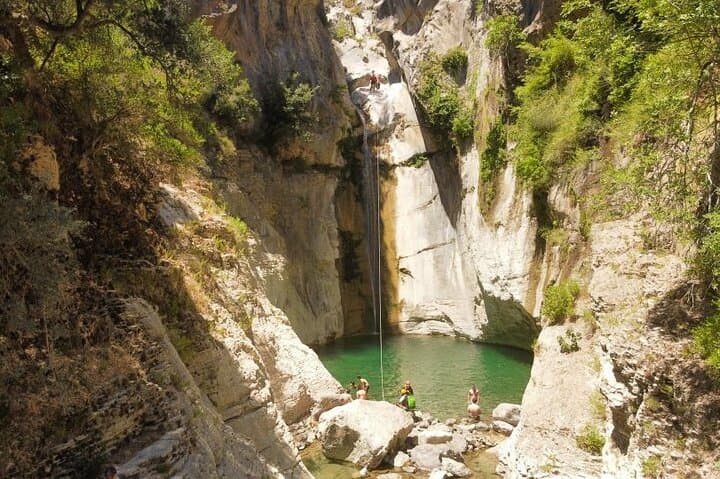
What the day feels like
You step off the last boulder and the gorge leans in around you—the walls close, light narrows to a ribbon, and the river ahead dares you with a cool, green glare. Manikia Gorge on Evia (Euboea), Greece’s long second island that runs like a spine parallel to the mainland, is compact but theatrical: short, sudden waterfalls, plunge pools cut like cups into the bedrock, and a final curtain of water that insists you pay attention. The whole day moves with a rhythm—instruction, confidence, plunge, and then the slow, satisfied thaw over lunch at a taverna where locals cook in wood-fired pans.
The trip marketed from Athens is a tight, practical affair: a four-hour canyoning experience that’s low on logistics and high on moments. Guides begin with 15–20 minutes of abseiling instruction—straightforward, focused, and just enough to erase the jitter in your knees. You’ll practice on three smaller drops, each one teaching a little more about rope management, stance, and trusting friction. Then the gorge gives you its finale: a 25-meter (about 82-foot) waterfall abseil that reconfigures how you think about heights. Afterward, you’re rewarded with clear pools where the current momentarily loses its will and allows you to float and breathe.
Geology here is conversational: the river speaks to the rock in a slow, patient accent. Over millennia, water has scored the limestone and schist, creating plunge pools and ledges that make canyoning possible. The scale is intimate—unlike alpine canyons that feel monumental, Manikia invites you close. That intimacy is part of the pleasure; the sound of the water ricochets off the walls the way an audience cheers at the end of a stanza.
Culturally, Evia is undersung. The island has been a satellite of Athens since antiquity and carries a quieter, more local energy. You’ll pass villages where laundry hangs between stone houses and a child might wave from the roadside. If you opt for the pickup and lunch, the post-canyon taverna is a highlight: a simple selection of grilled fish or slow-cooked lamb, bright salads, and a carafe of local wine. It’s the sort of meal that frames what you just did and reminds you that adventure often tastes best when paired with olive oil.
Why go? Because canyoning like this compresses a range of outdoor skills into a morning: swimming through current, negotiating uneven rock, and leaning into ropework. It’s accessible to fit people with a head for heights and some comfort in moving water; instructors shoulder the technical instruction so you can focus on the experience. For travelers in Athens with limited time, the trip is a tidy, thrilling escape—roughly half a day of movement and adrenaline that ends in a relaxed communal lunch.
Practical edge: the activity runs about four hours total. Expect a short land approach to the gorge and repeated wet sections—bring footwear that grips and dries quickly. Guides commonly provide harnesses, helmets, ropes, and often wetsuits; confirm with the operator what’s included. The final abseil is 25 meters; if you’re nervous about heights, the progression from small to large drops is designed to build confidence. Hydration, a light breakfast, and a positive attitude are all part of a good day.
Safety and sustainability are threaded through the trip. The guides are attentive to both the rock and the river—moving as a team, choosing lines that minimize environmental impact, and briefing participants on how to tread lightly in riparian habitats. The gorge is resilient but not invincible: leave nothing behind, keep soap and sunscreen out of the pools, and follow instructions to avoid damage to delicate mosses and aquatic insects.
Photographers will find themselves reaching for different tools at different moments: a wide-angle for the canyon’s narrow geometry, a mid-range for the faces and motion, and a fast shutter to stop water into glittering beads when you want detail. Drones are tempting but regulated—check local rules and operator policies before trying to launch.
If you can, plan this in late spring to early autumn. Water levels are friendlier than in winter, and the weather makes sitting in a wet suit between drops tolerable. The trip is also an excellent learning bridge for anyone curious about technical ropework and canyon travel—skills you can develop further in longer canyons elsewhere.
In short: Manikia compacts the pleasures of canyoning into a confident, accessible day trip from Athens—equal parts technical practice, sweaty gains, and crystalline reward. When the final anchor comes into view and you lower yourself over that 25-meter curtain, you’ll understand why this small gorge leaves a loud impression.
Trail wisdom
Small choices, better day.
Start Hydrated
Bring at least 1.5–2 liters of water; moving through the gorge and wearing a wetsuit can dehydrate you faster than you expect.
Wear Grippy Water Shoes
Choose footwear with a sticky sole and good drainage—regular hiking shoes will be heavy when wet.
Trust the Progression
Practice abseiling on smaller drops; guides design the route to build confidence before the 25‑m descent.
Protect Your Phone
Use a dry bag or leave electronics with your guide—water and sharp rock are unforgiving.
Local knowledge
Read the place, not just the route.
Watch for native species including Common Kingfisher, Balkan Green Lizard.
Keep an eye out for wildlife during the transition between areas and habitats. Respect distance guidelines.
Stick to marked lines, pack out all trash, and avoid using soap in pools; these practices protect delicate riparian ecosystems and local freshwater species.
Follow the guide's instructions on size limits, ethical handling, and leave-no-trace practices.
Small upstream plunge pools you can reach by short scrambles. A local viewpoint above the gorge that offers a silent panorama of the valley
Locally recommended viewpoints and quiet spots known best to local operators.
Evia (Euboea) is Greece’s second-largest island and has been inhabited since antiquity, serving as a local maritime and agricultural hinterland to Athens.
Maritime roots and regional tradition shape the waterways and working coasts.
Seasonal guide
Four versions of the same landscape.
Spring
Best forWildflowers · Cooler water temps · Lower crowds
ChallengesHigher water levels after rains · Chillier mornings
Spring brings comfortable air temperatures and active rivers—expect stronger flows after rain, which can make some sections more dynamic.
Summer
Best forWarm water swims · Stable weather · Post-trip taverna lunches
ChallengesHeat during transfers · Crowds on peak summer days
Summer is the most popular time: predictable weather and warm pools, though booking early is smart on busy weekends.
Fall
Best forFewer crowds · Crisp air · Good water clarity
ChallengesCooling water temps · Shorter daylight
Autumn tightens the seasons: excellent light and quieter gorges, but bring an extra layer for post‑canyon chill.
Winter
Best forOff-season solitude · Strong river flows (for advanced groups)
ChallengesCold water requiring thicker wetsuits · Potential road/weather closures
Winter is possible for experienced groups with proper gear, but expect cold, more powerful flows and limited pickup options.
Operator details
What the booking data adds.
Included
- ✓Pickup and drop-off (if the option is selected)
- ✓Free Photos of the adventure
- ✓Canyoning Guide
- ✓Lunch (If option is selected)
- ✓Canyoning equipment (helmet, harness, wetsuit)
Not included
- —Tips (optional)
- —Alcoholic Beverages
Good to know
- ✓Not recommended for travelers with spinal injuries
- ✓Not recommended for pregnant travelers
- ✓Not recommended for travelers with poor cardiovascular health
- ✓Travelers should have a high level of physical fitness
- ✓What to Bring :Close Toe Hiking Shoes ,Sunglasses ,Swimwear ,Sun hat ,Sunscreen, Change of clothes ,Towel
Pack with intention
What to bring.
Good to know
Common questions.
The full activity runs about four hours, including instruction, the canyon route, and transfers at the site.
Plan the edges
The details that make the day easier.
Evia (also spelled Euboea) is Greece’s second-largest island after Crete, stretching over 180 kilometers along the mainland’s eastern coast.
After the canyon, head to the nearby village taverna for grilled fish or lamb, a Greek salad, and a carafe of local wine—simple, slow food that pairs perfectly with an adrenaline morning. If returning toward Athens, Chalkida has sea-front cafes and casual bars for a post-trip beer.
- Closest airport
- Athens Eleftherios Venizelos (ATH). Driving
- transfer time
- ~1.5–2.5 hours from central Athens (varies by traffic). Cell service: generally available in towns and on main roads, patchy inside the gorge. Permits: none typically required for this commercial activity—confirm with operator.
The gorge’s pools and riparian plants are sensitive—pack out trash, use biodegradable sunscreen only if necessary, and avoid disturbing wildlife or removing stones from the riverbed.
Explore by topic
Follow the threads.
Keep exploring
Make the story part of the trip.
Set out from Bass Harbor for a private, customizable day on Blue Hill Bay — lighthouses, puffins, seals, and the chance to feel Acadia from the water. Small groups, local captains, unforgettable views.
In four hours you can move from shaded canyon ferns to wind-scoured coastal ridgelines, guided by someone who knows where the light—and the hidden views—live. This private half-day hike on the Monterey Peninsula or Big Sur is compact, curated, and perfect for travelers who want depth without a multiday commitment.
 Related story
Beneath a sky of shifting light, Skaftafell’s ice reads like a map of time. This three-hour guided glacier hike mixes technical instruction with geology and culture: compact, safe, and unforgettable.