
What the day feels like
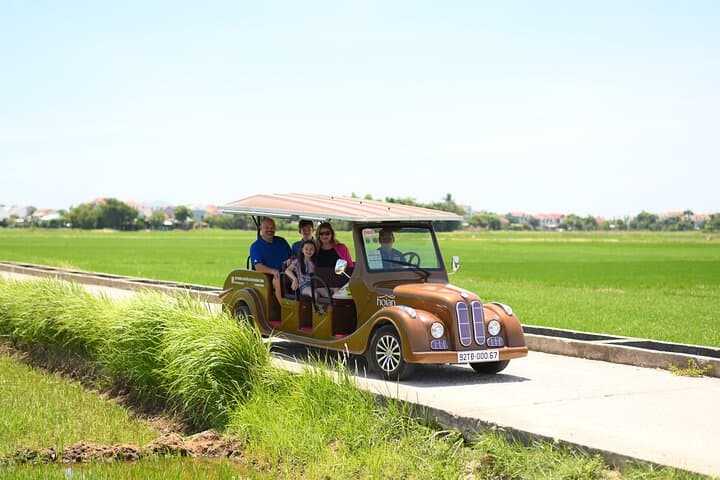
You leave the clatter of Hoi An’s old town behind and, in ten minutes, the world softens. Tile roofs give way to green steps—rice paddies tiered like a low-slung amphitheater—and an electric car hums along narrow lanes with the gait of something that respects rather than disturbs the land. In the space of an hour the city’s tempo drops away, replaced by birdsong, the distant lowing of water buffalo, and farmers shaping the day’s work under a wide central-Vietnam sun.
This is not a race through rural postcard fragments. The Countryside Adventure Private Tour by Electric Car is a deliberate unspooling: a private driver-guide steers a silent vehicle through a patchwork of wet rice farming, tilled plots, and a tucked-away coconut forest most visitors never see. The hum of the motor feels appropriate—conservation by convenience—letting you hear the place instead of drowning it out.
Geology and history are subtle here. Central Vietnam’s flat coastal plain, fed by short, seasonal rivers from the Annamite Range, creates soils that have sustained wet-rice agriculture for centuries. Hoi An itself, a UNESCO World Heritage Site since 1999, grew prosperous on maritime trade routes; the rural hinterland supplied the town’s markets and still follows rhythms shaped by the monsoon. Those rhythms are visible on the land—contoured paddies filled and drained, fences of coconut trunks, and irrigation channels that dare you to follow their slow logic.
Cultural notes arrive not as museum plaques but as lived gestures. Cows and water buffalo aren’t scenery here; they are essential partners in traditional agriculture, their presence a reminder of slower mechanical archetypes. Farmers still transplant rice by hand in season; children wave from shaded porches; a roadside stall might sell bánh mì or fresh sugarcane juice if the timing is right. Ask your driver to stop—this private tour encourages it—and you’ll find small-human stories as compelling as the broad landscape: a woman mending a net, a man sharpening a sickle, a line of ducks threaded through a canal.
The hidden coconut forest is the trip’s minor revelation. Within minutes of the main road you can be under a green ceiling, palms fluting light into pools on the ground. Few tour buses enter these lanes; the electric car’s nimbleness makes it a more respectful visitor. Here, the air smells faintly of earth and salt, and the forest’s quiet is emphatic—palms that shade with the patience of old sentinels.
Why do this one-hour loop? For clarity—an hour gives a concentrated dose of rural Vietnam without the commitment of a multi-hour bike ride or a full-day excursion. It’s ideal for travelers short on time who want more than a postcard. It’s also a good primer: photographers, families, and anyone curious about agricultural life can sample the patterns of place. The private format makes it flexible; your driver can pause for photos, pick up fresh produce, or point you to a local craftsperson.
Practicalities are simple but matter. The tour is a one-hour private ride, with instant confirmation and free cancellation—useful when your itinerary is a moving target. The small price point and private setup mean you can schedule a sunrise run for the softest light, a cool early-morning hour when farmers are active, or a late-afternoon stretch that catches the fields’ gold. Wear sun protection and insect repellent, and bring a small camera or phone with a charged battery; the electric car is quiet enough that the clicks and whirrs of shutters feel respectful rather than intrusive.
Sustainability here is tangible. An electric vehicle lowers local emissions and minimizes noise; the tour’s small scale keeps pressure off fragile lanes and private plots. Responsible visitors take the next step: do not feed livestock, stay on the roadside, ask before photographing people closely, and consider buying a snack or drink from a roadside vendor to directly support local incomes.
If you want to deepen the experience, combine this short tour with a longer bike or walking loop that explores a single village in detail. But even alone, the hour offers layered rewards: a sensory reset, a clearer picture of Hoi An’s agricultural roots, and a chance to move slowly through a landscape that often feels like it’s holding its breath between tides of modern change.
Logistics snapshot: the tour departs from Hoi An and lasts roughly 60 minutes; the terrain is rural lanes rather than trails, so there’s no hiking required. Best times are early morning or late afternoon for light and temperature. The driver typically speaks basic English and will accommodate stops for photographs. Pack light, move deliberately, and leave room on your phone for a lot of images—you’ll want them.
This is an intimate look at a living landscape, not a staged attraction. The rice breathes, the coconut forest keeps its secrets, and the electric car lets you be a quiet witness. For travelers who want a brief but meaningful encounter with Vietnam’s agrarian heart, this one-hour escape is both efficient and generous—an invitation to see how a place feeds a town, and how silence can be the most civilized sound on the road.
Trail wisdom
Small choices, better day.
Time it for soft light
Book an early-morning or late-afternoon slot to avoid midday heat and capture the paddies in flattering light.
Pack insect repellent
Rural lanes and coconut groves can be buggy—repellent keeps the ride comfortable during stops.
Respect private land
Stay on lanes and ask before entering fields or photographing people up close.
Bring a power bank
The electric car is quiet enough for great audio and photos; a backup battery keeps your devices running.
Local knowledge
Read the place, not just the route.
Watch for native species including Water buffalo, Egret and heron species.
Keep an eye out for wildlife during the transition between areas and habitats. Respect distance guidelines.
The tour’s electric vehicle minimizes local emissions; support local livelihoods by buying from roadside vendors and avoid disturbing wildlife or farm operations.
Follow the guide's instructions on size limits, ethical handling, and leave-no-trace practices.
An off-the-beaten-path coconut grove perfect for shaded photos. Small family-run stalls selling fresh sugarcane juice and local snacks
Locally recommended viewpoints and quiet spots known best to local operators.
Hoi An’s prosperity as a trading port shaped the surrounding agricultural economy; the fields you see supplied markets and boats for centuries.
Maritime roots and regional tradition shape the waterways and working coasts.
Seasonal guide
Four versions of the same landscape.
Spring
Best forMild temperatures · Transplanting season photos · Birdwatching
ChallengesOccasional showers · Muddy access lanes
Spring (Feb–Apr) is often the most pleasant time—cooler temperatures and vibrant green paddies as planting begins.
Summer
Best forLush, full paddies · Dramatic clouds · Warm morning light
ChallengesHigh humidity · Afternoon storms · Stronger sun
Summer delivers saturated green fields but brings heat and frequent afternoon rains—plan morning tours.
Fall
Best forHarvest-time scenes · Warm golden light · Lower humidity
ChallengesHarvest traffic · Variable weather depending on monsoon
Autumn can show harvested fields and golden tones; timing determines whether you see crops in the ground or being gathered.
Winter
Best forClear skies · Cooler rides · Calmer humidity
ChallengesCooler nights · Some fields lie fallow
Winter months are drier and cooler, offering visibility and crisp air though paddies may be less verdant.
Operator details
What the booking data adds.
Included
- ✓Private transportation
Not included
- —Optional guide with licence
- —Basket Boat trip not included
Good to know
- ✓Wheelchair accessible
- ✓Infants and small children can ride in a pram or stroller
- ✓Service animals allowed
- ✓Public transportation options are available nearby
- ✓Infants are required to sit on an adult’s lap
- ✓Suitable for all physical fitness levels
Pack with intention
What to bring.
Good to know
Common questions.
The standard tour lasts about 60 minutes and is designed as a concise private loop through nearby countryside.
Plan the edges
The details that make the day easier.
Hoi An Ancient Town was inscribed as a UNESCO World Heritage Site in 1999 for its unique blend of indigenous and foreign influences in architecture and urban fabric.
After the tour, head back to Hoi An’s riverside for a bowl of mì Quảng or the town’s signature cao lầu; small cafes along the Thu Bồn River serve cold beers and fresh seafood, and skilled tailors in the old town can craft a custom piece from locally woven cloth.
- Closest airport
- Da Nang International Airport (~30 km). Typical driving time from Hoi An center: 10–20 minutes. Cell service: Good near town, can be patchy in some rural lanes. Permits: None required. Duration: 60 minutes. Booking: Instant confirmation.
This electric-car tour reduces local emissions and noise—please stay on public lanes, avoid littering, and support local vendors directly when possible.
Explore by topic
Follow the threads.
Keep exploring
Make the story part of the trip.
Set out from Bass Harbor for a private, customizable day on Blue Hill Bay — lighthouses, puffins, seals, and the chance to feel Acadia from the water. Small groups, local captains, unforgettable views.
In four hours you can move from shaded canyon ferns to wind-scoured coastal ridgelines, guided by someone who knows where the light—and the hidden views—live. This private half-day hike on the Monterey Peninsula or Big Sur is compact, curated, and perfect for travelers who want depth without a multiday commitment.
 Related story
Beneath a sky of shifting light, Skaftafell’s ice reads like a map of time. This three-hour guided glacier hike mixes technical instruction with geology and culture: compact, safe, and unforgettable.