
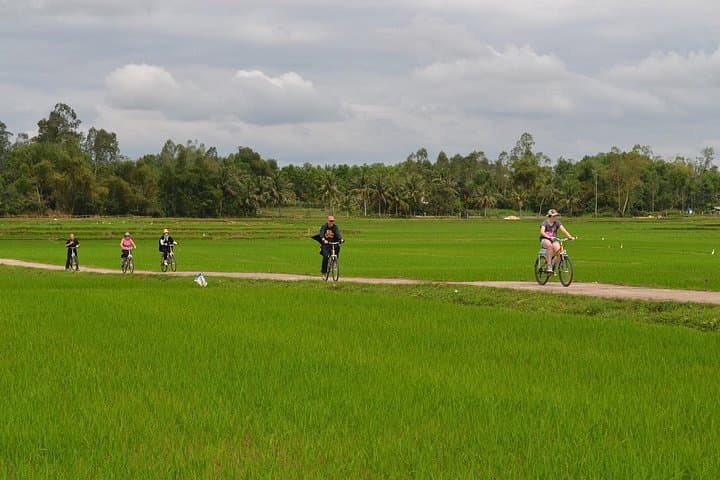
What the day feels like
The morning begins with the whirr of a well-oiled chain and the light—thin, pale, polite—lifting across a flatscape of irrigated fields. Mist hangs low in the hollows between rice paddies while farmers in conical hats bend at the water’s edge, a steady human rhythm against a horizon held by low karst and distant peaks. You pedal through it: a single-file thread through a painted tableau that, until you slow, risks looking like a postcard rather than real life.
This is a 54-kilometer day on two wheels that keeps you close to the ground and close to people. The Adventure Bike Tour from Hoi An is less about speed than exposure. Over roughly 10 hours, you cross small rivers by local ferries, balance on seasonal bamboo bridges, and ride past workshops where incense and cloth are still made by hand. The road is generous and forgiving—mostly flat country lanes, compacted dirt, and occasional paved ribbon—but it refuses pretense. It pulls you into conversations and curiosity, whether that’s asking an older woman how many times she’s replanted her plot this year or watching a water buffalo contentedly sink its hip into a muddy pool.
Historically this landscape has been a corridor of movement: Cham and Vietnamese communities trading through the centuries, colonial-era weaving techniques still visible in village looms, and, less comfortably, remnants of wartime infrastructure—the forgotten tunnels of the Viet Minh and the hulking silhouette of an old American air base—both reminders that the past is braided into the present. Geologically the region is a gentle one; coastal plains give way to skeletonized limestone formations further inland. It’s farmland first, an engineered mosaic of canals and dikes designed to keep water where rice needs it.
Culturally, the ride reads like a micro-ethnography. Villages you pass will offer bursts of craft: weaving cotton the way their grandparents did, incense rolled with an unmistakable fragrance of resin and sandalwood, and small-market counters selling coffee and fresh fruit. Locals run their businesses with an easy hospitality; the tour is built around those exchanges—time to ask, time to observe, time to share a cooling drink under a mango tree.
Practicalities matter here: the distance is 54 km over about 10 hours, with frequent stops. Elevation gain is minimal—this is coastal plain cycling—so fitness matters more for endurance than climbing prowess. Terrain shifts between paved village roads and packed dirt; during the rainy season some sections can be soft and muddy, and the aforementioned bamboo bridges are often only present in summer when waters are low. Your support crew handles the logistics—transfers, local ferry crossings, and a mid-route lunch—so the ride feels like an elongated, properly fed walk.
If you want to maximize the experience, ride early and pace your day. Start with a light breakfast; the ride includes plenty of cultural stops, so there’s no need to sprint. Hydration and sun protection are non-negotiable: central Vietnam can go from cool morning to intense heat by noon. Wear shoes that can handle a bit of mud and a few riverbank hops, but keep them comfortable—this is a day designed for long pedaling, not technical maneuvering.
Timing your photo moments is part craft, part luck. Low-angle morning light flatters the paddies; late-afternoon gold warms village faces and wooden bridges. Don’t rush the small things: a hand-rolled incense stick being wrapped, the slow blink of a water buffalo, or a grandmother showing you the mechanics of an old loom—these moments are the trip’s currency.
Logistics are straightforward. The tour departs from Hoi An, with travel time from nearby Da Nang International Airport of roughly 40 minutes (30 km) depending on traffic. Bikes are maintained to a reliable standard for mixed-surface riding; guides know the routes and cultivate local contacts—farmers, ferry operators, and cafe owners—so you’re not just on a trail but inside a community. The pacing makes it accessible to most people who cycle regularly; expect a full day with plenty of standing, listening, and walking between pedaling segments.
Sustainability is threaded through the experience. The tour favors local businesses and small cooperatives, and you’ll be encouraged to keep your trash and respect village routines—no feeding livestock, mindful photos, solid tips for guides and families who open their homes to visitors. That reciprocity is what converts a good day into a meaningful one.
Why do this ride? Because it’s both simple and dense. It’s a day that rewards attentiveness: pedal slowly, look closely, ask questions, and the country will answer with texture and generosity. You leave the comforts of Hoi An’s lantern-lit streets and find an active way to understand rice culture, rural craft, a quieter wartime history, and the slow economy of a place that still measures time by planting and harvest. It’s not a conquering route; it’s a traveling classroom, a human-scale tour that lets you see—not just as a tourist, but as a temporary neighbor—how central Vietnam lives its days.
Trail wisdom
Small choices, better day.
Start Early
Begin at or before dawn to avoid midday heat and to catch the low light across the paddies.
Bring Cash for Markets
Small vendors and ferry operators often accept only cash—carry small denomination Vietnamese đồng.
Mind the Bamboo Bridges
Seasonal bamboo crossings can be slippery; dismount and walk bikes across when instructed.
Pace Your Ride
The route includes many cultural stops—plan for photo breaks and conversations to avoid burning out.
Local knowledge
Read the place, not just the route.
Watch for native species including Water buffalo, Kingfisher.
Keep an eye out for wildlife during the transition between areas and habitats. Respect distance guidelines.
The tour partners with local artisans and vendors; visitors are encouraged to avoid single-use plastics, stick to marked roads, and not disturb farm animals or crops.
Follow the guide's instructions on size limits, ethical handling, and leave-no-trace practices.
A small incense workshop where makers demonstrate rolling and scenting by hand. A riverside café near a local ferry that serves fresh ca phe sua da and an unobstructed view of rice fields
Locally recommended viewpoints and quiet spots known best to local operators.
The route passes sites tied to colonial craft villages and wartime infrastructure—Viet Minh tunnels and an old American air base—revealing layers of 20th-century history tucked into farmland.
Maritime roots and regional tradition shape the waterways and working coasts.
Seasonal guide
Four versions of the same landscape.
Spring
Best forDry riding conditions · Blooming rice shoots · Comfortable temperatures
ChallengesOccasional early showers · Some markets may be quiet
Spring (Feb–Apr) brings dry, pleasant weather and green young rice; it’s one of the most comfortable seasons for a full-day ride.
Summer
Best forWarm water crossings · Seasonal bamboo bridges (present) · Lush, high paddies
ChallengesHeat and high humidity · Heavy afternoon storms
Summer offers lush scenery and seasonal bridges but expect heat; start early and watch weather forecasts for storms.
Fall
Best forHarvest colors · Crisp mornings · Fewer tourists
ChallengesShorter daylight hours · Possible typhoon season overlaps
Autumn can be golden during harvests—stunning vistas—but check for intermittent rains late in the season.
Winter
Best forCooler cycling temperatures · Quieter villages
ChallengesCool damp mornings · Some services may operate on limited schedules
Winter is cooler and less humid, making long mileage feel easier, though mornings can be damp and grey.
Operator details
What the booking data adds.
Included
- ✓Bottled water
- ✓Use of bicycle and helmet
- ✓Lunch
- ✓English - french speaking tour guide
- ✓Transport by air-conditioned minivan
Not included
- —Optional visit to My Son Temple is an extra $10
- —Insurance
- —Hotel pickup and drop-off
Good to know
- ✓Public transportation options are available nearby
- ✓Specialized infant seats are available
- ✓Not recommended for travelers with spinal injuries
- ✓Not recommended for pregnant travelers
- ✓Not recommended for travelers with poor cardiovascular health
- ✓Travelers should have at least a moderate level of physical fitness
- ✓This tour is recommended for people in good physical condition.
- ✓The heat could make the tour more challenging, especially during the months of May to August (summer in central Vietnam), but this tour is relatively easy during the rest of the year.
- ✓We need minimum 2 guest for run this tour. If you are alone, please contact us to join one group.
- ✓Option: Visit My Son Temple: $8 USD / Person (150 000 Vnd)
- ✓8 persons max
- ✓Departure: 8:00 am. Return: 6:00 pm Distance: 54 km
Pack with intention
What to bring.
Good to know
Common questions.
Moderate fitness is sufficient—this is largely flat terrain—but you should be comfortable cycling 30–50 km in a day and standing for several hours with stops.
Plan the edges
The details that make the day easier.
Hoi An’s Old Town is a UNESCO World Heritage Site (designated in 1999) celebrated for its well-preserved architecture and traditional trading port history.
After the ride, head back to Hoi An’s riverside for cao lầu or a banh mi; try Bia Hoi or a local rice-wine with artisans at a market stall—support craftsmen by buying a small incense bundle or handwoven cloth.
- Closest airport
- Da Nang International Airport (30–40 min drive); Driving distance from Hoi An center: starts near the Old Town; Cell service: generally available in villages, intermittent on rural stretches; Permits: none required for day tours.
Support local livelihoods by buying directly from artisans, avoid single-use plastics, and respect agricultural land—stay on lanes and don’t pick crops or feed livestock.
Explore by topic
Follow the threads.
Keep exploring
Make the story part of the trip.
Set out from Bass Harbor for a private, customizable day on Blue Hill Bay — lighthouses, puffins, seals, and the chance to feel Acadia from the water. Small groups, local captains, unforgettable views.
In four hours you can move from shaded canyon ferns to wind-scoured coastal ridgelines, guided by someone who knows where the light—and the hidden views—live. This private half-day hike on the Monterey Peninsula or Big Sur is compact, curated, and perfect for travelers who want depth without a multiday commitment.
 Related story
Beneath a sky of shifting light, Skaftafell’s ice reads like a map of time. This three-hour guided glacier hike mixes technical instruction with geology and culture: compact, safe, and unforgettable.