
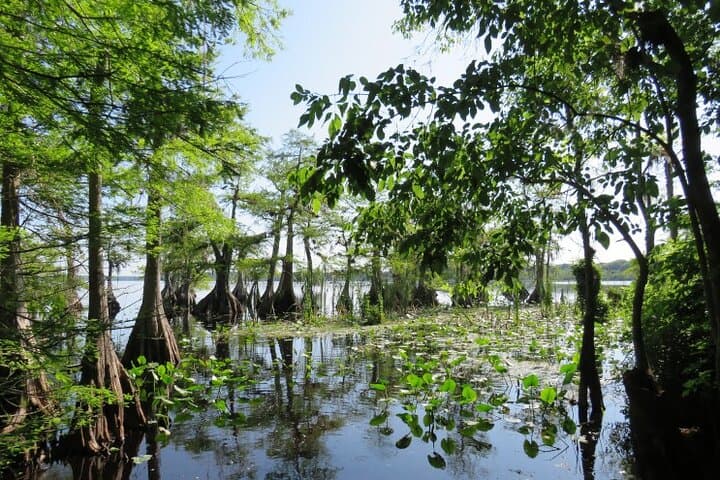
What the day feels like
You push off from a narrow, muddy bank and immediately the world changes. The motor hum of distant traffic evaporates into a hush of dripping lichen and the soft scrape of paddle against water. Cypress knees puncture the glassy surface like an ancient forest's teeth; trunks rise in gray-green columns and sunlight slices between them into golden, silt‑dusted shafts. An otter slips ahead and disappears under an arch of roots. For the next three hours you move through a landscape that feels curated for quiet observation—the kind of Florida most visitors never see.
Lake Norris is a private-feeling, public-minded place: not a manicured resort lake but a tangle of channels, coves, and flooded swamp that reads like a natural cathedral. Boat traffic is low here and the water is slow, giving species—from wading birds to turtles and, yes, alligators—room to live on their own terms. On this small-group, guided outing you don’t simply traverse the water; you learn how the swamp is organized: where the deeper channels are, how to read a cypress ring by its waterline, where the longleaf pines give way to wetland hammock.
This particular corner of central Florida plays a longer game than the tourist beaches. The cypress swamp is a remnant of an older landscape, part of a web of wetlands that helped shape the region’s hydrology and ecology long before roads and subdivisions. Geologically the land is flat, with limestone bedrock punctuated by sinkholes and springs. The slow flow of water across this terrain allowed cypress and swamp hardwoods to establish dense, peat‑rich soils that store carbon and temper floods. Culturally, these waterways sustained indigenous communities and later settlers who used them for transport and subsistence; today they provide a critical corridor for Florida’s larger mammals, including the black bear.
On the practical side, the tour’s three-hour window is lean and generous at once: lean because you cover only a few miles—enough to keep you immersed but not exhausted; generous because the guide will stop you on a dime to watch a heron stalk a mudflat or to point out a swallowtail butterfly drifting like a punctuation mark. Small-group formats matter here. They reduce disturbance to wildlife and let guides interpret the day in detail—local history, bird identification, or the best angle for a photograph.
Book this as part of a day in the Orlando region and you get a contrast that sticks in the memory: theme-park neon to cypress hush in under an hour. The company running the trip provides boats, paddles, lifejackets, and a guide, and because the launch and route are on calmer water, newcomers to kayaking feel comfortable quickly. That said, conditions can change—wind funnels down lakes; afternoon storms appear without ceremony—so timing your trip for morning or late afternoon reduces wind and maximizes wildlife activity.
If you go, accept a few basic truths of swamp travel: give wildlife space, expect insects during warm months, and respect low-light under the canopy (it’s great for mood, less great for cellphone photos). Your guide's local knowledge is the part of the ticket you’ll appreciate most: they know where the hidden side channels open into small, quiet coves, and where the osprey perch that usually hold a snack.
Practical booking and getting there: this is an easy half-day commitment priced at a modest level for the region. Small-group tours with local operators are often flexible on cancellations and support conservation-minded practices. For exact tour details and to reserve a spot on a scheduled departure, visit the guided booking page for the <a href="https://app.advcollective.com/local-experts/lake-norris-kayak-explorer-3-hour-guided-small-group-tour-in-floridas-cypress-swamp">Lake Norris Kayak Explorer</a>.
Why travelers should consider this trip: it offers accessible adventure without the spectacle—no Class IV thrills, no long portage, just an intimate relationship with a classic Florida ecosystem. It’s ideal for families comfortable in tandem kayaks, photographers after atmospheric images of cypress and reflections, or anyone who wants a calmer counterpoint to the more crowded water destinations. The trip is a practical half‑day that pairs easily with nearby small towns—grab lunch afterward in lakeside Mount Dora or return to Orlando for evening plans.
Final, practical notes: go early in the day for cooler temps and better light; bring a dry bag and good footwear that can get wet; apply insect repellent and reef-safe sunscreen; and leave the noisy water toys at home. Do that and the swamp will repay you with quiet, wildlife, and that particular brand of Florida magic: raw, alive, and unmistakably place‑based.
Reserve, prepare, and arrive curious. The cypress will do the rest—listening, shading, and quietly showing you how the slow water keeps a place working for life.
Trail wisdom
Small choices, better day.
Go Early
Morning light minimizes wind and insect activity while maximizing wildlife sightings.
Use a Dry Bag
Bring a medium dry bag for phone, snacks, and camera—water under the canopy is inevitable.
Wear Secure Footwear
Lightwater shoes or sandals with straps protect your feet during launch and if you step out into shallow water.
Listen to the Guide
Small-group etiquette keeps wildlife calm and improves everyone’s chance to see birds and otters.
Local knowledge
Read the place, not just the route.
Watch for native species including River otter, Great blue heron.
Keep an eye out for wildlife during the transition between areas and habitats. Respect distance guidelines.
Small-group, low-impact tours help minimize disturbance; follow guide instructions, pack out trash, and avoid feeding wildlife.
Follow the guide's instructions on size limits, ethical handling, and leave-no-trace practices.
Narrow side channels where cypress roots create mirror-like reflections. A shallow north cove famous among locals for quiet morning paddles and solitary birding
Locally recommended viewpoints and quiet spots known best to local operators.
These cypress swamps have long been integral to local hydrology and were travel and resource corridors for indigenous peoples before settlement.
Maritime roots and regional tradition shape the waterways and working coasts.
Seasonal guide
Four versions of the same landscape.
Spring
Best forMigratory birdwatching · Comfortable temperatures · Fewer afternoon storms
ChallengesAllergies · Occasional high water after heavy rains
Spring delivers pleasant temperatures and active birdlife—bring binoculars and a light jacket for cool mornings.
Summer
Best forLush foliage · Long daylight hours · Amphibian and insect activity
ChallengesHigh heat and humidity · Mosquitoes and afternoon thunderstorms
Summer is vibrant and green but prepare for heat and bugs; early starts are essential.
Fall
Best forLower humidity · Good photography light · Active wildlife
ChallengesHurricane season remnants possible · Variable temperatures
Fall balances warm days and cooler nights—expect clear skies but watch for storm-driven wind on open water.
Winter
Best forCooler weather · Fewer insects · Calmer water days
ChallengesCooler mornings · Shorter daylight
Winter offers the most comfortable paddling weather and reduced insects—dress in layers for changing temperatures.
Operator details
What the booking data adds.
Included
- ✓A professional medically trained certified kayak guide
- ✓Trail snacks and bottled water
- ✓Top-of-the-line kayak gear (kayak, paddle, PFD)
- ✓A commitment to make the tour as exciting, challenging, and informative as you like
Not included
- —Gratuity
Good to know
- ✓Wheelchair accessible
- ✓Infants and small children can ride in a pram or stroller
- ✓Service animals allowed
- ✓Infants are required to sit on an adult’s lap
- ✓Suitable for all physical fitness levels
- ✓It is recommended you wear quick dry clothes and water/river shoes
- ✓We recommend you bring a swim suit, warm wool or fleece top (winter), waterproof rain jacket or poncho, sun protection (sunhat, sunglasses, sun screen), a camera, and a towel to dry off afterwards.
Pack with intention
What to bring.
Good to know
Common questions.
No—this small-group tour is beginner-friendly; guides provide a quick skills briefing and safety orientation before launch.
Plan the edges
The details that make the day easier.
Lake Norris and its surrounding wetlands provide habitat that expands the Florida black bear corridor, supporting larger-scale wildlife movement—this is noted by local conservation groups.
After your paddle, head to nearby Mount Dora for lakeside cafes, local craft breweries, and antique shops—try a casual seafood spot for fried fish or a sandwich and a cold beer to round out the day.
- Closest airport
- Orlando International (MCO)
- Typical drive time from Orlando
- 45–60 minutes
- Cell service
- limited under dense canopy
- Permits
- Included with guided tour—no extra launch permits usually required
This cypress swamp is a sensitive habitat—use reef-safe sunscreen, pack out all trash, and let wildlife dictate photography distance to minimize stress.
Explore by topic
Follow the threads.
Keep exploring
Make the story part of the trip.
Set out from Bass Harbor for a private, customizable day on Blue Hill Bay — lighthouses, puffins, seals, and the chance to feel Acadia from the water. Small groups, local captains, unforgettable views.
In four hours you can move from shaded canyon ferns to wind-scoured coastal ridgelines, guided by someone who knows where the light—and the hidden views—live. This private half-day hike on the Monterey Peninsula or Big Sur is compact, curated, and perfect for travelers who want depth without a multiday commitment.
 Related story
Beneath a sky of shifting light, Skaftafell’s ice reads like a map of time. This three-hour guided glacier hike mixes technical instruction with geology and culture: compact, safe, and unforgettable.