
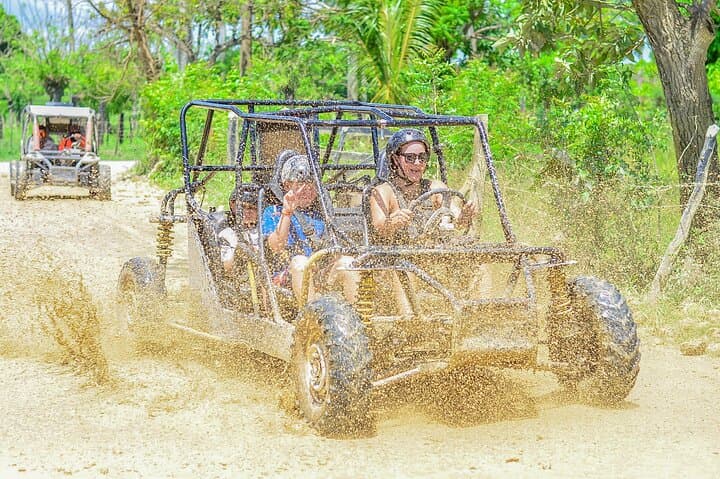
What the day feels like
The engine kicks with a promise: a throatier, dirt-eating version of freedom. You climb into a two-seater buggy, the sun is already warm, and the Atlantic wind lifts the scent of salt and citrus from roadside palms. Within minutes the paved road peels away and you’re threaded into a tangle of sugarcane rows and rutted trails that lead to Playa Macao—one of Punta Cana’s last great public beaches. The first splash of surf, the first cloud of dust, the first river crossing; the tour is tactile in a way resorts can’t be. Nature has agency here—the ocean dares you to take off your helmet and run into the breakers; the red clay insists on a new coat of mud; the cave narrows and nudges you forward.
This four-hour buggy loop is honest and loud. It pairs a short off-road odyssey—roughly 12–18 miles of sand, dirt, and single-track—with coastal moments that feel almost cinematic: an exposed Atlantic shoreline that’s exposed to trade winds and steady surf, a rural village where children wave and horses graze, and a small limestone river cave where water has been carving passageways for millennia. The route is Dominican Republic in concentrated form: raw coastline, agricultural memory, and a geography that alternates between flat coastal plains and pocketed limestone features.
Geology here is modest but telling. The north-facing beaches of the Punta Cana region meet the Atlantic with broad, sandy spits formed by longshore drift and backed by low dunes and coral-derived sands. Inland, the karstic bedrock means rainwater finds weaknesses and forms short, snaky underground streams—and the little caves and sinks on this tour are the local expression of that process. Culturally, the ride peels back the resort curtain. You pass small towns and roadside stands selling empanadas and cold juices; the tour is a quick lesson in how coastal Dominican life still orbits fishing, small-scale agriculture, and a lively informal economy.
This itinerary isn’t an endurance slog. It’s a fast, social way to put yourself in the landscape: the carves and jolts make conversation quieter—gestures and shared laughter become the language. The operator’s route typically includes a beach stop at Macao where you can swim or take surf photos, an inland section that runs through pastures and sugarcane trails, and a short walk into a shallow river cave where the light goes green and the air cools. Expect to get dusty, likely a little muddy, and maybe a little wet. Those are features, not bugs.
Practical matters: the tour runs about four hours, costs from USD 45, and usually includes transportation from Punta Cana area hotels. The vehicles are purpose-built recreational buggies; drivers/guide teams provide helmets and safety briefings, but the trails can be bumpy and require basic motion tolerance. There’s no significant elevation gain—the route is coastal plain—but terrain varies from soft sand that slows you to hard-packed tracks that let the buggy fly. Bring a healthy respect for the sun and an appetite for informal stops; the schedule leaves room for a snack or a cold drink at a local stand.
Timing is everything. Mornings are the coolest and tend to have better light for photos; afternoons can be windier and produce bigger surf at Macao. If you want calmer water for a swim or photos, aim for late morning. In the high season (December–April) the weather is dryer and trails are less muddy; the rainy season can make sections trickier and more thrilling if you’re prepared to embrace mud. The tour is family-friendly if you’re comfortable with bumps, but check operator age or weight limits.
Packing and preparation are simple but smart: closed-toe shoes, sun protection, a lightweight long-sleeve for sun and spray, and a waterproof pouch for your phone will make the day easier. Bring cash for roadside snacks and tips; while the tour often includes pickup from major Punta Cana hotels, confirm transport details in advance. Drivers are usually experienced on local tracks, but keep expectations modest about creature comforts—the day trades polish for presence.
If you go, approach it as a conversation with the place. Slow down to watch fishermen mend nets, step off the sand to feel the heat of gravel, and treat the cave as a fragile feature—not a playground. The experience is as much about reading the landscape as it is about throttle control: the map is a suggestion, the land will correct your speed, and a good guide knows when to open up and when to tuck in.
For travelers who spend most of their time poolside at all-inclusive resorts, this buggy tour is a necessary jolt. It’s short enough to fit in a half-day and long enough to feel like a proper escape. You’ll return with clothes that smell of salt and soil, a handful of candid photos, and a clearer sense of Punta Cana beyond the manicured beachfront. And if the Atlantic, the cave, or the mud demands more of you, you’ll find yourself answering—usually with a grin and another set of keys for the next ride.
Trail wisdom
Small choices, better day.
Bring a waterproof phone case
Beach spray and river splashes are guaranteed; protect electronics and ID.
Wear closed-toe shoes
Sand, rock, and rutted trails make sandals a poor choice—sturdy footwear protects toes and gives grip.
Time for morning light
Book a morning slot for cooler temperatures, easier photos, and calmer seas at Macao.
Carry small cash
Local vendors and guides often accept only cash for snacks, tips, or small souvenirs.
Local knowledge
Read the place, not just the route.
Watch for native species including Brown pelican, Lesser noddy and shorebird species.
Keep an eye out for wildlife during the transition between areas and habitats. Respect distance guidelines.
Protect dunes and avoid trampling native vegetation; support local vendors to keep tourism benefits in the community and pack out all trash.
Follow the guide's instructions on size limits, ethical handling, and leave-no-trace practices.
Early-morning surf breaks at Macao where local surfers gather. A roadside fruit stand known for freshly squeezed sugarcane juice
Locally recommended viewpoints and quiet spots known best to local operators.
Playa Macao has long been a public fishing beach outside the resort corridor—its exposure to the Atlantic kept large-scale hotel development at bay and preserved local access.
Maritime roots and regional tradition shape the waterways and working coasts.
Seasonal guide
Four versions of the same landscape.
Spring
Best forWarmer sea swims · Fewer crowds than peak winter · Good lighting for photos
ChallengesOccasional short showers · Roads can be soft after rains
Spring (March–May) tends toward warm, pleasant days and fewer resort crowds—expect occasional showers that freshen the landscape.
Summer
Best forLush inland scenery · Lower tour prices · Warm water temperatures
ChallengesHotter afternoons · Higher humidity and afternoon storms
Summer is hot and humid with tropical afternoons that can bring brief heavy rain—dress light and be flexible on timing.
Fall
Best forQuieter beaches · Good value travel · Green agricultural backdrops
ChallengesIncreased hurricane-season risk · Unpredictable weather windows
Fall can offer quieter tours and greener scenery but carries elevated storm risk—monitor forecasts closely.
Winter
Best forDry, reliable weather · Calmer seas most days · Peak photo conditions
ChallengesHigh tourist season prices · Busier beaches and pickups
Winter (Dec–Apr) is the dry season—sunny, stable weather and prime conditions for off-road exploring and beach stops.
Operator details
What the booking data adds.
Included
- ✓Professional guide
- ✓The transport is shared with other people.
- ✓The pick up is collective.
- ✓Round trip transportation
- ✓The tour is shared with other people.
- ✓This is not a private tour
Not included
- —Bathing suit
- —Flip flops or water shoes
- —Towel
- —Photos
- —The client must be aware of their belongings, our company is not responsible for lost items.
- —This tour does not include pickup in Verón/Bávaro Pueblo, but we can arrange a nearby meeting point.
- —This tour does not include pick-up at Cap Cana or the airport area, taxi is at the client's expense.
Good to know
- ✓Not recommended for pregnant travelers
- ✓Suitable for all physical fitness levels
- ✓Operated by a multi-lingual guide
- ✓The tour is shared with other people.
- ✓The pick up is collective.
- ✓The transport is shared with other people.
- ✓This is not a private tour
- ✓This tour does not include pick-up at Cap Cana or the airport area, taxi is at the client's expense.
- ✓This tour does not include pickup in Verón/Bávaro Pueblo, but we can arrange a nearby meeting point.
Pack with intention
What to bring.
Good to know
Common questions.
The tour is approximately 4 hours from hotel pickup to return; confirm pickup window when booking.
Plan the edges
The details that make the day easier.
Playa Macao is one of the few major public beaches in the Punta Cana region that remains largely outside resort ownership and is a popular local surf spot.
After the ride, head to a nearby beach shack for fresh ceviche and cold Presidente beer or try a local roadside stand’s fried empanadas—there’s no need for formal dining to taste Dominican coastal flavors.
- Closest airport
- Punta Cana International Airport (PUJ)
- Typical drive from major resort areas
- 20–40 minutes
- Cell service
- reliable in town, spotty on trails and in the cave
- Permits
- none usually required
This coastal region is sensitive—stay on designated tracks, avoid damaging dune vegetation, support local small businesses, and pack out all trash.
Explore by topic
Follow the threads.
Keep exploring
Make the story part of the trip.
Set out from Bass Harbor for a private, customizable day on Blue Hill Bay — lighthouses, puffins, seals, and the chance to feel Acadia from the water. Small groups, local captains, unforgettable views.
In four hours you can move from shaded canyon ferns to wind-scoured coastal ridgelines, guided by someone who knows where the light—and the hidden views—live. This private half-day hike on the Monterey Peninsula or Big Sur is compact, curated, and perfect for travelers who want depth without a multiday commitment.
 Related story
Beneath a sky of shifting light, Skaftafell’s ice reads like a map of time. This three-hour guided glacier hike mixes technical instruction with geology and culture: compact, safe, and unforgettable.