
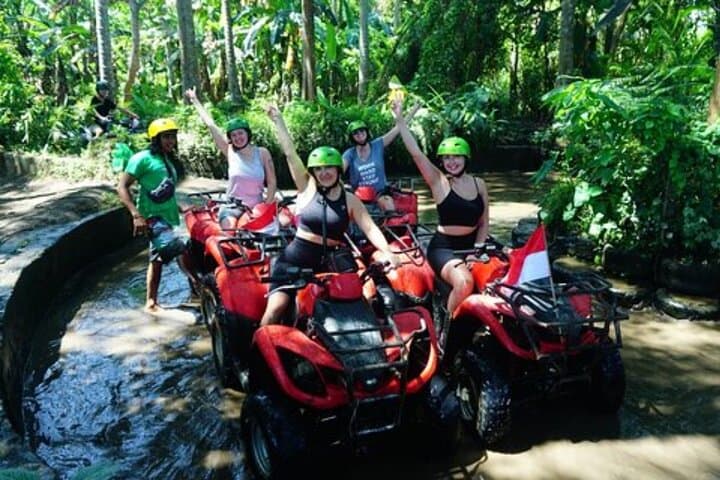
What the day feels like
You know you’re in Bali the second the engine blips and the jungle answers back. An ATV’s rumble becomes part of the landscape — less a machine than a way of reading the island’s pulse. You pull forward, squinting through a fine spray of mud and sunlight, and the terraces open like green pages. Downriver, the Ayung keeps its own counsel, water threading through limestone and volcanic rock, daring you to find a faster line.
This hybrid half-day is uncomplicated in promise and generous in payoff: two very different ways to move through the Balinese interior. The quad portion drives across rice paddies, small village tracks, and sticky red earth, while the rafting leg runs you through carved gorges and playful rapids. Together they form a tidy essay on Bali’s physical and cultural landscape — human-managed fields above, a river that remembers its volcanic origins below.
Ubud sits at the center of this story. Tucked into Bali’s central highlands, its name has become shorthand for slowed-down culture, rice terraces, and arts markets; the town also acts as a gateway to activities that are less about resort pools and more about dirt under your nails. The rice terraces you’ll ride past are part of Bali’s centuries-old subak system, an irrigation method rooted in cooperative water management and designated a UNESCO World Heritage Cultural Landscape. Downstream, the Ayung River slices through layers of ash and lava from the island’s volcanic past, shaping rapids that vary from playful to heart-thumping.
Culturally, the ride-and-raft combo is a modern overlay on a very old place. Balinese Hinduism informs the rhythms here: small woven offerings at the edge of a field, umbrella-topped shrines by the trail, a procession of daily rituals that stops you and reminds you that adventure is happening in lived-in country. Local guides — often young, quick with a joke, and fluent in the practicalities of getting you safely across a river or through a technical corner — are your translators not only of the land but of its etiquette.
The geology is visible in the textures: volcanic soils that produce famously lush rice and jungle, and river gorges cut into soft tuff and harder basalt. The Ayung has been sculpting this valley for millennia; today, it offers rapids classified commonly as Class II–III — accessible for most people who are comfortable with moderate exertion and an appetite for a little spray.
Practicality: this tour is flexible in length — operators commonly package it between one and six hours depending on your chosen route and whether you combine the two activities. Expect the ATV leg to last roughly 60–90 minutes on trail, with climbs and descents that are more about terrain than altitude gain. The rafting stretch averages 8–12 kilometers and takes 1.5–3 hours depending on flow and how many photo stops your guide wants.
What you’ll want to know before you sign up: the operator supplies well-maintained ATVs, helmets, safety gear, and life jackets for rafting. You’ll get a short safety briefing for both activities; pay attention. The riding is forgiving but can get messy; the river is playful but has technical lines that reward listening to your guide. There are standard weight and age restrictions — typically a minimum age around 12 for rafting and a weight cap on quads — so check specifics when booking.
Timing matters. Book a morning slot if you want soft light on the terraces and cooler air on the trail; afternoons can get hot, and the later the day, the muddier the ATV routes become. If you’re visiting during the wet season, flow on the river increases and the thrill factor rises at the cost of fewer calm pools for photos.
Fitness and skills — no specialist expertise required, but a baseline of fitness helps. You should be comfortable shifting your weight on a vehicle for turns and able to paddle for several stretches on the river. Dress for function: quick-dry clothes, closed-toe shoes you don’t mind wrecking, and a waterproof case for your phone if you insist on taking pictures.
Why bother? Because this pairing gives you the best of Bali’s contradictions: a cultivated human landscape interleaved with raw, moving water. The ATVs get you where photos fail to explain — up close to terraces and into shadowed tracks — while the river reorients you to the island’s physical origins. Together, they make a compact, full-sensory score that’s easy to slot into a longer Ubud itinerary.
If you go: carve out a day to do it slowly. Eat a light breakfast, drink well beforehand, and leave room for cold Bintang or fresh coconut water afterwards. Bring a sense of curiosity and a willingness to get muddy. Local guides expect nothing less and will reward it with stories, shortcuts, and vantage points you wouldn’t see on foot.
Trail wisdom
Small choices, better day.
Book a Morning Slot
Early departures offer cooler temperatures, softer light for photos, and firmer trails for the ATV leg.
Wear Closed-Toe Shoes
Traction and protection matter — expect mud and wet riverbanks, so no sandals.
Bring a Waterproof Case
Whether on the raft or riding through spray, a dry phone case keeps your camera usable and your valuables safe.
Listen to Your Guide
Guides read the river and terrain; follow their instructions for the safest lines and best photos.
Local knowledge
Read the place, not just the route.
Watch for native species including Long-tailed macaques, Kingfishers and herons along the Ayung.
Keep an eye out for wildlife during the transition between areas and habitats. Respect distance guidelines.
Choose operators that respect local waterways, minimize single-use plastics, and avoid disturbing riverbanks and irrigation channels; these ecosystems are sensitive to runoff and waste.
Follow the guide's instructions on size limits, ethical handling, and leave-no-trace practices.
Campuhan Ridge Walk at sunrise — a quiet, panoramic trail before the crowds. Pura Gunung Kawi — a lesser-visited temple complex with carved shrines and rice-terrace views
Locally recommended viewpoints and quiet spots known best to local operators.
The rice terraces you’ll ride past are irrigated through the subak system, a cooperative water-management practice that dates back centuries and is UNESCO-listed.
Maritime roots and regional tradition shape the waterways and working coasts.
Seasonal guide
Four versions of the same landscape.
Spring
Best forLush terraces · Cooler mornings
ChallengesOccasional showers · Variable trail conditions
Spring (March–May) bridges wet and dry seasons — terraces are vivid and the trails are generally manageable, but sudden showers can make surfaces slick.
Summer
Best forDry, firm trails · Stable river levels
ChallengesHot afternoons · Higher tourist numbers
Summer (June–August) is the best overall: dry trails for ATVs and predictable rapids for rafting, but expect more people on the routes.
Fall
Best forGood light for photography · Reduced crowds early fall
ChallengesReturn of intermittent rain late season
Fall (September–November) still enjoys many dry days early on, with increasingly lively river flows as rains return.
Winter
Best forLusher jungle · Bolder rapids on high flows
ChallengesHeavy rain, slippery tracks · Limited calm photo stops
Winter (December–February) is Bali’s wet season; the landscape is vivid but conditions can be muddy and the river swifter.
Operator details
What the booking data adds.
Included
- ✓Safety equipment (rafting: helmet, life jacket, paddle; ATV: helmet, boots)
- ✓Professional instructor / guide and safety briefing and basic instruction session before activities
- ✓Insurance coverage during the activity
- ✓Private hotel pickup & drop-off within selected service areas (All-Inclusive option only)
- ✓Indonesian set menu lunch
- ✓Government tax and service charges
Not included
- —Photo and video services (available as an optional personal service on-site)
- —Tips and gratuities
- —Personal expenses and other additional purchases
Good to know
- ✓Public transportation options are available nearby
- ✓Suitable for all physical fitness levels
Pack with intention
What to bring.
Good to know
Common questions.
Most operators include hotel pickup in central Ubud, ATV and rafting equipment (helmets, life jackets), safety briefings, and bottled water; check specific inclusions when booking.
Plan the edges
The details that make the day easier.
The Balinese subak irrigation system, which shapes the island’s rice terraces, is a UNESCO World Heritage cultural landscape.
After the ride, head back into Ubud for a late lunch — try local Balinese dishes like bebek betutu or vegetarian options at one of Ubud's health-focused cafes, then grab a Bintang at a riverside warung. If you have energy left, wander the market for carved souvenirs or visit a nearby spa for a post-adventure massage.
- Closest airport
- Ngurah Rai International Airport (DPS). Driving time to Ubud: ~1–1.5 hours. Typical meeting
- collection
- hotel pickup in Ubud. Cell service: generally good in Ubud, patchy in river gorges. Permits: none required for day trips; check operator rules for age
This area relies on clean water and functioning irrigation; respect rice paddies and riverbanks, avoid single-use plastics, and choose operators who practice Leave No Trace.
Explore by topic
Follow the threads.
Keep exploring
Make the story part of the trip.
Set out from Bass Harbor for a private, customizable day on Blue Hill Bay — lighthouses, puffins, seals, and the chance to feel Acadia from the water. Small groups, local captains, unforgettable views.
In four hours you can move from shaded canyon ferns to wind-scoured coastal ridgelines, guided by someone who knows where the light—and the hidden views—live. This private half-day hike on the Monterey Peninsula or Big Sur is compact, curated, and perfect for travelers who want depth without a multiday commitment.
 Related story
Beneath a sky of shifting light, Skaftafell’s ice reads like a map of time. This three-hour guided glacier hike mixes technical instruction with geology and culture: compact, safe, and unforgettable.