
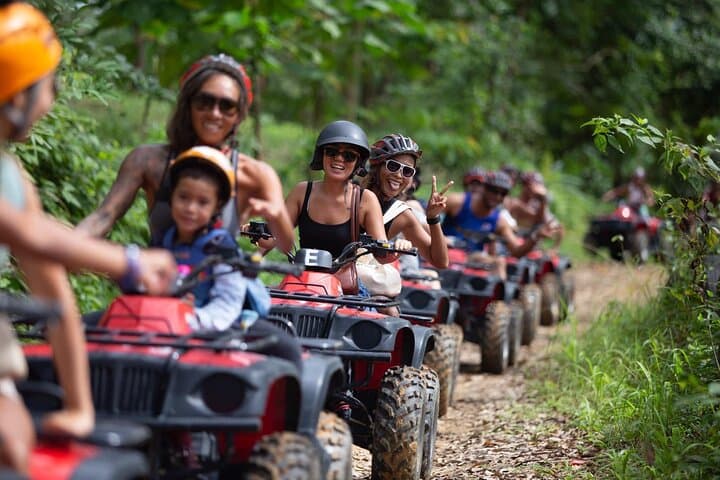
What the day feels like
There’s a rhythm to riding a quad through Phuket’s southern slopes—the steady thrum of a Polaris Phoenix 200cc under your hands, the slap of rubber tires on packed earth, and the hush of a rubber plantation that seems to hold its breath when a rider passes. You crest a low granite ridge and the island exhales: below, the Andaman Sea threads silver between headlands; ahead, the Big Buddha sits calm on Nakkerd Hills, a white sentinel watching over villages and coconut palms. The trail smells of wet soil and crushed leaves. The jungle dares you to look away.
This two-hour ATV tour is compact but layered. It’s not only about speed or a selfie next to a helmeted guide; it’s a short, sensory immersion into Phuket’s working landscape—an island shaped by tin, marble, and rubber. The route spends most of its time on natural tracks and farm roads that slice through rubber plantations and patches of secondary rainforest. You’ll meet local forest and plantation workers tightening a tap on a latex tree or packing harvested sheets into a truck; they wave, often amused to see foreigners choosing mud over beaches.
Geology and history are threaded into the dirt. Phuket’s hills are granite and schist—ancient rock pushed up by tectonic forces and exploited for tin in the 19th and 20th centuries. When mining slowed, rubber took the lead. Rows of rubber trees, planted in straight, disciplined lines, turn the landscape into a human-made forest, punctuated by cashew and banana patches. The Big Buddha—built from reinforced concrete and veneered in Burmese white marble to a height of 45 meters—dominates the skyline, a modern devotional landmark completed through public donations and local fundraising.
Culturally this is coastal southern Thailand as lived by everyday people: smallholder farmers, roadside markets selling fish and curries, and fishermen mending nets by hand. Locally run ATV operators often weave short cultural moments into the ride: a photo stop at a viewpoint, a quick chat about latex tapping, or a visit to a hillside shrine. On clear days the vista stretches to sea; on cloudy afternoons the ocean recedes into a soft gray, and the hills press in with wet green intensity.
Why take an ATV tour here instead of another beach day? For many travelers, it’s about contrast—trading flat sand for track, sun lounger for throttle. It’s also efficient: in two hours you get off the coastal fringe, learn something tangible about local livelihoods, and sample inland Phuket without hours of driving. The tour’s small groups and guided instruction lower the barrier to entry: operators supply helmets and basic training, and the Polaris Phoenix 200cc is forgiving enough for first-timers but lively enough for riders who want a little throttle.
Practical edge: start early. The best light—and the coolest air—arrives before mid-morning. Afternoon monsoon squalls are common from May through October; slick ruts and reduced visibility are part of the package then. Footwear matters: sturdy trail shoes or lightweight boots keep your ankles protected and give grip when you need to dab a foot. Bring a compact hydration system, sunscreen, and a weatherproof phone case; cameras and phones get splattered.
Safety and etiquette are straightforward. Stay on assigned trails; those paths keep you out of sensitive regrowth and away from farm operations. Listen to guides and test throttle control in a clearing before tackling steeper tracks. If you’re in the habit of leaning into turns on a bicycle, remember that ATVs demand a different center-of-gravity approach—smaller, more measured moves and active footwork. For families: many operators set minimum age limits and pair inexperienced riders with guides when necessary.
Logistics are compact and friendly. Hotel pick-up and drop-off are commonly included, and the experience offers instant confirmation and free cancellation—useful if the weather forecast shifts. Prices start affordably, making this a low-commitment taste of inland Phuket that pairs well with a half-day of beach or a sunset meal afterward.
Photographing the ride rewards a little forethought. Wide-angle shots from a low kneeling position at viewpoint stops make the ATV feel embedded in landscape; use burst mode for motion sequences and keep your shutter fast (1/500s or faster) if you want sharp wheels in action. For portraits, diffuse light after a rainstorm flatters skin tones and washes the plantation green. Protect your gear from spray with a simple ziplock or small dry bag.
When to go: the dry season (November–April) is reliably drier, cooler, and the best bet for clear views from the Big Buddha. If you travel during the monsoon window, enjoy the greening landscape but expect mud, canceled runs during heavy squalls, and a louder engine to hear through rain.
After the ride, wind down like a local: head to Karon or Kata for fresh seafood and a cold beer, or find a small family-run noodle shop tucked behind the beachfront resorts. The island’s flavor is most honest where people eat between shifts, not in the hotel buffet.
This ATV safari doesn’t try to be an expedition; it’s a fast, tactile way to layer Phuket’s coastal shine with its quieter inland work. For two hours you trade the predictable horizon for narrow trails, local stories, and the simple satisfaction of a bike that responds to a wrist twist. The island pushes back a little—heat, sand, a burst of rain—but mostly it invites you to see a side of southern Thailand shaped by human hands and natural force. If you want a condensed, palpable memory from Phuket that’s equal parts throttle and place, an ATV through the plantations delivers.
Trail wisdom
Small choices, better day.
Go Early
Start in the morning to avoid heat and afternoon squalls and to get the clearest ocean views at the Big Buddha viewpoint.
Sturdy Footwear
Wear closed-toe shoes with ankle support—ATV footwells and damp trails are unforgiving to sandals.
Protect Electronics
Use a waterproof phone case or small dry bag; straps or a chest harness keeps cameras steady and safe from splatter.
Respect Local Farms
Stay on established tracks and follow your guide—plantation rows and farm equipment are working areas.
Local knowledge
Read the place, not just the route.
Watch for native species including Monitor lizards, Tropical bird species (kingfishers and bulbuls).
Keep an eye out for wildlife during the transition between areas and habitats. Respect distance guidelines.
Stick to trails to avoid trampling regrowth in secondary forest; choose operators that limit group size and follow local waste-management practices.
Follow the guide's instructions on size limits, ethical handling, and leave-no-trace practices.
Nakkerd Hills viewpoint aside from the big statue—smaller, quieter vistas for coastal panoramas. A roadside morning market in Karon where fishermen sell grilled squid and fresh fruit
Locally recommended viewpoints and quiet spots known best to local operators.
Phuket’s inland landscape shifted from tin mining to rubber production in the 20th century; rubber plantations remain a defining feature of southern Phuket’s economy and scenery.
Maritime roots and regional tradition shape the waterways and working coasts.
Seasonal guide
Four versions of the same landscape.
Spring
Best forWarmer dry days · Less humidity than summer · Good visibility at dawn
ChallengesHeat builds by midday · Occasional haze in March–April
Spring (Mar–May) grows hotter; mornings are ideal for the ride before temperatures spike and late haze lowers long-distance visibility.
Summer
Best forLush green jungle · Lower visitor numbers · Dramatic skies
ChallengesMonsoon rains (May–Oct) · Slippery trails and cancellations
Summer brings frequent showers and vibrant vegetation—expect mud, shortened routes in heavy rain, and cooler late-afternoon air.
Fall
Best forTransitional weather · Rich plantation color · Fewer crowds post-monsoon
ChallengesUnpredictable showers in early fall · Trail maintenance after storms
Fall (Sep–Nov) transitions from monsoon to dry seasons; late fall is often the most reliable window for drier tracks and clearer skies.
Winter
Best forClear sea views · Cooler temperatures · Stable dry trails
ChallengesIncreased tourist numbers · Slightly higher prices
Thai winter (Nov–Feb) is the prime season—cooler, drier, and the clearest time to see the Andaman from ridge viewpoints.
Operator details
What the booking data adds.
Included
- ✓Drinking water
- ✓Accident Insurance for rider & passenger (ATV damages not covered)
- ✓First Aid Kit
- ✓Safety equipments
- ✓Round trip transfer from Patong, Kata, Karon, Rawai or Chalong
- ✓Tour Guide
- ✓Raincoat (on rainy days)
Not included
- —Out of zone pickup fees
- —ATV damage costs
- —Entry fees
Good to know
- ✓Not recommended for travelers with spinal injuries
- ✓Not recommended for travelers with poor cardiovascular health
- ✓Not recommended for pregnant travelers
- ✓Public transportation options are available nearby
- ✓Suitable for all physical fitness levels
- ✓Child ticket age between 4-11 years or less than 130cm in height (proved may be required)
- ✓The trip has no weight restrictions. Riders have to be in good physical and mental ability to ensure safety. No alcohol is permitted.
- ✓For passengers, make a reservation by specifying a child ticket, and driving is not allowed.
- ✓Pregnant women should not participate in the tour. People with disabilities should not participate in the tour.
- ✓During the tour, riders are asked to strictly follow the tour guide/instructor. The tour operator has the right to stop any risky riding with no refund.
- ✓On the rare occasion that we should be required to cancel a tour, we will inform you in advance and offer a different tour date, an alternative tour or provide a full refund.
- ✓The interior of the Big Buddha is temporarily closed, but don’t worry! You can still marvel at its grandeur from the outside and take in the breathtaking bird’s-eye views of the surrounding area. The experience remains as memorable and enjoyable as ever!
Pack with intention
What to bring.
Good to know
Common questions.
No—operators provide a safety briefing and basic instruction; the Polaris Phoenix 200cc is suitable for beginners under guide supervision.
Plan the edges
The details that make the day easier.
The Big Buddha on Nakkerd Hills is approximately 45 meters tall and is faced with Burmese white marble, funded largely through public donations.
After the ride, head to Karon or Kata for fresh seafood—try grilled snapper or squid with a cold local beer. For a casual meal, stop at a family-run noodle stall behind the beach for authentic southern Thai flavors.
- Closest airport
- Phuket International Airport (HKT); Typical driving distance from Phuket Town: ~20–30 km depending on coast; Cell service: generally available on main roads, patchy on interior ridges; Permits
- passes
- none for this tour; operator provides helmets and hotel pick-up.
Respect plantation rows and avoid off-trail riding—rubber plantations are working landscapes; choose operators who minimize group sizes and pack out any trash.
Explore by topic
Follow the threads.
Keep exploring
Make the story part of the trip.
Set out from Bass Harbor for a private, customizable day on Blue Hill Bay — lighthouses, puffins, seals, and the chance to feel Acadia from the water. Small groups, local captains, unforgettable views.
In four hours you can move from shaded canyon ferns to wind-scoured coastal ridgelines, guided by someone who knows where the light—and the hidden views—live. This private half-day hike on the Monterey Peninsula or Big Sur is compact, curated, and perfect for travelers who want depth without a multiday commitment.
 Related story
Beneath a sky of shifting light, Skaftafell’s ice reads like a map of time. This three-hour guided glacier hike mixes technical instruction with geology and culture: compact, safe, and unforgettable.