
What the day feels like
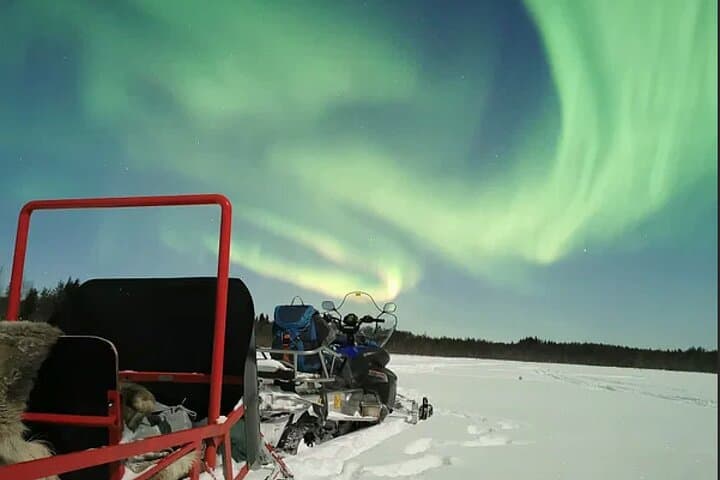
You climb aboard a low wooden sledge, the runners hissing softly as the snowmobile nudges forward. The guide kills the auxiliary lights and for a moment only moonlight and a frost-bright sky remain. Pine silhouettes become tall, dark punctuation marks. The world shrinks to the breath of the engine, the hush of the forest, and the distant possibility that the sky will come alive.
This is not a theme-park northern-lights show. The Northern Lights Sledge Ride in Levi is built around deliberate darkness: trails that weave across frozen lakes and through boreal forests, led by drivers who know the fells and the moods of Arctic skies. Over roughly two hours you slide into a wilder slice of Lapland, away from village glow and shop-front sodium lights. You stop. The sledge becomes a theater; the sky, sometimes, becomes a performance.
Lapland’s northern geometry makes this part of the world a favored stage for aurora. Levi sits well within the auroral oval and the nights between late autumn and early spring are long enough for prolonged sky-watching. The terrain underfoot reads like deep time: rounded fells and thin soils created by ancient bedrock and scoured by Pleistocene glaciers, a landscape that now supports stunted pines, lakes that freeze solid, and a handful of human settlements dotting the rim of the wilderness.
Culturally, Lapland is Sámi country. Reindeer have shaped both landscape and livelihood for centuries—today you may see them grazing the edges of trails or being herded in winter pastures. Levi itself is one of Finland’s most popular winter destinations, a practical hub with the small airport at Kittilä and a string of hotels and services. But the sledge ride is a reminder that the village exists at the edge of something vaster: the Arctic night.
Practically speaking, the ride is short on distance and big on atmosphere. It’s a motorized tour—sledges towed by snowmobiles—so expect minimal exertion and maximum exposure to the cold. Trails are generally groomed or tracked routes over snow and ice; you may cross frozen lakes and level forest plateaus. Elevation gain is negligible; the challenge is staying warm, keeping batteries alive, and keeping your eyes open through the 2 a.m. lull when the aurora often starts.
Why take it? Because the arrival of an auroral curtain in total silence is unexpectedly intimate. The lights do not merely appear; they unfurl, roll, and pulse, sometimes as thin as a pale smear and at other times as vivid green ribbons, sometimes threaded with pinks and violets. The sledge ride gives you both mobility—pilots move to darker pockets—and context: guides will point out constellations, explain basic aurora science, and pass along local lore about how Sámi people read the night.
Timing and tip: the best nights are cold and clear, with little moonlight and minimal cloud cover. The operator runs the experience late at night to maximize darkness and to chase clear sky patches. The tour lasts about 120 minutes and is rated easy in terms of physical exertion, but prepare for Arctic temperatures. Bring a warm parka, insulated boots, and hand warmers; keep your camera batteries warm inside your jacket and bring a small tripod.
Photography-wise, this is a jackpot if the sky cooperates. Use a tripod, set a wide lens to f/2.8–f/4 if possible, ISO 800–3200 depending on your camera, and exposures from 5 to 15 seconds as the aurora intensity changes. A remote shutter helps keep the frame steady. If you’re using a phone, set it on Night mode and steady it against a sledge rail or pack.
Safety and etiquette matter: follow the guide’s instructions about where to stand and how close to the sledges you can get. The engine noise can spook wildlife and disturb reindeer, so avoid shining powerful lights around animals. Dress in layers, hydrate before you go—the cold is dehydrating—and limit alcohol that reduces body heat.
The cost, confirmed at the time of booking, starts around USD 118 for the two-hour excursion, and instant confirmation plus free cancellation offers make it an easy add-on to most Levi itineraries. The activity is family-friendly though very young children may struggle with the late hour and cold.
If the aurora is elusive, the ride still succeeds: you’ll return with a different kind of souvenir, one of the quiet—snow undertrack, starlit treetops, and the metallic crispness of Arctic air. When the lights do appear, they feel exactly as the guides describe—like the sky has been learning a new language and is now rehearsing it for you.
For travelers, the sledge ride is a focused piece of a larger Lapland puzzle. Pair it with a day of downhill skiing or a husky safari; linger afterward with a steaming bowl of local stew and a tart cloudberry dessert. And remember: in a place where daylight can be a rumor, the night is full of possibility—if you go out and listen.
Trail wisdom
Small choices, better day.
Dress in layers
Wear a moisture-wicking base, insulating mid-layers, and a windproof, insulated outer shell to handle Arctic night temperatures.
Keep batteries warm
Store camera and phone batteries inside your jacket to prevent quick drain in cold weather.
Bring a compact tripod
A small tripod or stable surface is crucial for multi-second exposures of the aurora.
Respect wildlife and quiet
Avoid shining bright lights at animals and follow guides to minimize disturbance to reindeer and birds.
Local knowledge
Read the place, not just the route.
Watch for native species including Reindeer, Owls.
Keep an eye out for wildlife during the transition between areas and habitats. Respect distance guidelines.
Minimize light pollution and noise, avoid approaching reindeer, and pack out all waste to protect fragile Arctic environments.
Follow the guide's instructions on size limits, ethical handling, and leave-no-trace practices.
The higher slopes of the Levi fell offer quieter, panoramic clearings perfect for sky-watching. Small, sheltered clearings beside frozen lakes yield mirror-like ice for reflections of the aurora
Locally recommended viewpoints and quiet spots known best to local operators.
The Levi area sits in traditional Sámi lands where reindeer herding has been a cornerstone of culture for centuries.
Maritime roots and regional tradition shape the waterways and working coasts.
Seasonal guide
Four versions of the same landscape.
Spring
Best forLonger twilight for softer sky color · Stable cold nights with clear air
ChallengesVariable snowpack · Occasional thaw that can affect trails
Late winter to early spring brings clearer skies and slightly milder nights—good aurora odds but keep an eye on trail conditions.
Summer
Best forNot applicable for this tour · Midnight sun prevents aurora viewing
Challenges24-hour daylight · No snow cover for sledges
Summer is outside the operational window—there’s not enough darkness or snow for a sledge ride.
Fall
Best forEarly aurora sightings · Quieter shoulder season
ChallengesShort nights early in season · Unpredictable weather
As nights lengthen in late autumn you might spot the aurora, but reliable sled routes typically require established snowpack.
Winter
Best forPeak aurora season · Reliable snow and trail conditions
ChallengesExtreme cold on some nights · Late-night timing
Winter is the ideal time: long, dark nights and packed snow make for the most dependable sledge rides and aurora viewing.
Operator details
What the booking data adds.
Included
- ✓Winter overalls
- ✓Air-conditioned vehicle
- ✓Snowmobile equipments
Not included
- —Insurance
Good to know
- ✓Public transportation options are available nearby
- ✓Specialized infant seats are available
- ✓Not recommended for travelers with spinal injuries
- ✓Not recommended for pregnant travelers
- ✓Suitable for all physical fitness levels
Pack with intention
What to bring.
Good to know
Common questions.
The experience lasts about 120 minutes in total, including transfers and stops to watch the sky.
Plan the edges
The details that make the day easier.
Levi sits well above the Arctic Circle (around 67.8°N), placing it beneath the auroral oval where Northern Lights are frequently visible in winter.
After the ride, warm up with local Lappish fare—think reindeer stew, smoked fish, and dense rye bread—paired with herbal tea or a local craft beer in Levi village.
- Closest airport
- Kittilä (KTT) — ~15–20 km to Levi village; Driving distance from nearest town: short transfers usually provided; Cell service: reliable in Levi, intermittent on backcountry trails; Permits: none required for tourists; Meeting point: arranged in Levi village by the operator.
This tour operates in fragile Arctic habitat—minimize light and noise pollution, avoid disturbing reindeer, and carry out all trash to protect the tundra and waterways.
Explore by topic
Follow the threads.
Keep exploring
Make the story part of the trip.
Set out from Bass Harbor for a private, customizable day on Blue Hill Bay — lighthouses, puffins, seals, and the chance to feel Acadia from the water. Small groups, local captains, unforgettable views.
In four hours you can move from shaded canyon ferns to wind-scoured coastal ridgelines, guided by someone who knows where the light—and the hidden views—live. This private half-day hike on the Monterey Peninsula or Big Sur is compact, curated, and perfect for travelers who want depth without a multiday commitment.
 Related story
Beneath a sky of shifting light, Skaftafell’s ice reads like a map of time. This three-hour guided glacier hike mixes technical instruction with geology and culture: compact, safe, and unforgettable.