
What the day feels like
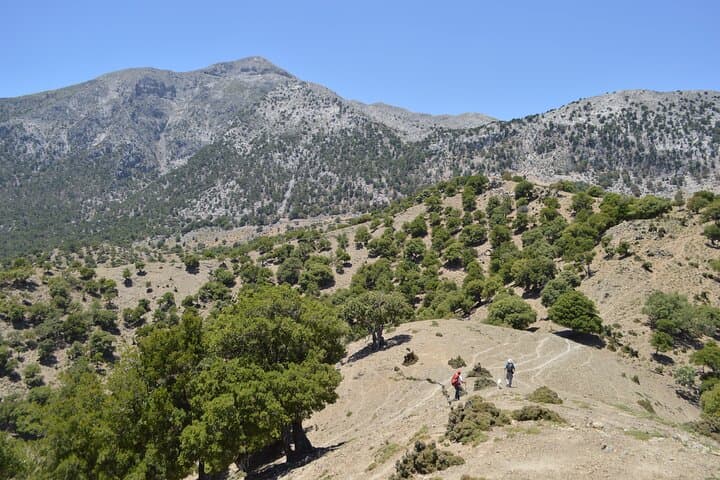
The trail begins as a hush. Morning light threads through a cathedral of broadleaf and holly, dust motes drifting like slow stars. Footsteps sink into a carpet of leaf litter and pine needles; the air smells of wet stone and something older—sap, earth, the mineral tang of springs. Rouvas Gorge doesn’t announce itself with a single grand vista. It reveals itself in sequences: a sudden open shelf of limestone that lets you look down into a valley of green, a resident stream daring you to come closer, a stand of ancient holly trees that seem to lean in and listen. On a private full-day trek through the Saint Nicholas gorge and Rouvas forest, that slow unfolding is the point.
This is Crete at its quieter scale. The hike threads a protected ecosystem that locals and naturalists prize—the forest around Zaros is noted for its population of holly trees and natural springs that have supplied water since antiquity. Geologically, Rouvas is where limestone plateaus give way to deeper cuttings, small canyons carved by millennia of winter runoff. The gorge is not alpine drama; it’s intimate: stone steps smoothed by centuries, mossed boulders that hold small ferns, and channels that funnel the island’s seasonal water toward the valley and the village below. You move through microclimates—sun-drenched clearings, draped beech and pine shades, and humid pockets near the springs—so the day has a natural rhythm that makes the eight-hour outing feel dynamic rather than inert.
Culturally, the route sits within rural Heraklion’s landscape—an area where shepherding and small-scale agriculture still shape rhythms. Zaros, the nearest village, is known locally for its spring waters and lakeside tavernas; for visiting trekkers, it’s a good lunchtime stop or post-hike reward. The private nature of the product on offer means the route can flex: your guide may slow for botanizing, or press on to reach a ridge that rewards you with coastal glimpses on a clear day. Operators list this as an eight-hour activity with private-guide flexibility and instant confirmation—the kind of day that offers both a physical workout and a gentle education in local ecology.
Why do this trek? Because Rouvas feels both rare and accessible. It’s not the crowded Samaria Gorge spectacle; instead, it’s a forested, ecological pocket where you can look closely—at endemic plants, at birdlife, at the slow-moving water that makes Zaros’ springs famous. For travelers who want a full day outdoors without multi-day logistics, it hits a sweet spot: challenging enough to feel earned, forgiving enough for keen beginners who have decent fitness.
What to expect on the ground: trails alternate between well-trodden stone switchbacks and softer, root-crossed singletrack. Expect roughly 8 hours total on a typical private itinerary (including guide time and breaks); many groups cover around 8–12 kilometers with cumulative elevation gain in the range of 400–700 meters depending on the variant chosen. Terrain can be rocky and uneven—sturdy footwear and a steady pace matter. Spring and autumn are the most pleasant months for temperature; midsummer brings sun and heat at lower elevations, while winter can be wet and slippery.
Practical edge: the operator lists a per-group starting price (from USD 597.28) for a private tour—worth noting if you’re traveling with a partner or small group and want a bespoke pace. The booking includes free cancellation and instant confirmation, which is helpful when plans are fluid. Pickup and exact meeting logistics vary by operator—confirm whether transfer from Heraklion or local hotels near Zaros is included. Local guides are invaluable for interpreting flora and fauna, and for keeping the day paced to your group’s fitness.
Safety and stewardship are simple but essential. Stay on the trail to protect fragile undergrowth, pack out all waste, and carry water—the springs are frequent but not guaranteed potable for visitors without local guidance. A midday stop at a village taverna after the hike provides not only a culinary reward (think grilled lamb, Cretan dakos, and local olive oil) but also a way to funnel income back into the community that maintains these trails.
For photographers and curious hikers alike, Rouvas rewards slow observation: look for insect life on damp logs, mosses framing the stream edges, and the play of light through holly leaves. If you want varied terrain without committing to a multi-day trek, this private full-day offers an elegant, contained experience of Crete’s wild interior.
If you go, do so with modest expectations and good gear: the day can be long, the trails unrelenting in places, but the payoff is that intimate, green, and surprisingly cool world that sits tucked into Crete’s spine—a place where water remembers its history and the forest keeps you honest.
Operator notes drawn from the tour listing: private group format, roughly a full day (up to 8 hours), instant confirmation, free cancellation, and a starting price reflected on operator pages. Ask your provider about exact distance, elevation, pickup, and whether the itinerary includes meals or transport to and from Heraklion or Zaros.
Trail wisdom
Small choices, better day.
Start Early
Begin at first light to avoid midday heat and to catch forest light at its best.
Footwear Matters
Wear sturdy hiking shoes with good tread—sections are rocky and rooty.
Hydrate & Filter
Bring 2–3 liters of water and a small filter or purification tablets if you plan to top up from springs.
Hire a Local Guide
A local guide interprets the ecology and adjusts pace for safety and enjoyment.
Local knowledge
Read the place, not just the route.
Watch for native species including Cretan chukar (partridge), Mediterranean passerine birds and occasional reptiles.
Keep an eye out for wildlife during the transition between areas and habitats. Respect distance guidelines.
Rouvas Forest is a protected ecosystem—stay on designated trails, avoid picking plants, and minimize noise to protect nesting birds.
Follow the guide's instructions on size limits, ethical handling, and leave-no-trace practices.
The small freshwater lake near Zaros for a post-hike swim or picnic. A shaded springside taverna in Zaros serving local honey and Cretan dakos
Locally recommended viewpoints and quiet spots known best to local operators.
Zaros has been known since antiquity for its springs; local communities historically depended on this water and the surrounding forest for grazing and wood.
Maritime roots and regional tradition shape the waterways and working coasts.
Seasonal guide
Four versions of the same landscape.
Spring
Best forWildflowers · Cool temperatures · Full springs
ChallengesMud on lower tracks · Changeable weather
Spring offers wildflowers, strong spring flows, and pleasant hiking temperatures—expect occasional muddy sections after rains.
Summer
Best forLong daylight · Dry trails in upper reaches
ChallengesHeat at low elevations · Limited shade on exposed ridges
Summer brings long days but midday heat; start early and plan shaded breaks near springs.
Fall
Best forComfortable temps · Autumn light · Reduced crowds
ChallengesEarly rains possible · Shorter daylight hours
Fall mirrors spring in comfort and color; water levels drop but trails remain pleasant.
Winter
Best forCrisp air · Quiet trails
ChallengesWet, slippery paths · Cold mornings
Winter is quiet and green but can be wet—expect slippery rocks and stream crossings.
Operator details
What the booking data adds.
Included
- ✓Experienced, English speaking trekking guide
- ✓Trekking equipment (trekking poles and backpack) upon request
- ✓Snack pack (energy bar, fruit, water)
- ✓Free transport from/to your hotel with our vans (if you are within the predefined pick-up area)
- ✓Two Bottles of water per person
Not included
- —• Anything that it is not mentioned at the "Price includes" list
Good to know
- ✓Not recommended for pregnant travelers
- ✓Not recommended for travelers with poor cardiovascular health
- ✓Travelers should have at least a moderate level of physical fitness
Pack with intention
What to bring.
Good to know
Common questions.
The operator lists this as a private full-day activity—expect 6–8 hours on trail with moderate terrain and some elevation gain; suitable for hikers with moderate fitness.
Plan the edges
The details that make the day easier.
Zaros’ springs have supplied fresh water since antiquity and the surrounding Rouvas Forest contains holly stands considered of national ecological interest.
After the hike, head to a Zaros taverna for fresh trout or dakos and a local raki; nearby lakeside cafés serve the village’s famed spring water and make a relaxed place to compare trail notes with locals.
- Closest airport
- Heraklion International (HER); Driving distance to Zaros: ~45–75 minutes from Heraklion; Cell service: intermittent in the gorge; Permits: none typically required—confirm with operator.
Rouvas is a sensitive forest ecosystem—pack out all trash, avoid off-trail shortcuts, and hire local guides to support responsible trail stewardship.
Explore by topic
Follow the threads.
Keep exploring
Make the story part of the trip.
Set out from Bass Harbor for a private, customizable day on Blue Hill Bay — lighthouses, puffins, seals, and the chance to feel Acadia from the water. Small groups, local captains, unforgettable views.
In four hours you can move from shaded canyon ferns to wind-scoured coastal ridgelines, guided by someone who knows where the light—and the hidden views—live. This private half-day hike on the Monterey Peninsula or Big Sur is compact, curated, and perfect for travelers who want depth without a multiday commitment.
 Related story
Beneath a sky of shifting light, Skaftafell’s ice reads like a map of time. This three-hour guided glacier hike mixes technical instruction with geology and culture: compact, safe, and unforgettable.