
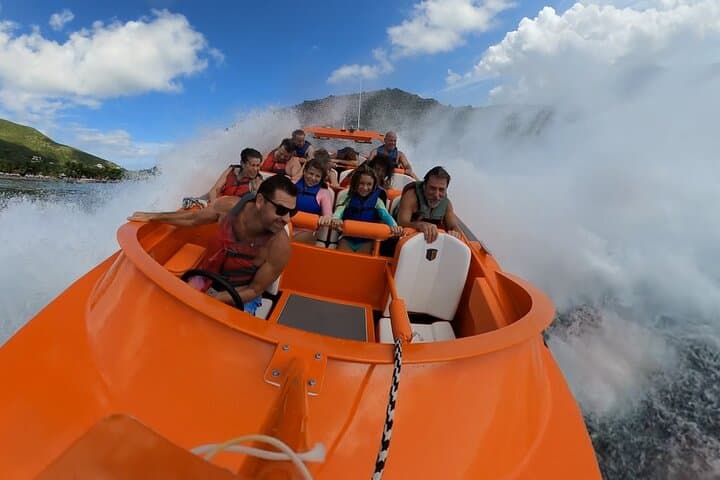
What the day feels like
The Moggaro jet boat cuts the bay like a pen skimming a page—one clean line, then a playful scribble. Salt spray flecks your cheeks, the captain’s laugh rolls over the throttle, and the island’s coastline unfurls in a feverish panorama: black volcanic ridges, pockets of sugar-white sand, and yachts bobbing lazily like punctuation marks. For twenty minutes the water dares you—spin, dive, speed—and you answer.
This is not a slow scenic jaunt. The Extreme Jetboat Advenutre is a short, concentrated blast of motion design built to thrill. The boat was born for these Caribbean seas: the Moggaro’s hull drinks the swell and spits it out in 360-degree arcs, while the skipper times a playful “underwater dive,” when the bow breaches and the stern plows a curtain of spray that cools sun-warmed skin. It’s efficient: two dozen minutes of sustained adrenaline, then applause, smiles, and the smell of salt and engine oil.
Understanding why St. Kitts is the perfect stage for this performance means reading the island’s geological script. Mount Liamuiga, the island’s sleeping volcano, gives the shoreline its dramatic profile—jagged cliffs on the windward side, gentler fringe beaches on the leeward. These coastal contrasts produce protected bays where operators stage high-speed runs and exposed reaches where the ocean stretches into a horizon that looks endless.
Beyond geology there’s a layered human history. St. Kitts’ harbors and coves once sheltered trading sloops and sugar ships; today the same coves host catamarans and jet boats. The island’s colonial past—forged by sugar, slavery, and maritime trade—sits in the shadow of Brimstone Hill Fortress, a UNESCO World Heritage Site and an audient presence visible from some coastal approaches. The modern-moment of tourism here is about balance: active marine experiences woven with respectful local commerce.
Locals add flavor to the technical. You’ll hear the boat crew joke about which racers can take the spin and which prefer a mild wake. Operators tend to be Kittitian: practical, warm, and proud to show off the coast. Expect a quick safety briefing, life jackets that click into place, and a captain who knows precisely when to play showboat and when to throttle back for a view: maybe a tiny green turtle slipping past a buoy, or a fishing boat hauling in a midday catch.
Practicalities matter here. The advertised run is twenty minutes of on-water time; factor in check-in and pre-ride briefing to make the full appointment closer to 30–45 minutes. Cost runs from about $75 per person. The experience is sold as a manual confirmation product with free cancellation in many cases, but check the operator’s policy for weather-related changes. Conditions dictate whether the spins and dives are on the menu: glassy calm invites the greatest theatrics; a bumpy swell will lead to a tamer show.
Suit up smart. Wear a swimsuit or quick-dry shorts under light layers, a strap for sunglasses, and shoes that grip (water shoes or secure sandals). Bring reef-safe sunscreen and a waterproof phone pouch if you plan photos. If you’re prone to motion sickness, a short-acting preventative or a patch is sensible—the jet boat’s choreography includes sudden changes that can unsettle even confident sea-goers.
For photographers the opportunity is split-second—wide-angle captures of the coastline, candid water-sprayed faces, and low-angle shots where the boat’s bow cleaves the frame. Listen to the guide; the best frames are taken on the captain’s cue between maneuvers.
Who should book this? Travelers who like a shot of adrenaline without investing half a day. Families with teens, couples seeking a memory-marker, and cruise passengers with a tight port window will find the duration ideal. It’s not technical: no seafaring license required for guests, though captains are professionals. If you want a longer marine day—snorkel stops, snorkeling reefs, or a sunset cruise—pair this short dose of intensity with a separate, slower-water activity.
Finally, keep an eye on local stewardship. St. Kitts’ reefs and sea life are fragile; responsible operators minimize wakes over sensitive reef patches, avoid anchoring on coral, and follow local wildlife guidelines. As a guest, use reef-safe sunscreen, listen to briefings about protected zones, and never discard trash.
When you step back onto the dock, heart still racing, the island settles around you like a patient companion. The jet boat has done its work: it reorients your day, flips the usual rhythm on its head, and leaves you with one of those small, bright memories—salt in your eyebrows and a grin you can’t wash off. For a pocket-sized injection of pure Caribbean kinetic energy, there’s little that compares.
Trail wisdom
Small choices, better day.
Take motion-sickness meds ahead of time
If you’re sensitive to motion, take a preventative 30–60 minutes before boarding; the ride includes sudden spins and drops.
Secure eyewear and electronics
Use a strap for sunglasses and a waterproof pouch for phones—spray will be constant during spins.
Wear reef-safe sunscreen
Protect your skin and the marine environment with reef-safe sunscreen; apply before boarding.
Listen to the safety briefing
Crew instructions determine seating, hand placement, and timing for maneuvers—follow them for a safer ride.
Local knowledge
Read the place, not just the route.
Watch for native species including Frigatebirds, Sea turtles (hawksbill and green turtles).
Keep an eye out for wildlife during the transition between areas and habitats. Respect distance guidelines.
Operators are increasingly conscious of reef protection; choose companies that avoid anchoring on coral and follow local wildlife guidelines.
Follow the guide's instructions on size limits, ethical handling, and leave-no-trace practices.
Sandy Point’s quiet beaches and nesting areas (seasonal). A series of small northeast coves visible only from the water
Locally recommended viewpoints and quiet spots known best to local operators.
St. Kitts’ coastline once served sugar trade and naval routes; remnants of plantation and fort infrastructure—like Brimstone Hill Fortress—are visible inland and speak to the island’s colonial and maritime past.
Maritime roots and regional tradition shape the waterways and working coasts.
Seasonal guide
Four versions of the same landscape.
Spring
Best forLower crowds · Calmer seas for spins · Better visibility for photos
ChallengesIntermittent showers · Slightly variable winds
Late winter into spring offers warm, stable weather and calm seas—ideal for the boat’s spins and clear coastal views.
Summer
Best forWarmest water temperatures · Lush coastal scenery · Flexible booking
ChallengesHigher humidity · Occasional tropical storms
Summer is hot and humid with potential brief squalls; mornings are usually smoother for high-speed runs.
Fall
Best forQuieter docks · Lower shoulder-season prices · Still-warm water
ChallengesHurricane season risk · Possible choppier seas
Fall brings the tail end of hurricane season—book with flexible cancellation and check weather notices before travel.
Winter
Best forDry-season calm · Best visibility · Peak tourist season amenities
ChallengesHigher prices · Busier marinas
Winter (Dec–Apr) is the dry season—calm seas and consistent sunny days make for the most reliable performance runs.
Pack with intention
What to bring.
Good to know
Common questions.
The on-water experience is about 20 minutes; allow 30–45 minutes total for check-in and briefing.
Plan the edges
The details that make the day easier.
Brimstone Hill Fortress, visible from parts of the St. Kitts coast, is a UNESCO World Heritage Site and one of the best-preserved fortifications in the Caribbean.
After the ride, head into Basseterre for local flavor: grab a bowl of Kittitian goat water stew at a local eatery, sip a cold Carib beer at a beachfront bar in Frigate Bay, or stroll The Circus for street vendors and Caribbean rhythms.
- Closest airport
- Robert L. Bradshaw International Airport (SKB)
- Typical meeting point
- Basseterre marina or Frigate Bay dock
- Driving distance from Basseterre downtown
- 5–15 minutes
- Cell service
- reliable near shore, may drop offshore
- Permits
- none required for tourists; operator holds necessary marine licenses
This coastline includes sensitive coral habitats—use reef-safe sunscreen, do not discard trash overboard, and choose operators committed to no-anchoring-on-reef policies.
Explore by topic
Follow the threads.
Keep exploring
Make the story part of the trip.
Set out from Bass Harbor for a private, customizable day on Blue Hill Bay — lighthouses, puffins, seals, and the chance to feel Acadia from the water. Small groups, local captains, unforgettable views.
In four hours you can move from shaded canyon ferns to wind-scoured coastal ridgelines, guided by someone who knows where the light—and the hidden views—live. This private half-day hike on the Monterey Peninsula or Big Sur is compact, curated, and perfect for travelers who want depth without a multiday commitment.
 Related story
Beneath a sky of shifting light, Skaftafell’s ice reads like a map of time. This three-hour guided glacier hike mixes technical instruction with geology and culture: compact, safe, and unforgettable.