
What the day feels like
You arrive to a sky that feels borrowed from a sea painter — thin, cool, and honest. The road from Bar Harbor climbs and curves through spruce and fir, each tree leaning like a spectator toward the ocean. In a single morning on the Bar Harbor Premium Tour with Cadillac Mountain and Acadia Park you trade town cobblestones for coastal cliff wind, granite ridgelines and a lobster roll eaten with your fingers while the water does the rest of the talking.
This is not a slog-hike; it’s a concentrated, curated slice of Mount Desert Island. The van picks you up in Bar Harbor and, within minutes, you’re in the protective, pine-scented quiet of Acadia National Park. Your first stop—Sieur de Monts Spring—feels like the park’s living room: boardwalks, shaded water, wildflowers and an exhibit that ground you in the human and natural history you’re about to see. Keep that memory, because it frames what comes next.
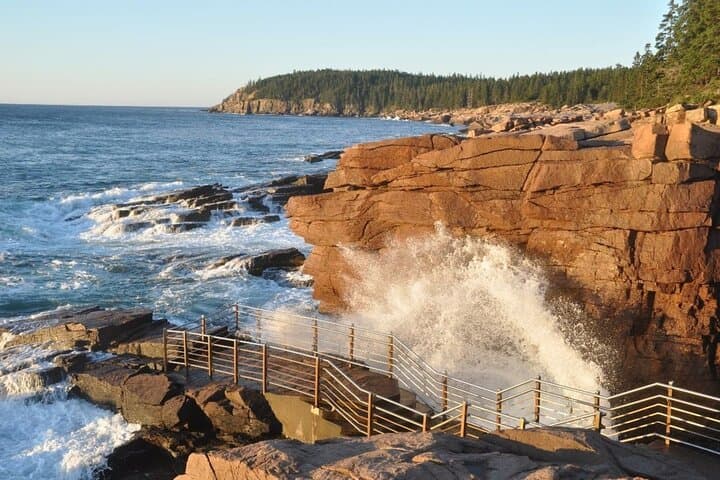
From there the road sings toward the coast. Thunder Hole is less a destination than a demonstration. At the right tide, Atlantic surf hurls itself into a narrow cleft in the granite, exploding in a plume of spray and a percussion you can feel in your chest. It’s dramatic on purpose, and the guides time the visit to show you the spectacle at its loudest. Nearby Otter Cliff drops off with theatrical nonchalance—sheer granite faces that attract climbers and seabirds, and where the horizon is an unending audition for light.
The crown jewel is Cadillac Mountain. At 1,530 feet it’s the highest point on the U.S. Atlantic coast; on clear days it gives an almost ruthless, honest view of the archipelago of islands, peninsulas and water that define Maine. Guides pause on the summit and point to the landmarks you’ll visit next—the polished mirror of Jordan Pond, the road that hugs the shoreline—and stitch them into a single, coherent story of geology and human use.
Jordan Pond is the tour’s soft landing. A short, gentle walk along the lake’s rim shows why artists and visitors have loved this place for centuries: glassy water reflecting blue spruce, granite ledges worn soft by ice and rain, and that famous pause—Jordan Pond House—where popovers and lobster rolls have become a local rite. The guide arranges a meal on the patio and it’s meant to be slow: you’ll eat, look, and let the afternoon settle.
Interwoven with the scenery is history. The bedrock here is ancient—silvery granite scraped and scoured by glaciers—and you can read a millennia in the coastline’s curves. The Wabanaki peoples lived on these islands long before summer visitors arrived; historic sites and place names around the park speak to those deep human connections. In the last two centuries, Acadia became a place of preservation and recreation, a laboratory for conservation and for Americans learning to value public lands.
Practical matters: the tour is four hours long with about two hours driving time between stops, and it’s designed for an easy-to-moderate level of exertion. If you’re looking to compress an Acadia highlights list into a single morning with thoughtful context, this is it. Booking includes pickup in Bar Harbor, a guided route timed for tides and light, and—crucially—a local guide who knows when to slow the van, when to linger at a viewpoint and where to get the best lobster roll.
What the tour gives you is perspective—geological, cultural and gastronomic—in an approachable package. You’ll come home with a dozen images, a handful of names to look up, and a clearer sense of how coastline and climate, geology and human history have layered here.
If you want to deepen the experience, your guide can recommend a longer hike—like the Cadillac Summit loop or the Jordan Pond Path (the latter is roughly 3.3 miles if you take the full loop)—or point out quiet coves away from the main viewpoints. And if the high tide’s scheduled to show off Thunder Hole, be prepared: the ocean will make its presence known. For a fuller preview and to compare routes, check out local expert info on <a href="https://app.advcollective.com/local-experts/explore-bar-harbor-cadillac-mountain-thunder-hole-acadia-coastal-wonders">Bar Harbor & Acadia Coastal Wonders</a>.
Why book it? For many visitors, Acadia is logistically tricky — narrow roads, seasonal parking crunches, and tide-dependent spectacles. This tour removes those headaches and adds historical context, a curated route timed for light and tides, and a local guide who can make the day both efficient and intimate. It’s ideal for travelers with limited time who want a meaningful, sensory-rich introduction to island life, coastal geology and Maine’s lobster culture.
If you go: plan for wind on the summit and sun at Jordan Pond; bring layers and sensible shoes; bring a camera (or your phone) with charged batteries; and be ready to eat a popover in full appreciation mode. For more planning and to book a guided experience that ties these stops into a single, seamless morning, explore local expert options at <a href="https://app.advcollective.com/local-experts/explore-bar-harbor-cadillac-mountain-thunder-hole-acadia-coastal-wonders">Bar Harbor & Acadia Coastal Wonders</a>.
This tour isn’t about conquering distance; it’s about making a handful of places memorable. Four hours, some good local storytelling, a legal lobster roll and the Atlantic beating the rocks—enough to make you want to come back and explore the rest of the island on your own terms.
Trail wisdom
Small choices, better day.
Time Thunder Hole with the tide
Ask your guide for the high-tide window—Thunder Hole’s drama is tide-dependent and best within an hour of peak.
Layer for summit wind
Cadillac’s elevation exposes you to strong gusts even on warm days—bring a windproof layer.
Wear sturdy shoes
Paths around Otter Cliff and Jordan Pond can be uneven; trail shoes with good grip are ideal.
Bring binoculars
A small pair helps spot seabirds, seals, and the intricate geology along the coast.
Local knowledge
Read the place, not just the route.
Watch for native species including Harbor seals, Peregrine falcons.
Keep an eye out for wildlife during the transition between areas and habitats. Respect distance guidelines.
Acadia experiences heavy visitation—stay on marked trails, pack out trash, and follow seasonal closures to protect fragile coastal and alpine habitats.
Follow the guide's instructions on size limits, ethical handling, and leave-no-trace practices.
The quieter side of Sand Beach for tidal pools and photo opportunities. Short walk to the Bowl area off the Jordan Pond Path for reflective lakeshore shots
Locally recommended viewpoints and quiet spots known best to local operators.
Acadia’s landscape was shaped by glaciers; European summer estates in the late 19th century helped drive early conservation efforts that led to the park we visit today.
Maritime roots and regional tradition shape the waterways and working coasts.
Seasonal guide
Four versions of the same landscape.
Spring
Best forWildflower blooms · Quiet trails · Migratory birds
ChallengesUnpredictable weather · Cooler water temperatures
Late spring softens the island after winter: fewer crowds and fresh greenery, but bring waterproof layers for changeable conditions.
Summer
Best forWarm weather · Extended daylight · Full service at Jordan Pond House
ChallengesCrowds and parking · Higher prices
Summer offers the most services and long days—book early and expect busy viewpoints during peak hours.
Fall
Best forFall foliage · Cooler light for photos · Fewer crowds
ChallengesShorter daylight · Variable weather
Autumn is peak scenic value—the island turns crimson and gold—just dress warm and plan for earlier sunsets.
Winter
Best forSnowy landscapes · Solitude · Sea-ice photography opportunities
ChallengesLimited road access · Closed facilities · Icy conditions
Winter is quiet and dramatic but many park services are closed; this tour is primarily seasonal and limited in winter.
Operator details
What the booking data adds.
Included
- ✓Complimentary Downtown Hotel Pick-Up and Drop-Off
- ✓See Sieur de Monts Spring, Thunder Hole, Otter Cliff, and Jordan Pond
- ✓Fully Narrated Tour By A Local Guide
- ✓Cadillac Mountain (Admission Included)
- ✓Small Group Tour (Max 7 Guests)
Not included
- —Gratuities (optional)
- —NPS Non-US Resident Park Entrance Fee
Good to know
- ✓Wheelchair accessible
- ✓Infants and small children can ride in a pram or stroller
- ✓Service animals allowed
- ✓Public transportation options are available nearby
- ✓Transportation options are wheelchair accessible
- ✓Suitable for all physical fitness levels
- ✓the remaining time is allotted for transportation between stops and is included in the total duration.
Pack with intention
What to bring.
Good to know
Common questions.
The tour lasts about four hours and includes guided stops at Sieur de Monts Spring, Thunder Hole, Otter Cliff, Cadillac Mountain and Jordan Pond, with local commentary and a lobster roll or popover at Jordan Pond House included.
Plan the edges
The details that make the day easier.
Cadillac Mountain is the highest point on the U.S. Atlantic coast at about 1,530 feet and is among the first places in the U.S. to see sunrise for part of the year.
After the tour, head to Jordan Pond House for classic popovers, then explore downtown Bar Harbor for seafood shacks and craft beer—Atlantic Brewing Company and small lobster shacks offer a relaxed end to the day.
- Closest airport
- Hancock County–Bar Harbor Airport (BHB) or Bangor International Airport (BGR, ~1.5 hrs drive); Driving distance from Bar Harbor: 5–30 minutes to stops; Cell service: patchy in parts of Acadia; Permits: Acadia park entrance fee or pass may be required
Acadia is a high‑use park—pack out all trash, stick to marked trails, avoid feeding wildlife, and support local businesses to keep tourism sustainable.
Explore by topic
Follow the threads.
Keep exploring
Make the story part of the trip.
Set out from Bass Harbor for a private, customizable day on Blue Hill Bay — lighthouses, puffins, seals, and the chance to feel Acadia from the water. Small groups, local captains, unforgettable views.
In four hours you can move from shaded canyon ferns to wind-scoured coastal ridgelines, guided by someone who knows where the light—and the hidden views—live. This private half-day hike on the Monterey Peninsula or Big Sur is compact, curated, and perfect for travelers who want depth without a multiday commitment.
 Related story
Beneath a sky of shifting light, Skaftafell’s ice reads like a map of time. This three-hour guided glacier hike mixes technical instruction with geology and culture: compact, safe, and unforgettable.