
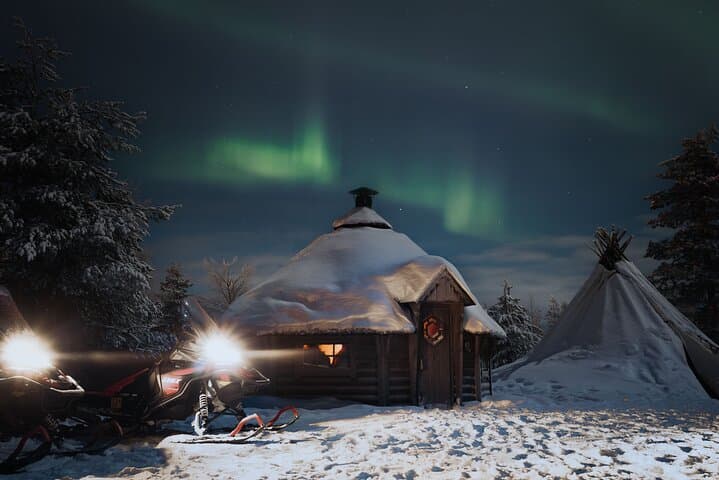
What the day feels like
The engine chatter settles into a steady hum and the world narrows to a ribbon of headlight cutting through spruce and birch. Ice breath clouds in front of your visor; the snow beneath the sled sings a thin, metallic note. Then the sky shifts—first a pale smear, then a slow green ribbon, then a curtain of light folding and unfolding above the forest. For four wild hours outside Rovaniemi, you are moving through a landscape that seems to have been designed to show off the aurora, and the only way to keep up is to keep the throttle open.
This isn’t a documentary stop-and-stare moment. It’s a campaign: you and a handful of other riders, guided by a local expert, pushing across frozen lakes and backcountry trails in pursuit of something that usually arrives without a schedule. The trip advertised as the "Northern lights safari by snowmobile" is equal parts mechanical intimacy and celestial payoff—an active, dark-sky strategy for anyone who wants to chase the aurora rather than wait for it.
Lapland’s weather, terrain and light all conspire to make this possible. Geologically, you’re riding across the ancient bedrock of Fennoscandia—granite and gneiss scoured by the last ice age and dotted with glacial lakes that turn to mirrors in the cold. The region’s proximity to the magnetic pole means auroral activity is stronger and more frequent than farther south, and the wide-open spaces around Rovaniemi give photographers uninterrupted horizons.
There’s a cultural layer here, too. Lapland is Sámi country; the land and its rhythms remain central to Sámi identity, from reindeer herding routes that date back centuries to modern storytelling about the lights. Local guides often weave short lessons into the ride—how to read weather for breaks in cloud cover, or a Sámi explanation for the dancing sky—making the chase also a lesson in place. If you want more context on the experience and local operators, see this local-experts link that outlines the basics of chasing the aurora by snowmobile.
The practical anatomy of the trip is straightforward. Most operators run launches from Rovaniemi and return you the same evening. The posted itinerary is about four hours, which includes safety orientation, a guided route that adapts to conditions, and a break for a fireside BBQ or hot drink where you warm up and compare sightings. The actual mileage will vary—expect anywhere from 20–60 kilometers on groomed and ungroomed trails. The degree of difficulty is moderate: you’re sitting on a fast, light vehicle on uneven surfaces at night, so basic coordination and cold tolerance matter.
Timing matters. The aurora season runs from late August through March, but prime months are the deep winter months when nights are longest and air is driest—December through February. Cloud cover is the real enemy; operators often scan forecasts and reposition on the fly, using clear-sky windows to maximize chances.
Safety is a practical art here: listen to your guide, keep a safe distance between sleds, and leave personal pride at the trailhead—if conditions are poor, the guide will reroute or stop. Dress for the Arctic like it’s a job: insulating base layers, a windproof outer shell, mittens, and a helmet with balaclava. Phones die fast in the cold, so carry spare batteries for cameras and a personal fuel source for heat packs.
For photographers the night is a study in restraint and preparation. Bring a sturdy tripod and a wide, fast lens (24mm f/2.8 or wider); set exposure times between 5–20 seconds depending on auroral intensity and use manual focus with live view on a distant light. Handheld aurora shots are possible, but if the guide stops at a black-sky overlook, set up the tripod and use a remote or 2-second delay to avoid shake. The local-experts page linked earlier has a practical primer if you’re new to aurora photography and want pointers specific to snowmobile safaris.
There’s a reason snowmobiling is the vehicle of choice: it’s nimble and allows guides to cover more ground quickly when a patch of clear sky opens. But that mobility carries responsibilities—respect wildlife (including reindeer herds), stay on designated trails to protect winter vegetation and minimize impact, and opt for operators who follow local sustainability practices.
What you’ll take home is both literal and ineffable: a handful of long-exposure images, a chilled-memories grin, and the satisfaction of having actively pursued one of the planet’s great natural light shows. The whole experience manages to be both rugged and intimate—enough adrenaline to feel earned but still quiet enough to notice the slow, patient way the sky dances.
If you plan to book, lean on local operators for weather-savvy scheduling, and come prepared to be flexible. The lights don’t run on your timetable, but with a reliable guide and a warm helmet, you’ll give yourself the best possible shot at seeing them.
Trail wisdom
Small choices, better day.
Dress for the Arctic
Layer merino base, insulating mid-layer and a windproof shell; mittens and a balaclava are essential to protect exposed skin.
Bring Spare Batteries
Cold drains batteries fast—carry spares for cameras and phones in an inner pocket close to your body.
Listen to Your Guide
Guides choose routes for safety and aurora visibility—follow instructions on distance, speed, and stopping points.
Use a Tripod for Photos
If your operator stops for a clear-sky view, set up a tripod and use long exposures for crisp aurora shots.
Local knowledge
Read the place, not just the route.
Watch for native species including Reindeer, Arctic hare.
Keep an eye out for wildlife during the transition between areas and habitats. Respect distance guidelines.
Choose operators who stay on marked trails to protect fragile winter vegetation and who limit noise near wildlife corridors.
Follow the guide's instructions on size limits, ethical handling, and leave-no-trace practices.
Drive to a frozen-lake overlook for uninterrupted northern-horizon views. Ask guides about small Sámi cultural stops or a chance to meet reindeer herders
Locally recommended viewpoints and quiet spots known best to local operators.
Rovaniemi grew rapidly after WWII and has become the gateway to Finnish Lapland; Sámi culture and reindeer herding remain central to the region's identity.
Maritime roots and regional tradition shape the waterways and working coasts.
Seasonal guide
Four versions of the same landscape.
Spring
Best forLonger daylight for mixed activities · Chance of late-season aurora displays
ChallengesVariable snow conditions · Unpredictable meltwater on trails
Early spring can still produce auroras but trails may be slushy; expect more daylight and changing trail quality.
Summer
Best forNot applicable for aurora chases · Daylight sightseeing and midnight sun activities
ChallengesNo aurora visibility during midnight sun · Snowmobile tours generally not available
Aurora viewing isn’t possible in summer; snowmobile safaris do not operate in the midnight-sun season.
Fall
Best forClear crisp nights early in the season · Fewer crowds and lower prices
ChallengesEarly snow inconsistent · Shorter season with variable road conditions
Fall marks the start of aurora season; nights lengthen but trail conditions can be unpredictable until solid freeze.
Winter
Best forPrime aurora visibility · Reliable snowmobile conditions
ChallengesExtreme cold and short daylight · High demand—book ahead
Mid-winter is the optimal time for snowmobile aurora hunts: stable snow, long nights and frequent displays.
Operator details
What the booking data adds.
Included
- ✓Transfer from selected locations in Rovaniemi
- ✓Winter Clothes (overall, boots, gloves and balaclava)
- ✓Professional guide
- ✓Warm juice and biscuits by campfire
- ✓Snowmobiling equipment (helmet)
Not included
- —Travel insurance and other emergencies
- —Liquors, beers and bottled beverages
- —Photography accessories like cameras etc.
- —Hotel pickup and drop off
Good to know
- ✓Public transportation options are available nearby
- ✓Specialized infant seats are available
- ✓Not recommended for travelers with spinal injuries
- ✓Not recommended for pregnant travelers
- ✓Not recommended for travelers with poor cardiovascular health
- ✓Suitable for all physical fitness levels
- ✓Please note: in order to drive a snowmobile, a valid drivers license is required. We are not able to accept a picture of the license or provisional driving license.
- ✓2 adults share 1 snowmobile, single driving is available on site for 50€ (according to availability)
- ✓Children and adults without a drivers’ license can join the safari by sitting on the sledge. We recommend one of the parents to sit with a small child in the sledge for the child’s safety.
- ✓If a child over 140 cm wishes to sit in a snowmobile as a passenger, a full adult price will be charged (according to availability).
- ✓Northern lights are subject to weather conditions, so they are not guaranteed.
- ✓The snowmobile driver is responsible for any damages to the vehicle, with a personal self-liability of 950€ per person per snowmobile in case of an accident. Additional insurance can be purchased on site for 15€, reducing self-liability to 150€. This insurance must be purchased before the start of the tour.
- ✓Tour operator won't cancel the activity according to the weather conditions. Please check the weather forecast couple of days before the activity start.
Pack with intention
What to bring.
Good to know
Common questions.
Temperatures can range from -5°C to -30°C (23°F to -22°F) depending on the month; dress in layers and bring windproof outerwear.
Plan the edges
The details that make the day easier.
Rovaniemi lies just south of the Arctic Circle and is officially where Santa Claus Village is located; the region also experiences polar night north of the circle in deep winter, offering prolonged dark skies ideal for aurora viewing.
After the ride, warm up with traditional Lappish fare in Rovaniemi—try reindeer stew or Arctic char at a local restaurant, or seek out a brewery for a craft beer and swap photos with your guide.
- Closest airport
- Rovaniemi Airport (RVN)
- Driving from Rovaniemi center
- 10–40 minutes depending on meeting point
- Cell service
- intermittent in remote areas, but functional near towns
- Permits
- none for typical guided tours—always use licensed operators
Stick to designated trails to protect tundra and winter vegetation; choose operators that follow local wildlife guidelines and minimize noise and light pollution.
Explore by topic
Follow the threads.
Keep exploring
Make the story part of the trip.
Set out from Bass Harbor for a private, customizable day on Blue Hill Bay — lighthouses, puffins, seals, and the chance to feel Acadia from the water. Small groups, local captains, unforgettable views.
In four hours you can move from shaded canyon ferns to wind-scoured coastal ridgelines, guided by someone who knows where the light—and the hidden views—live. This private half-day hike on the Monterey Peninsula or Big Sur is compact, curated, and perfect for travelers who want depth without a multiday commitment.
 Related story
Beneath a sky of shifting light, Skaftafell’s ice reads like a map of time. This three-hour guided glacier hike mixes technical instruction with geology and culture: compact, safe, and unforgettable.