
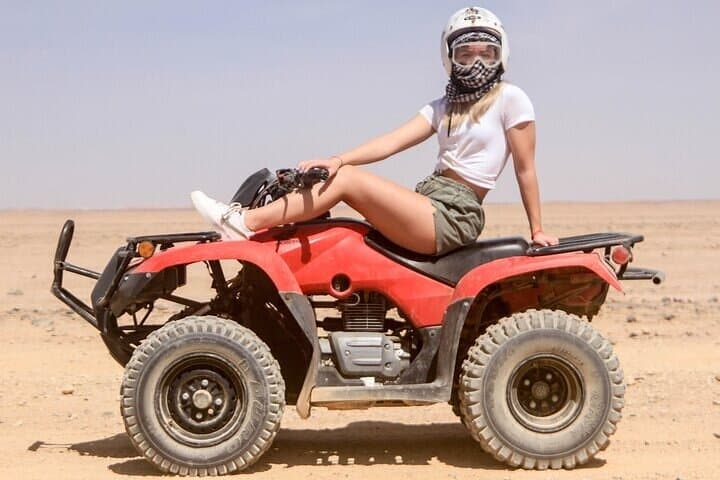
What the day feels like
The morning light in the Eastern Desert slices the horizon clean—thin, white and merciless against the ripple of sand. Engines cough to life, and for a moment the desert seems to hold its breath. Then a convoy of ATVs eases into a rhythm, tires carving temporary signatures across the dunes as a single camel caravan ambles like a punctuation mark in the distance. That contrast—speed and stillness, machine and beast—is the quiet promise of a three‑hour safari outside Marsa Alam.
This is not a theme‑park drift through dunes. The tour stages two very different ways to know the desert. First comes the ATV leg: a short briefing, helmets adjusted, and the exhilaration of acceleration up and over wind‑sculpted ridgelines. Tracks drop you into wide bowls where the light pools, each crest delivering a view of the coast’s distant shimmer and the inland plain that unfolds toward Wadi El Gemal National Park. After the throttle cools and the group convenes, the pace changes. A handful of local camel handlers lead the animals on a low, hypnotic walk—an interlude of tradition and time. A thermos of sweet tea makes the transition formal: you drink, listen to guide‑told stories of Bedouin life, and let the desert expand around you.
Geologically, the landscape you ride across is part of the Egyptian Eastern Desert, an ancient marine plateau pushed up and eroded into the corrugated dunes and rocky wadis you see today. Centuries of trade and migration have threaded this land; Bedouin tracks and camel paths predate the four‑wheel exhaust we now use to visit them. The close proximity to the Red Sea means your desert experience is hybrid: salt air on one horizon, timeless sand on the other. Local guides often point out quartz pebbles, the occasional bit of fossilized shell, or the black scars of basalt outcrops—small evidence of a much older geological story.
Culture is part of the ride. Your hosts are often from communities linked to the coast and the nearby protected lands; they bring stories about Bedouin navigation, how to read the wind, and how camels were integral to trade before paved roads arrived. The camel segment is not a novelty prop; it’s a restrained cultural framing—an opportunity to slow down and notice details: the sound of padding feet, the hiss of wind through coarse grasses, and the guides’ careful handling of their animals.
Practicalities matter here. The tour runs roughly 3–4 hours door‑to‑door, including hotel transfers. The ATV section is beginner friendly but requires basic coordination; expect bursts of adrenaline and sections of soft sand that demand throttle control and momentum. The camel walk is gentle and low impact, suitable for most travelers who can mount with assistance. There’s no heavy elevation gain—this is desert travel, not alpine climbing—but sun exposure and heat are the real considerations.
Why do this trip? For the range it offers in a compact window: one hour of heart‑pounding ATV dune runs, followed by an hour of contemplative camel pacing, plus time for tea and photos. It’s efficient storytelling—the arc of an active morning that gives you both the powder‑streaked grin of an off‑road sprint and the slow satisfaction of a traditional, human‑powered journey. For independent travelers with limited time in Egypt, it maximizes sensory variety without requiring a day’s commitment.
Timing and gear are simple but important. Start early to avoid the desert’s heat peak. Bring sun protection, breathable layers, sturdy closed shoes for ATV control, and sunglasses that clip in for sand. Hydration is nonnegotiable; guides usually supply water and tea, but carry a small reusable bottle and sip often. Leave flip‑flops to the resort concierge—sand eats them and the dunes will betray you.
On conservation: the Eastern Desert is ecologically fragile. Stick to guide‑directed tracks to limit scarring, avoid litter, and treat camel handlers and their animals with respect—ask before photographing close up. Responsible operators balance the thrill of an ATV with local livelihoods; book companies that hire local guides and contribute to the community economy.
If you’re picturing the afterglow, plan your time in Marsa Alam accordingly. A seafood dinner in Port Ghalib or a beer at a simple beach café offers a satisfying contrast: salt on the tongue after desert dust on your shoes. For photographers, the low angle of light during the golden hour makes ripples in the sand read like topographic maps; on the flip side, noon flattens everything and emphasizes color—contrasts you can exploit for dramatic images.
This safari works well as an introduction to Egypt’s desert side: it’s accessible, visually diverse, culturally anchored, and logistically straightforward. It’s not an expedition into remote solitude—cell signals may cut in and out—but it is a well‑crafted three‑hour story that leaves you with adrenaline, tea, and a clearer sense of why the desert still calls to travelers.
If you want louder engines, longer rides, or multi‑day trekking, plan a different itinerary; but if you want a compact, authentic desert taste—equal parts adrenaline and hush—this Marsa Alam ATV and camel combo is one of the most effective mornings you can buy.
Practical snapshot: 3 hours total; ATVs and camels supplied; hotel transfers typically included; cost from USD 20; best to book in advance in high season (Oct–Apr).
Trail wisdom
Small choices, better day.
Hydrate before you go
Drink water during transfer and carry a small reusable bottle—desert heat can dehydrate quickly even on short trips.
Bring sun protection
Use a wide‑brim hat under your helmet, high‑SPF sunscreen, and UV‑blocking sunglasses to protect against reflected sand glare.
Wear closed shoes
Sturdy trainers or light hiking shoes give better control on ATVs and protect feet while mounting camels.
Follow your guide’s route
Stick to designated tracks to protect fragile desert vegetation and avoid getting lost in featureless terrain.
Local knowledge
Read the place, not just the route.
Watch for native species including Desert fox (Fennec or Rüppell’s fox) seen rarely at dusk, Various desert lizards and migratory birds near wadis.
Keep an eye out for wildlife during the transition between areas and habitats. Respect distance guidelines.
The area sits near Wadi El Gemal National Park; respect guide tracks, pack out trash, and support operators who hire locally to reduce impact.
Follow the guide's instructions on size limits, ethical handling, and leave-no-trace practices.
A quiet outlook point used by guides for panoramic sunrise photos. A small oasis/behind a rocky wadi where Bedouin tea stops take place
Locally recommended viewpoints and quiet spots known best to local operators.
The Eastern Desert was historically a route for caravan trade to the Red Sea; Bedouin communities have navigated these sands for generations.
Maritime roots and regional tradition shape the waterways and working coasts.
Seasonal guide
Four versions of the same landscape.
Spring
Best forMilder temperatures · Wildflowers in wadis
ChallengesOccasional strong winds · Dusty conditions
Spring brings gentler temperatures and occasional floral bursts in sheltered wadis, though wind can stir up sand during afternoon runs.
Summer
Best forSunlight for photos · Low crowds
ChallengesExtreme heat · Midday rides can be uncomfortable
Summer is hot and best avoided for strenuous midday activity; early morning departures can still work for heat‑tolerant travelers.
Fall
Best forComfortable temperatures · Longer daylight hours
ChallengesPopular season—book ahead · Occasional coastal humidity
Fall is ideal: warm days and cooler mornings make for pleasant riding and camel walks, with reliable light for photography.
Winter
Best forCooler mornings · Clear skies
ChallengesChilly early starts · Night temperatures can drop
Winter mornings are brisk and comfortable for ATVs; pack a light insulated layer for transfers and early starts.
Pack with intention
What to bring.
Good to know
Common questions.
No—brief safety instruction is given and routes are chosen for mixed ability groups; basic coordination helps.
Plan the edges
The details that make the day easier.
Marsa Alam is the gateway town to Wadi El Gemal National Park, a protected area known for its desert landscapes and Red Sea coastline.
After the safari, head to Port Ghalib marina for seafood restaurants and sunset views; try a local Bedouin tea experience at a small café to connect with the guides’ culture.
- Closest airport
- Marsa Alam International Airport (RMF); Driving distance from nearest town: transfers typically 20–60 minutes from Marsa Alam resorts; Cell service: intermittent in dunes; Permits: none required for this commercial tour.
Stick to guide‑directed routes to minimize disturbance to fragile desert ecosystems, pack out all trash, and choose operators who employ local guides and respect camel welfare.
Explore by topic
Follow the threads.
Keep exploring
Make the story part of the trip.
Set out from Bass Harbor for a private, customizable day on Blue Hill Bay — lighthouses, puffins, seals, and the chance to feel Acadia from the water. Small groups, local captains, unforgettable views.
In four hours you can move from shaded canyon ferns to wind-scoured coastal ridgelines, guided by someone who knows where the light—and the hidden views—live. This private half-day hike on the Monterey Peninsula or Big Sur is compact, curated, and perfect for travelers who want depth without a multiday commitment.
 Related story
Beneath a sky of shifting light, Skaftafell’s ice reads like a map of time. This three-hour guided glacier hike mixes technical instruction with geology and culture: compact, safe, and unforgettable.