
What the day feels like
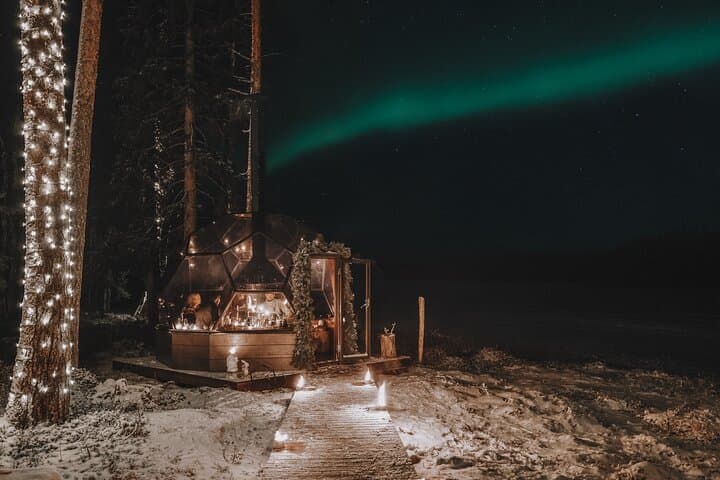
The glass dome smelled faintly of smoke and spruce—wood smoke that belonged to the lake, to a place where fire and sky still negotiated the night. Through curved panes, the boreal horizon sat low and patient; treetops in silhouette waited like an audience. When the first curl of green unfurled above the trees, it didn’t so much appear as respond, sliding and stuttering as if the sky had heard the crackle of the campfire and decided to join.
Thirty kilometers from the tidy streets of Rovaniemi, the Northern Lights dinner in a Glass Igloo is an exercise in gentle extremity: you are cocooned in comfort—the heat of the fire, a steaming bowl of reindeer stew passed across a wooden platter—while outside the Arctic night performs in ways your phone screen can only attempt to capture. The experience is equal parts theatre and geology: a handmade igloo with glass walls, a campfire where local cooks braise root vegetables and smoke fish, and an aboveground dome of luminous weather that has been shaping northern life for millennia.
Lapland’s landscape reads like a slow book of ice and time. The lakes and low ridges that cradle the igloo were carved by the last Ice Age, its glaciers grading the bedrock into rounded hills and scoured basins that now hold mirror-calm water. The boreal forest—pine, birch, spruce—protects the shoreline, a dark velvet that lets the aurora appear all the more vividly. The lights themselves are charged particles interacting with Earth’s magnetic field; here at the rim of the Arctic Circle, the collisions are close enough to feel intimate.
There’s culture braided into the itinerary. You eat Lapland: simple, direct, fired over open flame—local cheeses, slow-cooked reindeer, flatbreads, and for dessert, cloudberries folded into cream. Those meals are not mere sustenance but a conversation with place. The Sami, Lapland’s indigenous people, have long read the sky and the land—reindeer routes, seasonal cycles, and weather patterns—and while this experience is a tourist product, it borrows from those colder, essential ways of living. Rovaniemi itself is a post-war city rebuilt from ruin; it’s a mixture of modern tourist infrastructure and stubborn northern traditions.
Why book something so deliberately staged? Because it works. The igloo gives you a front-row seat without the bone-deep chill of sleeping rough. The private dinner keeps the experience intimate; the guides know dark-sky pockets and can relocate you if clouds threaten. Practical details matter here: the venue sits roughly 30 kilometers from Rovaniemi, transfers typically accommodate private transport, the whole experience runs about three hours, and you should expect to pay from USD 399 per person. It’s not cheap—this is a curated, small-group/private evening designed to maximize comfort and the odds of seeing the aurora.
If you go, bring intention as much as gear. Layers are everything—merino next to the skin, a mid-layer fleece, and a down or synthetic outer shell. Winter boots with good insulation and grip keep you moving between the car, the igloo, and the shoreline. A camera with manual controls and a tripod will reward you; but if your goal is memory rather than a postcard, let your eyes do the photographing. Keep your headlamp on low or use a red filter to preserve night vision and the mood.
Timing is a pragmatic art. The aurora season here stretches from late August to April, but the clearest, coldest nights often come in February and March—long enough nights to increase your chances, but with air sharp enough for stellar visibility. Cloud cover is the wild card: a guide who monitors weather and local forecasts will be your biggest asset. Be prepared for variability. On some nights the sky is generous; on others you dine under a piling of stars.
The practical side has its own small comforts. The igloos are heated; glass walls cut drafts and send the northern panorama right into your lap. The dinner is prepared outdoors but served warm, with flavors that read of smoke and mountain herbs. Expect to spend about three hours on the excursion—enough time to dress, travel, eat, and watch—but if you are the sort who wants to linger, ask about staying longer or booking a follow-up night under darker skies.
There’s a conservation thread running through the evening. Light pollution is the enemy of aurora watching; operators tend to choose remote shorelines for their low-light profiles. Respect the land: stick to paths, don’t feed wildlife, and minimize plastic and packaging. The best souvenir is a memory—leave the place as you found it.
This is not an adrenaline trip. It’s a well-executed, sensory-rich encounter with one of the planet’s most humbling phenomena: you are small, the night is capacious, and for a few hours the sky gives you a private performance. For travelers who value warmth and authenticity over hardship, who want the thrill of the aurora without the discomfort of a tundra bivy, a glass-igloo dinner is a rare and generous compromise. And when the curtains of light unfurl, when color leaks into the long winter night, you will understand why people keep returning to this latitude to sit, to watch, and to feel the sky answer back.
Trail wisdom
Small choices, better day.
Dress in layers
Merino base layer, warm mid-layer, and a windproof insulated shell will keep you comfortable during transfers and outdoor pauses.
Bring a tripod
A sturdy tripod and a camera with manual settings are essential for crisp aurora photos on long exposures.
Protect electronics
Cold drains batteries fast—carry spares in an inside pocket and keep gear warm between shots.
Leave extra time
Plan buffer time for late arrivals and moving between vehicle and igloo—snow surfaces slow transit.
Local knowledge
Read the place, not just the route.
Watch for native species including Reindeer, Moose (elk).
Keep an eye out for wildlife during the transition between areas and habitats. Respect distance guidelines.
Operators avoid lit areas and encourage guests to minimize waste—respect reindeer grazing lands and avoid disturbing shoreline habitats.
Follow the guide's instructions on size limits, ethical handling, and leave-no-trace practices.
Ounasvaara hill trails for a daytime viewpoint. Korkalovaara lookout for quieter sunset vistas
Locally recommended viewpoints and quiet spots known best to local operators.
Rovaniemi was extensively rebuilt after World War II; the city and surrounding Lapland have long histories of Sami reindeer herding and seasonal migration.
Maritime roots and regional tradition shape the waterways and working coasts.
Seasonal guide
Four versions of the same landscape.
Spring
Best forTransition weather · Longer nights early spring
ChallengesVariable snowpack · Thawing mud on trails
Late winter to early spring can offer stable skies and milder evenings; still bring winter-rated gear as temperatures can drop.
Summer
Best forMidnight sun experiences · Daytime lake activities
ChallengesNo aurora · Short nights
Summer in Lapland is beautiful but not suitable for aurora viewing; glass-igloo dinners are generally a winter offering.
Fall
Best forAurora season start · Crisp, clear nights
ChallengesUnpredictable weather · Cooling temperatures
Fall brings the return of long nights and early auroras; autumn rains and wind can make shorelines messy.
Winter
Best forAurora viewing · Snow-covered landscapes
ChallengesExtreme cold snaps · Limited daylight hours
Winter is prime aurora season—cold, clear nights increase visibility; be ready for subzero temperatures and icy surfaces.
Operator details
What the booking data adds.
Included
- ✓Private transportation
- ✓WiFi on board
- ✓Bottled water
- ✓Booster seat
- ✓Snacks
- ✓Dinner
- ✓All Fees and Taxes
- ✓Air-conditioned vehicle
Good to know
- ✓Specialized infant seats are available
- ✓Service animals allowed
- ✓Public transportation options are available nearby
- ✓Infants and small children can ride in a pram or stroller
- ✓All areas and surfaces are wheelchair accessible
- ✓Transportation options are wheelchair accessible
- ✓Wheelchair accessible
- ✓Suitable for all physical fitness levels
Pack with intention
What to bring.
Good to know
Common questions.
Visibility depends on solar activity and cloud cover; operators choose remote dark-sky sites to maximize chances, but sightings are never guaranteed—weather is the deciding factor.
Plan the edges
The details that make the day easier.
Rovaniemi sits on the Arctic Circle and is officially marketed as the hometown of Santa Claus, attracting winter visitors worldwide.
After the igloo experience, head back to Rovaniemi for poronkäristys (sautéed reindeer) and local beers at Restaurant Nili, or warm up with coffee and local pastries in the city's small cafés—this is Lapland hospitality: hearty, smoky, and direct.
- Closest airport
- Rovaniemi Airport (RVN) • Typical drive to site: ~30 km (~30–45 minutes) • Cell service: usually available in towns, spotty at remote shorelines • Permits: none for commercial tours; check access rules if wandering off-trail
This service uses remote shorelines to reduce light pollution; please pack out waste, avoid disturbing reindeer grazing areas, and follow guide instructions to protect sensitive shoreline habitats.
Explore by topic
Follow the threads.
Keep exploring
Make the story part of the trip.
Set out from Bass Harbor for a private, customizable day on Blue Hill Bay — lighthouses, puffins, seals, and the chance to feel Acadia from the water. Small groups, local captains, unforgettable views.
In four hours you can move from shaded canyon ferns to wind-scoured coastal ridgelines, guided by someone who knows where the light—and the hidden views—live. This private half-day hike on the Monterey Peninsula or Big Sur is compact, curated, and perfect for travelers who want depth without a multiday commitment.
 Related story
Beneath a sky of shifting light, Skaftafell’s ice reads like a map of time. This three-hour guided glacier hike mixes technical instruction with geology and culture: compact, safe, and unforgettable.