
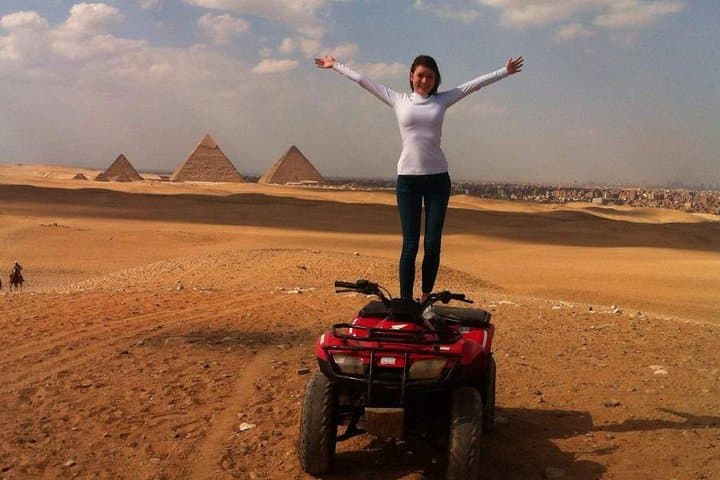
What the day feels like
The engine spits, a low mechanical laugh, and the desert answers. Sand lifts in a ragged halo behind the quad as you push forward, the Giza Plateau — limestone pyramids serrated against a washing blue sky — steadying in the mirror like an impressed audience. For an hour you trade the slow, reverent pace of the tourist circuit for something rawer: speed, grit, and the sudden intimacy of the Sahara’s edge. It’s a view of antiquity that moves.
There’s a cunning contrast to this ride. The pyramids are immutable — stone stacked in a geometry older than recorded history — while your route is ephemeral: tracks across wind-sculpted dunes, shallow gullies, and compact desert flats. Geology here is theatrical. The plateau’s bedrock shelves out of the surrounding sands in stepped terraces; wind sorts the grains into ridges that dare you to corner too fast. Elevation shifts are polite rather than dramatic — think gentle dune rolls and 20–50 meters of vertical play — but the terrain’s variability keeps you honest.
Culturally it’s no less layered. The view toward Cairo is a haze of modern sprawl and minarets; immediately beneath it, the pyramids anchor a story of kings, astronomical ambition, and logistics on a scale that still humbles engineers. Local guides on these tours double as storytellers, dropping quick, precise history between throttle bursts: how the Great Pyramid of Khufu once wore polished casing stones, how the Giza necropolis was both city and workshop. The ATV route deliberately skirts the protected archaeological zone, offering postcard panoramas without disturbing antiquities.
Practically, the ride is uncomplicated but physical. Viator’s format bundles a door-to-door private vehicle and an hour of actual riding within a roughly three-hour window for pick-up, safety briefing, and souvenirs. Expect to cover roughly 8–15 kilometers depending on route and stops — enough distance to feel accomplished without wiping you out. The real exertion is concentration: sand riding asks for body shifts, a steadied gaze, and a relaxed grip to let the front wheel find its line.
Why go? Because it re-tunes your perception of place. Standstill photos of the pyramids flatten scale; crossing the desert restores it. You feel the plateau’s isolation in a way a bus cannot replicate. For casual travelers it’s an adrenaline-tinted supplement to the museum-and-temple checklist. For the more seasoned, it’s a reminder that landscapes — even the most famous — reveal new faces when approached on a different tempo.
Safety and etiquette are straightforward. Helmets and goggles are standard; a quick skills demo precedes departure. Operators in the area emphasize staying on established tracks: the desert’s crust can hide archaeological debris and fragile microhabitats. Respecting those lines keeps both you and the heritage intact.
When to book? Cooler months from October through April are the smart bet. Midday summer heat can scorch equipment and patience; early mornings give you the soft, angled light that makes both sand and stone sing in photographs. Prices start around USD 40 and the private-pickup model in this tour means you can time the ride around sunrise or sunset if you want that gilded rim-light.
Packing for it is simple and strategic: closed shoes with good tread, lightweight long sleeves to block sun and sand, a hydration pack, and a neck gaiter that doubles as a filter when the wind turns. Bring a compact camera or phone in a secure chest harness; you’ll want to capture roving perspectives but your hands and attention must mostly stay on the bars.
This ride also reads well into a broader Cairo itinerary. It’s a kinetic counterpoint to the slow, detailed inspection of tombs and temples; after an hour of throttle you’ll appreciate the quiet of the solar-aligned chambers even more. And because the operator’s vehicle returns you to your doorstep in the city, it slots easily into a half-day plan along with the Egyptian Museum or a walk through downtown neighborhoods.
There’s a final, subtler reward. The desert here has a personality: patient, expansive, and occasionally mischievous. It pushes against your rhythm, nudges you into recalibration, then gives you back the view. When you peel off your helmet and the wind has calmed your overheated face, you’ll find the pyramids look different — not smaller, but more like something you reached, rather than simply saw.
If you go, come prepared to listen as much as to speed. Let your guide shape the route. Keep respect for the archaeological boundary non-negotiable. And leave enough time afterward to sit on a rooftop café in Giza with a cool drink, letting the desert’s dust settle into the memory where it makes for better stories than souvenirs.
In short: it’s an efficient, invigorating way to reframe one of the world’s oldest monuments. The quads carry you across the edge of time: under you, shifting sand; behind you, an architectural silence that keeps the loudest lesson — that some places are built to outlast human hurry — intact.
Trail wisdom
Small choices, better day.
Hydrate Before You Go
Drink 500–750ml of water before boarding; the desert heat and wind dehydrate faster than you expect.
Wear Closed Shoes
Light hiking or trail-running shoes with grip protect your feet from heat and sand and offer better control on the footpegs.
Use A Neck Gaiter
A lightweight gaiter blocks sun and filters grit on windy stretches; pull it up over nose and mouth when dust kicks up.
Listen to Your Guide
Follow the safety briefing and stay on marked tracks to avoid fragile areas and ensure a safe ride.
Local knowledge
Read the place, not just the route.
Watch for native species including Desert fox (Fennec) occasionally at dusk, Migratory birds skimming the plateau in winter.
Keep an eye out for wildlife during the transition between areas and habitats. Respect distance guidelines.
Operators are encouraged to use established tracks outside protected zones; avoid littering and support guides who emphasize cultural-site preservation.
Follow the guide's instructions on size limits, ethical handling, and leave-no-trace practices.
Rooftop cafés in Giza with pyramid views at sunset. A small local pottery stall behind the plateau for handmade souvenirs
Locally recommended viewpoints and quiet spots known best to local operators.
The Giza Plateau has been a focal point of Egyptian burial and funerary architecture since the 26th century BCE, with the Great Pyramid being the oldest of the original Seven Wonders.
Maritime roots and regional tradition shape the waterways and working coasts.
Seasonal guide
Four versions of the same landscape.
Spring
Best forMild temperatures · Wildflower edges on desert margins
ChallengesOccasional gusty khamsin winds · Sandy mornings
Spring offers comfortable riding temperatures but be ready for windier days—mid-morning departures balance light and calm.
Summer
Best forLong daylight for late rides · Clear skies for far-reaching views
ChallengesIntense midday heat · Reduced engine performance in extreme heat
Summer rides are best at sunrise or sunset to avoid heat; bring extra water and sun protection.
Fall
Best forStable weather · Golden afternoon light for photography
ChallengesVariable temperatures between morning and afternoon · Late-season wind events
Autumn gives consistently pleasant conditions; aim for late afternoon light for the most dramatic photos.
Winter
Best forCool riding temperatures · Clear horizons and crisper air
ChallengesChilly early mornings · Occasional rain (rare)
Winter is the optimal season for comfort and visibility—layer for early starts and you’ll ride longer, happier.
Operator details
What the booking data adds.
Included
- ✓Hotel pickup and drop-off
- ✓Private tour
- ✓Local taxes
- ✓Bottled water/ Snacks
- ✓Qualified Egyptologist guide
Not included
- —Gratuities
Good to know
- ✓Not recommended for pregnant travelers
- ✓Suitable for all physical fitness levels
Pack with intention
What to bring.
Good to know
Common questions.
No — operators include a safety briefing and a short practice session; basic comfort with throttle and brakes is sufficient.
Plan the edges
The details that make the day easier.
The Great Pyramid of Giza is the oldest of the original Seven Wonders of the Ancient World and the only one still largely intact.
After the ride, head to a rooftop café in Giza for koshary (Egypt’s hearty street-food staple) and mint tea while the pyramids cool in evening light; for a cultural detour, browse nearby artisan stalls selling alabaster and hand-blown glass.
- Closest airport
- Cairo International (CAI). Typical drive from downtown Cairo: 30–45 minutes. Cell service: generally good near roads, patchy on dunes. Permits: no special permits for the ATV route; pyramid complex entry tickets are separate.
Stay on designated tracks, avoid riding near archaeological boundaries, pack out all trash, and choose operators who limit groups and respect local heritage.
Explore by topic
Follow the threads.
Keep exploring
Make the story part of the trip.
Set out from Bass Harbor for a private, customizable day on Blue Hill Bay — lighthouses, puffins, seals, and the chance to feel Acadia from the water. Small groups, local captains, unforgettable views.
In four hours you can move from shaded canyon ferns to wind-scoured coastal ridgelines, guided by someone who knows where the light—and the hidden views—live. This private half-day hike on the Monterey Peninsula or Big Sur is compact, curated, and perfect for travelers who want depth without a multiday commitment.
 Related story
Beneath a sky of shifting light, Skaftafell’s ice reads like a map of time. This three-hour guided glacier hike mixes technical instruction with geology and culture: compact, safe, and unforgettable.