
What the day feels like
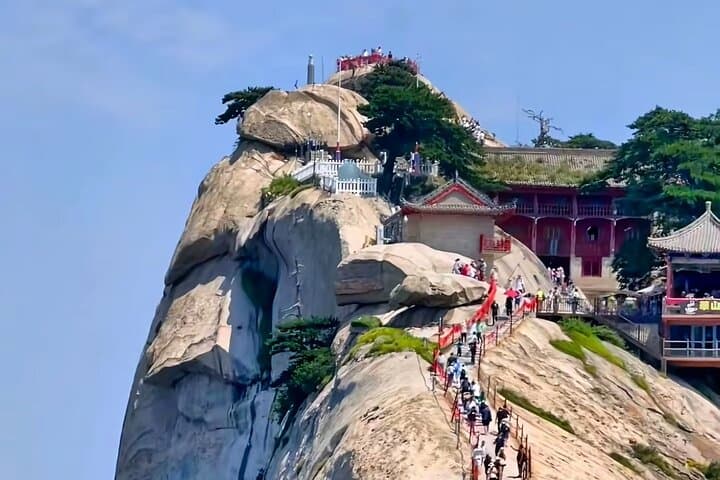
Sunrise on Mount Hua arrives like a verdict—slow, inevitable, and spectacular. You climb ribs of granite as the valley below remains a soft, sleeping thing; light slides along knife-edged ridges and turns the weathered Taoist pavilions into silhouettes that could belong to a different century. The wind here has a personality: blunt and insistent, it nudges you toward the view and away from complacency. By midmorning you’re negotiating centuries-old stone steps, stepping over prayer ribbons and sweeps of lichen, and later, if you choose, walking a narrow wooden plank bolted to a vertical face where the drop is absolute and your pulse writes its own story.
Mount Hua (Huà Shān) is less a single summit than a collection of characters—East Peak, West Peak, South Peak, North Peak, and Central Peak—each with its own temperament. The range rises from the plains east of Xi’an into sheer granite that was forged deep underground and exposed by eons of uplift and erosion; the result is a landscape of fractured faces, steep gullies, and spines that demand attention. Because of its dramatic profile and spiritual significance, Hua Shan is one of China’s Five Great Mountains and a center of Daoist practice for well over a millennium. Temples and shrines perch improbably on shoulders and ledges, their red lacquer and gold leaf a sharp human punctuation against stone.
A one-day adventure tour of Mount Hua condenses a long story into a single packed chapter: a coach ride from Xi’an, the cable car that saves hours of ascent, a traverse of the main ridge, a sunrise or sunset viewpoint, and the spine-tingling Chang Kong Plank Walk—an attraction that has entered travel folklore. Part adrenaline, part pilgrimage, the climb draws both weekend trekkers and people seeking a brush with something older than them—Daoist hermits’ whispers folded into the hum of modern hikers.
The geology is honest and tactile. Granite here is coarse-grained, exfoliated into faces and slabs that provide both handholds and hairline cracks. Trails follow the easiest seams but still ask for a steady step: stone stairs hewn by earlier generations alternate with steep, exposed ramps where chains are bolted into the rock like a nervous system. You’ll see small shrines tucked into caves and banners left for safe passage; the mountain is as much a cultural landscape as a natural one.
Practical rhythm matters. Most organized day tours last about nine hours—long enough to get a meaningful traverse but tight enough to keep a return to Xi’an realistic. Expect sustained ascend/descend sections and several stretches of scrambling or steep steps; total elevation from base to the highest peak is approximately 1,200–1,600 meters depending on route choices, with the park’s high points topping out around 2,150 meters. For many groups, the cable car shortens both effort and time, allowing more moments at view platforms and less time on monotonous switchbacks.
Safety is not a dare. The Plank Walk is famous for its publicity, but it’s regulated, and operators insist on harnesses and supervision; the walk itself is a short, intense flourish, not a long via ferrata. Weather is king—mist can obliterate views and make stone slick; lightning turns the summit into a risky place. For this reason, timing your hike for clear mornings (sunrise on the East Peak is a classic) or late-afternoon light (West Peak for sunset) pays off.
For the practical traveler: bring solid footwear, layered clothing for sharp temperature swings, and water—there’s food and tea at scattered businesses near the main peaks but expect lines during high season. Respect restrictions at religious sites; many temples still function and merit quiet. If you want the Plank Walk, confirm it ahead of time—some tours include it, others offer it as an extra; reservations and safety briefings are standard.
The cultural payoff is as immediate as the landscape. Daoist priests and hermits have made Hua Shan a place of ascetic practice; temples contain calligraphy and offerings that speak to a long human desire to be both humbled and elevated. Below the mountain, the flatlands around Xi’an are history in another register—where the Tang capital once hum and where modern Xi’an begins its own complicated life. A day on Hua Shan stitches those histories together: natural spectacle, spiritual practice, and contemporary adventure tourism.
Why go? Because the mountain asks something small and gives something large—the effort required is tangible but not extreme for a reasonably fit person, the views are uncompromising, and the cultural texture gives extra resonance to every step. You come away with a better sense of scale (both geologic and human) and with a handful of photographs and memories that say you’ve stood on one of China’s most storied ridgelines.
If you’re planning this day: aim for shoulder seasons to avoid crowds, budget time for the cable car lines, and temper ambition—try to take in one peak fully rather than racing to check five boxes. And allow a little quiet time at one of the temple courtyards: the view looks better when your pulse has settled and the place feels less like a checklist and more like a landscape you’ve actually earned.
Mount Hua is both physical and ceremonial terrain: granite that dares you and temples that remind you why you climbed. The plank walk is a thrill, sunrise is a religion, and the steps are an honest measure of effort. That combination—a place that pushes and then pays you back in light and perspective—is what keeps people returning to Hua Shan, decade after decade.
Trail wisdom
Small choices, better day.
Use the Cable Car Strategically
Save hours and conserve energy by taking the cable car up or down so you can spend more time on the ridge and at viewpoints.
Footwear and Grip Matter
Wear sturdy hiking shoes with good tread—many sections are steep, abrasive granite with occasional wet patches.
Time Your Sunrise/Sunset
For the clearest sky and best light, plan East Peak for sunrise or West Peak for sunset and allow buffer time for crowds and cable car waits.
Respect Temple Etiquette
Be quiet in temple areas, don’t touch ritual objects, and follow posted rules—these are active religious sites.
Local knowledge
Read the place, not just the route.
Watch for native species including Chinese muntjac (small deer), Various hill birds such as magpies and tits.
Keep an eye out for wildlife during the transition between areas and habitats. Respect distance guidelines.
Visitor pressure is managed through park entrance fees and regulated access to iconic features like the plank walk; stay on trails and pack out waste to limit erosion and litter.
Follow the guide's instructions on size limits, ethical handling, and leave-no-trace practices.
Hidden temple courtyards near East Peak for quieter views. Short side trails above North Peak with unique rock formations
Locally recommended viewpoints and quiet spots known best to local operators.
Mount Hua has been a center of Daoist practice for over a thousand years and is one of China’s Five Great Mountains, with temples dating back to the Tang and Song dynasties.
Maritime roots and regional tradition shape the waterways and working coasts.
Seasonal guide
Four versions of the same landscape.
Spring
Best forWildflowers and milder temperatures · Less crowded weekdays
ChallengesIntermittent rain and fog · Cool nights
Spring offers pleasant temperatures and green slopes; expect occasional fog that can hide views but gives the mountain a moody atmosphere.
Summer
Best forLush landscapes · Long daylight hours
ChallengesHeat in lowlands and potential thunderstorms · Peak crowds and long cable car lines
Summer brings dense foliage and warm lows, but also more visitors and afternoon storms—start early to beat heat and weather.
Fall
Best forClear vistas and crisp air · Spectacular light for photography
ChallengesCool mornings and potentially chilly winds · Higher demand during national holidays
Autumn is ideal for clarity and color; cooler air sharpens views but layer up for wind on exposed ridges.
Winter
Best forSnow-dusted landscapes · Fewer tourists on weekdays
ChallengesIcy sections and higher wind chill · Some services and cable car schedules may be reduced
Winter transforms Hua Shan into a stark, beautiful place; be prepared for ice on stairs and limited facilities.
Operator details
What the booking data adds.
Included
- ✓The fee only includes transportation costs and tour guide fees.
Good to know
- ✓Public transportation options are available nearby
- ✓Specialized infant seats are available
- ✓Not recommended for pregnant travelers
- ✓Not recommended for travelers with poor cardiovascular health
- ✓Suitable for all physical fitness levels
Pack with intention
What to bring.
Good to know
Common questions.
It’s challenging: long stair sections, short exposed stretches, and sustained elevation gain. A reasonable level of fitness and sure-footedness is recommended.
Plan the edges
The details that make the day easier.
Mount Hua is one of the Five Great Mountains of China and has been an important site of Daoist pilgrimage and temple construction since at least the Tang dynasty.
After descending, head to Xi’an or Huayin to try Shaanxi staples—biangbiang noodles, roujiamo sandwiches, and local wheat pancakes—then sip a cold Chinese craft beer while watching locals play chess at a teahouse.
- Closest airport
- Xi'an Xianyang International (XIY)
- Typical departure city
- Xi'an (2 hours drive to trailhead)
- Driving distance from Xi'an
- ~120 km
- Cell service
- patchy on exposed ridges
- Permits
- park entrance fee and cable car
Mount Hua is both a cultural and ecological site—carry out trash, stay on marked trails to reduce erosion, and avoid using single-use plastics where possible.
Explore by topic
Follow the threads.
Keep exploring
Make the story part of the trip.
Set out from Bass Harbor for a private, customizable day on Blue Hill Bay — lighthouses, puffins, seals, and the chance to feel Acadia from the water. Small groups, local captains, unforgettable views.
In four hours you can move from shaded canyon ferns to wind-scoured coastal ridgelines, guided by someone who knows where the light—and the hidden views—live. This private half-day hike on the Monterey Peninsula or Big Sur is compact, curated, and perfect for travelers who want depth without a multiday commitment.
 Related story
Beneath a sky of shifting light, Skaftafell’s ice reads like a map of time. This three-hour guided glacier hike mixes technical instruction with geology and culture: compact, safe, and unforgettable.