
What the day feels like
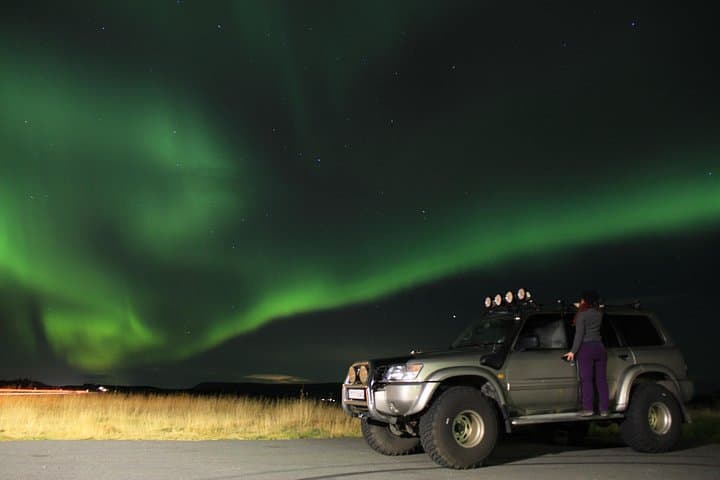
When the engine of a Super Jeep growls to life on the edge of Reykjavík, the city’s sodium glow recedes like a tide. In its place, blackened lava fields and the low silhouettes of distant mountains begin to fill the windows—landscape that a regular bus will never reach. We drive off the asphalt and into a quiet that has weight: wind rubbing over basalt, the hush of farmland, salt and sulfur folded into the air. This is a different kind of night tour. It is less about sightseeing than about being in the right place—far from light and routine—while the sky decides whether to give you a spectacle.
Iceland’s aurora season (September–March) is a hard-stopped romance between solar physics and weather. Aurora borealis are charged particles from the sun colliding with the upper atmosphere; their color and intensity depend on the energy of the particles and the composition of the air they meet. Here, on the broad shoulders of the North Atlantic, the lights often stretch low toward the horizon, rippling across volcanic ridges and reflecting off black sand or frozen ponds. Guides in Super Jeeps use that geography to their advantage, taking advantage of Iceland’s patchwork of microclimates to outrun cloud cover and find the clearest viewing basins.
The Super Jeep is part vehicle, part lifeline: raised suspension lets it crawl over rough lava and snow-packed tracks, and four-wheel drive means your night won’t end at a river or a drift. The downside is the unpredictability. Tour operators can only promise the hunt, not the catch: clouds, wind, and solar calm can cancel a show at the last minute. What they do promise—and usually deliver—is the story of how the lights form, a primer in night photography, and the experience of waiting under a wide Arctic sky.
There’s history and geology stitched into every turn of that Jeep. You’re traveling a landscape shaped by the Mid-Atlantic Ridge, where crustal plates pull apart and volcanoes build new land in fits and starts. Reykjanes Peninsula, often the target for aurora chases from Reykjavík, is a young, restless place: steaming geothermal fields, fissures littered with fresh basalt, and placid lakes nested in crater rims. Cultural context arrives in quiet forms—sheep fences, turf houses preserved in museums, and the shadowed recitation of sagas over a thermos of coffee when the group pauses to scan the sky.
Practicality matters in a place that can change in an hour. The guided Super Jeep tour is compact—about four hours from pickup to drop-off—so timing and layering are everything. Guides tend to be experienced locals who read not only aurora forecasts but also the land, knowing which fjord will likely clear first or which inland valley keeps its chill and cloud. They’ll coach you through camera settings, help position a tripod, and share ways to keep batteries warm in subzero air. If you want a photo you’ll be thankful you came prepared.
Who this is for: travelers who want more independence than a big-bus route but less risk than a self-driven overnight chase. Families, couples, photographers, and anyone with an appetite for an active evening in winter conditions will find this a high-value night out. The realism: the tour is not guaranteed—aurora are nature’s show—and it’s weather-dependent. But with the right expectations, the Jeep hunt is as much about practice in reading the sky and land as it is about a single perfect moment.
Tips that matter once you’re planning: book during months with longer, darker nights (Oct–Mar) and check both the aurora forecast and local cloud cover. Pack layers designed to trap heat (merino base, insulating mid-layer, windproof outer shell), a windproof hat, and gloves that let you operate a camera. Bring a tripod and spare batteries; cold drains them fast. Expect a pickup in central Reykjavík and an hour or two of driving to reach the prime remote spots. Finally, be flexible: sometimes the lights arrive in a half-hour flurry, sometimes they tease for hours before breaking into color.
Beyond the spectacle, the tour is a chance to connect with Icelandic ways of seeing landscape—practical, skeptical, and reverent at once. Guides often share stories about volcanic eruptions that reshaped communities, and about how modern Icelanders balance tourism with fragile ecosystems. In that way, the hunt is a night class in natural history, wrapped in one of the planet’s most dramatic theaters.
If you go expecting certainty, you’ll leave disappointed; go expecting skillful navigation, local knowledge, and the chance to witness a rare cosmic performance, and you’re likely to return saying you felt very small—and very fortunate—under a world of moving light.
Trail wisdom
Small choices, better day.
Layer for Arctic Nights
Bring a merino base, insulated mid-layer, and windproof shell—the Jeep ride can be cold and stops are exposed.
Keep Camera Batteries Warm
Store spare batteries inside your jacket; cold drains power quickly and the best shots can come late in the night.
Tripod and Remote Shutter
A sturdy tripod and remote release are essential for crisp aurora exposures; a beanbag won’t cut it on uneven ground.
Trust the Guide’s Route Choices
Guides chase clear pockets of sky and safe access points—follow their lead and avoid walking on fragile lava fields.
Local knowledge
Read the place, not just the route.
Watch for native species including Arctic fox (seldom seen), Harbor seals along coastal inlets.
Keep an eye out for wildlife during the transition between areas and habitats. Respect distance guidelines.
Stay on marked tracks and avoid walking on fragile moss or young lava flows; local operators emphasize minimal disturbance and limiting light pollution during aurora viewings.
Follow the guide's instructions on size limits, ethical handling, and leave-no-trace practices.
Hvalfjörður (Hvalfjordur) fjord—less-visited dark-sky corridor with reflective waters. Kleifarvatn lake on Reykjanes—remnant volcanic basin offering dramatic reflections and minimal light pollution
Locally recommended viewpoints and quiet spots known best to local operators.
The landscapes you pass are products of recent geology: the Mid-Atlantic Ridge and repeated volcanic events have reshaped this coastline for millennia, and Iceland’s settlement history ties closely to Norse sagas and maritime livelihoods.
Maritime roots and regional tradition shape the waterways and working coasts.
Seasonal guide
Four versions of the same landscape.
Spring
Best forShoulder-season aurora hunting · Fewer tourists · Combination tours with ice-cave melt-off viewing
ChallengesLimited availability (tour season ends in March) · More variable weather · Shorter nights later in spring
March may still offer aurora opportunities; by late spring the tour season typically ends and nights grow too bright.
Summer
Best forMidnight sun experiences (not aurora) · Daytime wilderness exploration · Hiking and birdwatching
ChallengesNo aurora—nights are too bright · Tour not available (season Sept–Mar) · Peak tourist crowds in Reykjavík
The Super Jeep aurora hunt does not operate in summer; consider midnight-sun excursions instead.
Fall
Best forEarly-season aurora · Dramatic weather transitions · Fewer visitors than winter holidays
ChallengesUnpredictable cloud cover · Cold nights early in the season · Variable road conditions
Autumn brings long nights and dynamic skies—good odds for sightings, but weather can swing quickly.
Winter
Best forPeak aurora potential · Snow-dusted landscapes for foregrounds · Extended dark hours for photography
ChallengesVery cold temperatures · Short daylight hours limit daytime sightseeing · Possible cancellations due to storms
Winter is the prime season for Super Jeep aurora hunts—ample night hours and dramatic scenery, but be ready for cold and occasional cancellations.
Operator details
What the booking data adds.
Included
- ✓Snacks
- ✓Air-conditioned vehicle
- ✓Coffee and/or Tea
- ✓Parking Fees
Not included
- —Dinner
- —Bottled water
- —Gratuities
Good to know
- ✓Public transportation options are available nearby
- ✓Specialized infant seats are available
- ✓Suitable for all physical fitness levels
Pack with intention
What to bring.
Good to know
Common questions.
Sightings depend on solar activity and cloud cover; guides maximize chances by traveling to clear pockets of sky, but the lights cannot be guaranteed.
Plan the edges
The details that make the day easier.
Reykjavík is the northernmost capital of a sovereign state, and Iceland straddles the Mid-Atlantic Ridge where the North American and Eurasian plates meet.
After the tour, warm up in Reykjavík’s Old Harbor: try a seafood stew at Sægreifinn or a hot dog from Bæjarins Beztu Pylsur, then find a craft beer at MicroBar or a low-key live-music spot for a digestible slice of Icelandic urban life.
- Closest airport
- Keflavík International Airport (KEF, ~45 km from Reykjavík). Driving distance from nearest town: pickup in central Reykjavík (0–60 minutes to prime viewing sites). Cell service: generally good near roads, spotty in remote valleys. Permits: none required for this commercial tour; respect private land access rules.
The aurora hunt traverses sensitive volcanic terrain—stay on vehicle tracks, minimize light use, pack out waste, and avoid walking on young lava or moss to prevent lasting damage.
Explore by topic
Follow the threads.
Keep exploring
Make the story part of the trip.
Set out from Bass Harbor for a private, customizable day on Blue Hill Bay — lighthouses, puffins, seals, and the chance to feel Acadia from the water. Small groups, local captains, unforgettable views.
In four hours you can move from shaded canyon ferns to wind-scoured coastal ridgelines, guided by someone who knows where the light—and the hidden views—live. This private half-day hike on the Monterey Peninsula or Big Sur is compact, curated, and perfect for travelers who want depth without a multiday commitment.
 Related story
Beneath a sky of shifting light, Skaftafell’s ice reads like a map of time. This three-hour guided glacier hike mixes technical instruction with geology and culture: compact, safe, and unforgettable.