
What the day feels like
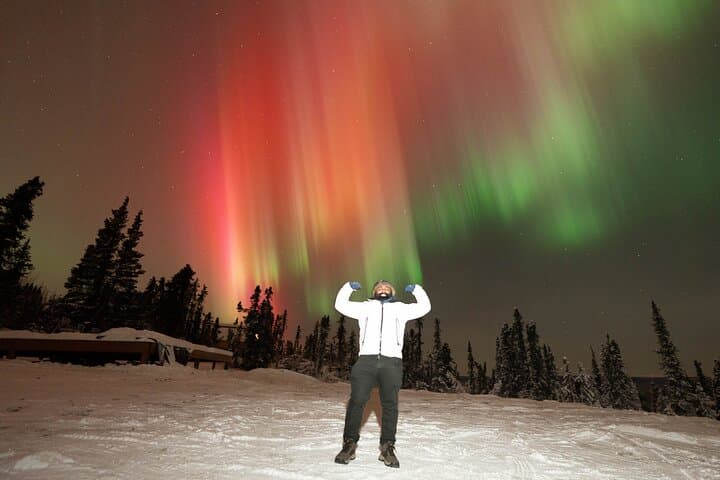
The road leaves Fairbanks behind as a ribbon of headlights through midnight snow. In the passenger seat, your guide watches the sky like someone reading a weather map written in green. There is no single place to see the aurora—there are preferred windows of darkness, pockets of clear sky and the slow negotiation with clouds—but there is always motion: the road, the breath fogging in front of your face, the aurora forecast pinging through the van’s GPS. Then, just beyond a ridge, the sky gestures. A curtain of pale green swells, folds and becomes a wide, slow wave. Cameras click, tripods settle, and for a few minutes you stand somewhere between scientific wonder and pure spectacle.
Fairbanks is not a backdrop; it’s a launchpad. Located under the auroral oval, this part of Alaska is one of the world’s most reliable staging grounds for the northern lights. The tour’s advantage is simple: mobility and expertise. Guides monitor geomagnetic activity, cloud cover, and local road conditions in real time—then drive you to the clearest vantage points. On a guided night drive you trade the guesswork of chasing weather apps for curated access to dark-sky pullouts, frozen lakes, or tree-lined ridgelines where the sky becomes an active participant rather than a passive ceiling.
There is a science to the show, too. Auroras are cousins of space weather: charged particles from the sun collide with Earth’s magnetic field and atmosphere, exciting oxygen and nitrogen atoms that release light. The result is color and motion—green from oxygen at lower altitudes, red at higher elevations, and occasional purple fringes where nitrogen joins the dance. Local guides translate these phenomena into practical tips: which settings to dial in on your camera, how to compose with foreground interest, and when to switch from photographing to simply watching.
This isn’t only a physics lesson. The region’s human story runs alongside it. Alaska Native communities have long observed and woven the aurora into oral traditions—stories that respect the lights as more than spectacle. Fairbanks itself is a frontier town with a history shaped by gold rush routes, railroad camps and the long winters that taught people to read the night. That context matters: when you stand under the lights, you’re also in a landscape shaped by culture, survival and a particular relationship to darkness.
Practicalities matter more than romance here. Tours typically last 4–5 hours—long enough to drive, scout, set up and shoot during the auroral peak windows. You’ll be outside in below-freezing temperatures; comfort and patience matter as much as camera gear. Guides often include hands-on photography coaching and sometimes supply final edited images, which is a boon if your lens-handling skills are still warming up. For photographers, the rhythm of a night drive is ideal: short bursts of action, long periods of observation, and a guide who readies a spot while you set up.
Expect variability. No operator can promise a show—that’s part of the deal with natural phenomena—but a local, experienced guide significantly improves your odds by reading microclimates and geomagnetic indices. Timing matters, too: equinox months often align with higher geomagnetic activity, and late winter/early spring brings clearer skies and crisper nights.
If you go: bring a sturdy tripod, a camera you can control manually, and lenses wide and fast enough to gather faint light (24mm at f/2.8 is a common starting point). Layer up: base layers, an insulating mid-layer, and a windproof shell. Keep camera batteries warm in an inside pocket; cold drains them fast. And prepare to alternate between the technician’s focus of capturing the perfect frame and the simple human impulse to drop the viewfinder and watch the sky move.
Beyond the image, a guided night drive gives you local narrative—where to stop for a foreground of birch trees, when to move to a frozen riverbank, which pullouts have the least light pollution. If you want photos and a story to tell, this is a pragmatic way to chase the aurora: you’ll leave with both a memory and practical skills for the next time the sky turns.
For travelers who want to maximize success without learning every technical detail first, consider a tour that includes professional images and real-time route choices. If you prefer a DIY approach, use the same principles—watch cloud cover, check geomagnetic forecasts, head for dark-sky locations and pack for cold—and give yourself the time to wait. Either way, the aurora is best when treated like a collaborator: coaxed, respected and sometimes simply witnessed.
If you’re ready to organize a night that balances skill-building and serendipity, this guided night drive in Fairbanks is a sharp, efficient way to meet the lights. For booking details and local guide information, see the dedicated Northern Lights tour page here: <a href="https://app.advcollective.com/local-experts/fairbanks-northern-lights-photography-tour-capture-the-aurora-on-a-guided-night-drive">Northern Lights Photography Tour</a>. For tips on camera settings and what to expect on a night drive, the tour page also breaks down gear and timing to help you plan.<a href="https://app.advcollective.com/local-experts/fairbanks-northern-lights-photography-tour-capture-the-aurora-on-a-guided-night-drive"> Book the guided night drive</a> and arrive prepared to let the sky do most of the talking.
Trail wisdom
Small choices, better day.
Warm your batteries
Keep spare camera batteries in an inside pocket; cold drains charge quickly and you’ll need replacements.
Bring a sturdy tripod
Long exposures require a solid support—cheap tripods produce blur in wind or on uneven snow.
Dress in layers
Wear base layers, an insulating mid-layer and a windproof shell; pack a hat and insulated boots.
Trust the guide’s route
Guides move based on real-time cloud and aurora data—follow their lead to maximize viewing windows.
Local knowledge
Read the place, not just the route.
Watch for native species including Snowshoe hare, Moose (possible along dark roads).
Keep an eye out for wildlife during the transition between areas and habitats. Respect distance guidelines.
Avoid using artificial lights and park only in designated pullouts to protect tundra and roadside vegetation; pack out all trash and minimize disturbance to wildlife.
Follow the guide's instructions on size limits, ethical handling, and leave-no-trace practices.
Drive to nearby frozen riverbanks for reflections and darker horizons. Small roadside pullouts outside town often offer better southern horizons than town viewpoints
Locally recommended viewpoints and quiet spots known best to local operators.
Fairbanks grew as a supply and transportation hub during the Alaska gold rush and later became a focal point for scientific and military efforts tied to its high-latitude location.
Maritime roots and regional tradition shape the waterways and working coasts.
Seasonal guide
Four versions of the same landscape.
Spring
Best forClear skies · Higher geomagnetic activity · Longer twilight
ChallengesVariable temperatures · Icier roads at night
Late winter into March often offers the best blend of frequent aurora activity and clearer skies, but pack for cold nights and changing road conditions.
Summer
Best forMidnight sun photography practice (not aurora) · Landscape scouting · Long daylight activities
ChallengesMidnight sun eliminates true darkness; aurora are rarely visible
Summer’s near-continuous daylight in Fairbanks makes aurora viewing impractical; focus on other outdoor activities instead.
Fall
Best forEarly dark nights · Fall road access before heavy snow · Colorful foregrounds
ChallengesUnpredictable early snow · Shorter nights early in season
Autumn brings earlier darkness and often clear, crisp nights—good chances if you time trips closer to late September through October.
Winter
Best forLongest, darkest nights · Consistent aurora viewing windows · Snowy foregrounds
ChallengesExtreme cold, limited daylight · Occasional road closures from storms
Winter offers the most reliable viewing windows and dramatic snowy scenes—dress for extreme cold and plan for flexible timing.
Pack with intention
What to bring.
Good to know
Common questions.
Tours typically run 4–5 hours (240–300 minutes), departing in the evening to align with auroral activity windows.
Plan the edges
The details that make the day easier.
Fairbanks lies directly under the ‘Auroral Oval,’ a ring-shaped region around the magnetic pole that concentrates auroral activity—this makes Fairbanks one of the most reliable places on Earth to view the northern lights.
After a night under the lights, head to a local brewpub or historic riverside restaurant in Fairbanks for thawing food and local stories. Visit the Morris Thompson Cultural & Visitors Center to learn about Alaska Native culture and regional history during daylight hours.
- Closest airport
- Fairbanks International Airport (FAI); Typical driving from downtown Fairbanks to viewing areas: 15–60 minutes; Cell service: good in town, spotty in remote pullouts; Permits: none required for commercial tours, but stay on maintained roads and respect private property.
Respect dark-sky etiquette—use low-light flashlights, avoid unnecessary car idling, and stay on designated pullouts to protect vegetation and wildlife corridors.
Explore by topic
Follow the threads.
Keep exploring
Make the story part of the trip.
Set out from Bass Harbor for a private, customizable day on Blue Hill Bay — lighthouses, puffins, seals, and the chance to feel Acadia from the water. Small groups, local captains, unforgettable views.
In four hours you can move from shaded canyon ferns to wind-scoured coastal ridgelines, guided by someone who knows where the light—and the hidden views—live. This private half-day hike on the Monterey Peninsula or Big Sur is compact, curated, and perfect for travelers who want depth without a multiday commitment.
 Related story
Beneath a sky of shifting light, Skaftafell’s ice reads like a map of time. This three-hour guided glacier hike mixes technical instruction with geology and culture: compact, safe, and unforgettable.