
What the day feels like
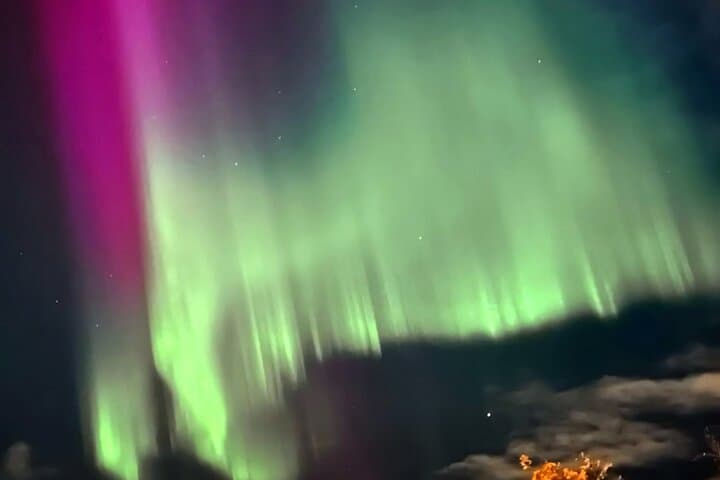
The road out of Tromsø opens like a dark ribbon, a band of asphalt threading between fjord and mountain under a cold northern sky. You leave the city’s sodium glow behind—the glow that softens the stars and blurs the aurora’s edges—and find, in a small minivan with a patient local guide, a freedom that feels almost conspiratorial. This is not a fixed route but a plan built on weather models, sky forecasts, and local instinct: drive where the clouds split and the darkness deepens, pull off at a cove or a ridge, and wait. When the aurora comes, the sky begins to move in ways the daytime landscape never does—curtains unroll, green arcs pulse, and purple veins stitch into the night—until the world feels less like place and more like a phenomenon you are fortunate to witness.
Tromsø sits at roughly 69.65°N, inside the auroral oval, which is why it functions as a nightly launch pad for hunters of the northern lights. The region’s climate is moderated by the Gulf Stream, so winter temperatures can be milder than the latitude suggests; still, the air bites when you step out of the van. Guides here know the moods of these skies. They track solar activity, read cloud cover, and move teams toward darker shores—often Ersfjordbotn, Kvaløya beaches, or quiet fjord shoulders—where horizons are wide and human-made light is minimal.
The geology around Tromsø is its own long story. Rugged schist and granite rise from deep fjords carved by ice and time, and the islands and inlets create pockets of dark sky that seem to have been reserved for auroral theatrics. Culturally, Tromsø is layered: a 19th-century Arctic port, a research hub, and a modern town with a coffee culture that keeps overnight aurora chasers alive. The city has been the base for polar expeditions and hunting, and you still feel that history when you sit with a thermos in hand listening to a guide describe the science behind the lights—charged solar particles colliding with atmospheric gases, producing color based on altitude and composition.
This particular chase is pragmatic and personal. It’s a six-hour evening excursion by comfortable minivan, sized small to stay flexible and minimize the crowds that can ruin a northern-light experience. Warm drinks and light snacks are included, and the guide not only shares stories and forecasts but stays near your camera: adjusting shutter speeds, recommending ISO settings, and suggesting foregrounds—boulders, lone pines, or the mirrored fjord—to anchor your compositions. The unspoken promise is that the group will move until conditions are best, and when the sky opens, you’ll have time to watch rather than rush from stop to stop.
For the practical adventurer, this trip asks less of physical endurance than of patience and preparation. Nights can be long and cold; standing still is part of the deal. It demands clothing that traps warmth, a mindset ready for unpredictability, and basic familiarity with camera settings if you want usable photos. It does not demand a steep fitness level or technical climbing skills—only the willingness to leave comfort behind for a stretch of raw northern dark.
Why go? Because seeing the aurora in an intimate, mobile setting changes the experience. You’re not a small figure among a hundred tripods; you’re a part of a group sizing up the weather and moving accordingly. You learn how to predict the sky’s temper, how to use the landscape to make an image of the lights, and you finish the night with a memory that feels earned. This is also a good option for people on shorter stays in Tromsø: in one evening you get guided access to remote vantage points without renting a car or navigating winter roads yourself.
If you plan to book, think seasonally: the polar night and clear winter skies between late November and early April are prime, with late winter months often offering clearer conditions and cold, stable air that photographers love. But auroras depend on solar conditions too—there are active years and quieter ones—so flexibility and realistic expectations are essential. The tour’s small size, local knowledge, and willingness to chase weather mean you maximize your odds without sacrificing comfort.
The humane details matter: bring a tripod and spare batteries (cold kills battery life fast), layer for standing still in Arctic wind, and arrive ready to listen and learn; guides will help with camera settings, but the best photos come from patience and a carefully chosen foreground. When the lights unfurl, turn off flash photography on phones; let the sky do the work. And afterward, back in the van with a warm drink, you’ll find that part of the pleasure comes from the shared silence—people exhaling at once, reluctant to break the spell of a sky that refuses to be ordinary.
This chase won’t promise you the aurora—no one can—but it will maximize your chances, put you where the sky is darkest, and teach you how to read the night. For travelers who want an efficient, guided, and locally fluent way to pursue the northern lights without the crowds, it’s one of the cleanest formats in Tromsø: mobile, informed, and focused on the view. Take the trip for the lights, stay for the quiet competence of guides who know when to drive and when to listen to the sky.
Trail wisdom
Small choices, better day.
Layer for motionless cold
Wear insulated layers and a windproof outer shell—standing still at night requires more warmth than brisk hiking.
Tripod and spare batteries
Bring a sturdy tripod and extra camera batteries; cold drains batteries quickly and long exposures require stability.
Follow the guide’s cues
Guides move based on cloud cover and aurora forecasts—be ready for short drives and spontaneous stops.
Protect your phone and hands
Use chemical hand warmers and keep phones inside insulated pockets between shots to avoid cold shutdowns.
Local knowledge
Read the place, not just the route.
Watch for native species including Reindeer, White-tailed sea eagle.
Keep an eye out for wildlife during the transition between areas and habitats. Respect distance guidelines.
Light pollution reduction and responsible tourism are priorities—guides aim to minimize group impact in sensitive shoreline and tundra areas; follow Leave No Trace principles.
Follow the guide's instructions on size limits, ethical handling, and leave-no-trace practices.
Ersfjordbotn viewpoint for dramatic fjord reflections. Sommarøy island beaches for dark horizons and minimal light pollution
Locally recommended viewpoints and quiet spots known best to local operators.
Tromsø grew as an Arctic port and received city status in 1794; it later became a staging point for polar exploration and research.
Maritime roots and regional tradition shape the waterways and working coasts.
Seasonal guide
Four versions of the same landscape.
Spring
Best forLate-season aurora · Quieter roads
ChallengesVariable cloud cover · Milder nights reducing aurora visibility
Early spring can still deliver strong aurora displays while roads begin to clear; expect mixed weather and longer twilight.
Summer
Best forMidnight sun photography (different experience) · Long daylight explorations
ChallengesNo true darkness during midnight sun · Aurora not visible
Summer in Tromsø brings the midnight sun; this particular night chase is not practical because of continuous daylight.
Fall
Best forAurora season kickoff · Cool, crisp nights
ChallengesUnpredictable storms · Early-season cloud cover
Fall marks the return of aurora season—clouds and storms are possible, but clear nights can be spectacular.
Winter
Best forPeak aurora viewing · Stable cold air for photography
ChallengesExtreme cold, polar night conditions · Short daylight hours
Winter is the prime season for aurora chases—dark nights, frequent displays, and atmospheric clarity for long-exposure photography.
Operator details
What the booking data adds.
Included
- ✓Hotel/Airbnb drop-off in Tromsø
- ✓Tasty Norwegian Snacks
- ✓Reindeer hides to sit on
- ✓Hot drinks: Coffee, Tea & Hot Chocolate
- ✓Air-conditioned vehicle
- ✓Campfire
- ✓Experienced & Friendly local guide
Not included
- —Personal expences
- —Travel insurance
Good to know
- ✓Public transportation options are available nearby
- ✓Suitable for all physical fitness levels
Pack with intention
What to bring.
Good to know
Common questions.
No—auroras are a natural phenomenon and cannot be guaranteed; the tour maximizes your chances by chasing clear skies and auroral activity.
Plan the edges
The details that make the day easier.
Tromsø sits above the Arctic Circle (about 69.65°N) and experiences polar night—from late November to mid-January the sun does not rise, which increases opportunities to see the aurora.
After the chase, warm up in Tromsø’s compact center: try fresh Arctic cod or king crab at Fiskekompaniet, sample local game or reindeer stew, and stop by Ølhallen—the city’s oldest pub—for a local beer and conversation with residents.
- Closest airport
- Tromsø Airport (TOS)
- Typical meeting point
- central Tromsø
- Driving from city center
- 20–60 minutes depending on stop
- Cell service
- good near town, spotty in remote fjords
- Permits
- none required for public pull-offs
Support dark-sky preservation by minimizing use of artificial light, follow guide instructions to avoid trampling vegetation, and pack out all trash—this region’s fragile arctic ecosystems recover slowly.
Explore by topic
Follow the threads.
Keep exploring
Make the story part of the trip.
Set out from Bass Harbor for a private, customizable day on Blue Hill Bay — lighthouses, puffins, seals, and the chance to feel Acadia from the water. Small groups, local captains, unforgettable views.
In four hours you can move from shaded canyon ferns to wind-scoured coastal ridgelines, guided by someone who knows where the light—and the hidden views—live. This private half-day hike on the Monterey Peninsula or Big Sur is compact, curated, and perfect for travelers who want depth without a multiday commitment.
 Related story
Beneath a sky of shifting light, Skaftafell’s ice reads like a map of time. This three-hour guided glacier hike mixes technical instruction with geology and culture: compact, safe, and unforgettable.