
What the day feels like
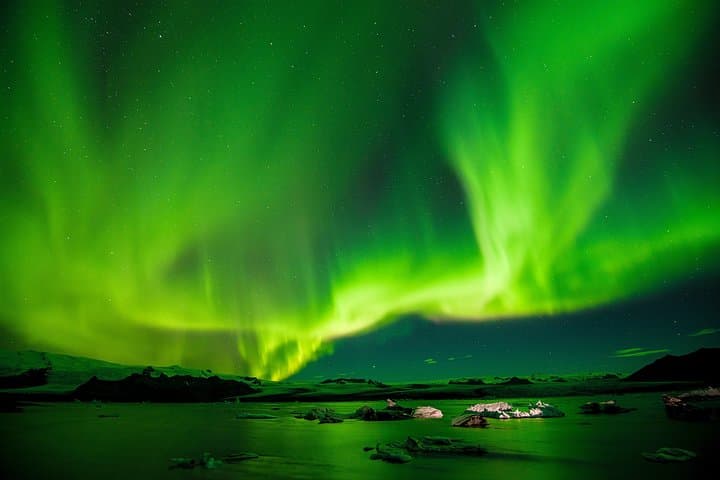
The lamp posts of downtown Reykjavik recede, the hum of the city thins, and the Atlantic presses cold air into your cheeks. It's only a short drive to Seltjarnarnes, a low-lying peninsula that juts west of the capital, but the shift in atmosphere is immediate: the night feels deeper here, the horizon lower, and the sky wider as if someone has unlatched it. Your guide—local, talkative, and used to reading the weather like a map—leads you along quiet streets toward a cluster of coastal rocks and a small lighthouse. You stand on asphalt that turns quickly to gravel and then to the salt-scented flat of the shore. Above, the aurora begins with a shy flicker. Then the green swells, pulls like breath, and the sky starts to move.
This private Seltjarnarnes tour condenses an elemental Icelandic experience into three hours of walking, storytelling, and skywatching. It’s not a chase across the island; it’s selection by strategy. The peninsula’s coastal edge, its minimal light pollution compared with inner Reykjavik, and a guide who knows how to read solar forecasts make it possible to watch the aurora while still being close to the city. The tour favors intimacy—your group alone—so you’re not elbowing for a tripod in the dark. The price reflects that privacy and local expertise: this is a curated, small-group offering led by guides who double as local interpreters of folklore, meteorology, and the peculiarities of Icelandic nights.
Geologically, Seltjarnarnes is modest—lava fields and glacial outwash that have been softened by centuries of sea and wind. Culturally, the area sits at the edge of Reykjavik’s everyday life; people come here to walk dogs, watch seabirds at dusk, and find quiet perspective. Historically, Icelanders have long read the skies: sagas and modern meteorology share a common fascination with how weather and northern lights signal seasons, storms, and, for the romantics, fate. Guides on this tour often weave short local histories—tales of fishermen, of the Grótta lighthouse keepers, of how the aurora used to be interpreted as omens—into practical advice about what to expect on a given night.
Seeing the aurora is part luck, part timing, and part preparation. The physics are simple in outline: charged particles from the sun punch into Earth’s magnetic field and excite gases in the upper atmosphere, which then emit light—greens, pinks, and sometimes purples. The high latitudes of Iceland place it under the auroral oval for much of the winter cycle; that gives you more nights when a display is possible. But clear skies and darkness are equally crucial, which is why the tour moves you to a coastal outcropping away from Reykjavik’s glare and why the guide monitors cloud cover and geomagnetic activity in real time.
Practicalities are straightforward and practical. The walk is easy—mostly flat, short stretches on paved or gravel paths, and often close to roadside parking if mobility is a consideration. Expect temperatures well below freezing for much of the season, wind that can slice through inadequate layers, and a horizon that feels endless when the lights arrive. Photographers will appreciate that the tour stops at several vantage points to try different compositions: the lighthouse as foreground, a distant city glow for scale, and the moveable dark beach for reflections.
For travelers who want to go beyond the immediate spectacle, this tour also functions as a primer. Guides will point out local birdlife on the shore, explain the ways Icelanders have managed light pollution in urban planning, and offer tips on shooting the aurora with a DSLR or mirrorless camera. They’ll also answer the practical questions: how long do aurora shows last (minutes to hours), can you bring children (yes, with warm clothes), and what are realistic expectations (no guaranteed curtain of color, but a high probability night for sightings during the season).
Why take a private tour here instead of driving to the interior? For many visitors, the trade-offs favor convenience: less time on the road, no need to rent specialized winter vehicles, and the ability to return to Reykjavik’s cozy restaurants and geothermal pools the same night. The tour’s private nature also suits photographers, couples, and small groups who want a flexible pace and a guide focused on their needs. And because the walk is short, it’s accessible to a broader range of fitness levels while still offering the cinematic payoff that draws people to Iceland in winter.
If you go, come prepared: a steady tripod, remote shutter release, and a camera capable of manual exposure will capture the best results; warm, layered clothing and a windproof outer shell will keep you watching instead of shivering; and patience will reward you. The aurora can be temperamental—one night a curtain, the next a faint smear—but when it comes, it has a tendency to make the ordinary world hush. The coastline listens back, and the light, mischievous and deliberate, puts on a performance that feels both ancient and immediate. For three hours on Seltjarnarnes, you’re not just looking at the sky. You’re in a town that knows how to stop and watch it.
Trail wisdom
Small choices, better day.
Dress in layers
Temperatures can drop quickly—base layer, insulating mid layer, and a windproof shell are essential to stay comfortable during long stretches of standing still.
Bring a tripod
Long exposures are the best way to capture auroras; a sturdy tripod and remote shutter or timer will reduce blur.
Protect batteries
Cold drains camera and phone batteries fast—store spares in an inner pocket close to your body.
Mind the tide and terrain
Stick to guide-recommended vantage points near the shore; wet rocks and dark beaches can be slippery at night.
Local knowledge
Read the place, not just the route.
Watch for native species including Arctic terns, Common eiders.
Keep an eye out for wildlife during the transition between areas and habitats. Respect distance guidelines.
Seltjarnarnes and nearby Grótta are sensitive bird habitats—stay on paths, avoid disturbing nests, and minimize light spill to protect nocturnal wildlife.
Follow the guide's instructions on size limits, ethical handling, and leave-no-trace practices.
Grótta lighthouse viewpoints for reflections and seabird roosting. Quiet streets of Seltjarnarnes for unobstructed horizon lines
Locally recommended viewpoints and quiet spots known best to local operators.
The peninsula has long been a working coastal fringe for Reykjavik; Grótta lighthouse and nearby fishing cottages speak to a history of small-scale maritime livelihoods.
Maritime roots and regional tradition shape the waterways and working coasts.
Seasonal guide
Four versions of the same landscape.
Spring
Best forLate-season aurora shows · Milder nights · Fewer crowds
ChallengesUnpredictable weather · Longer daylight
Spring (March–April) can still produce strong auroras with slightly warmer nights and fewer tourists, though daylight lengthens and clouds can be fickle.
Summer
Best forMidnight sun photography · Long daylight exploration · Birdwatching on the peninsula
ChallengesAurora rarely visible · Nearly continuous daylight
Summer offers vibrant coastal life and long days, but the midnight sun makes aurora viewing effectively impossible.
Fall
Best forSeasonal onset of aurora activity · Crisp, photogenic skies · Lower accommodation rates
ChallengesUnstable weather · Shortening daylight
Fall marks the return of reliable darkness and can offer excellent aurora nights, though storms become more common.
Winter
Best forPeak aurora season · Dark skies early in the evening · Snow-dusted landscapes
ChallengesCold temperatures · Icy conditions · Occasional road closures
Winter is prime aurora season with long dark nights and frequent displays, but you’ll need to manage cold and winter driving if exploring independently.
Operator details
What the booking data adds.
Included
- ✓Professional local tour guide
- ✓Transportation to Perlan Observatory, Seltjarnarnes Peninsula and Hallgrímskirkja (way back)
Good to know
- ✓Public transportation options are available nearby
- ✓Suitable for all physical fitness levels
Pack with intention
What to bring.
Good to know
Common questions.
No: the aurora is a natural phenomenon and cannot be guaranteed, but guides choose times and locations with the best odds and monitor conditions in real time.
Plan the edges
The details that make the day easier.
Aurora borealis are produced when charged particles from the sun interact with Earth’s magnetic field; Iceland’s high latitude places it directly beneath the auroral oval during much of the winter season.
After the tour, warm up in Reykjavik: grab a hot dog at Bæjarins Beztu Pylsur, book a table at Matur og Drykkur for modern Icelandic dishes, or sip local brews at Skúli Craft Bar—Reykjavik’s compact downtown makes it easy to turn a night of skywatching into a longer exploration of Icelandic food and culture.
- Closest airport
- Keflavik International Airport (KEF), ~50 km
- ~45 minutes to Reykjavik; Driving distance from city center
- 10–20 minutes; Cell service: Good in Reykjavik, generally available on Seltjarnarnes but can be spotty in isolated coastal spots; Permits: None required for this private tour
Respect sensitive shore and bird habitats—stay on established paths, minimize flashlight use, pack out all waste, and choose small-group tours to reduce local impact.
Explore by topic
Follow the threads.
Keep exploring
Make the story part of the trip.
Set out from Bass Harbor for a private, customizable day on Blue Hill Bay — lighthouses, puffins, seals, and the chance to feel Acadia from the water. Small groups, local captains, unforgettable views.
In four hours you can move from shaded canyon ferns to wind-scoured coastal ridgelines, guided by someone who knows where the light—and the hidden views—live. This private half-day hike on the Monterey Peninsula or Big Sur is compact, curated, and perfect for travelers who want depth without a multiday commitment.
 Related story
Beneath a sky of shifting light, Skaftafell’s ice reads like a map of time. This three-hour guided glacier hike mixes technical instruction with geology and culture: compact, safe, and unforgettable.