
What the day feels like
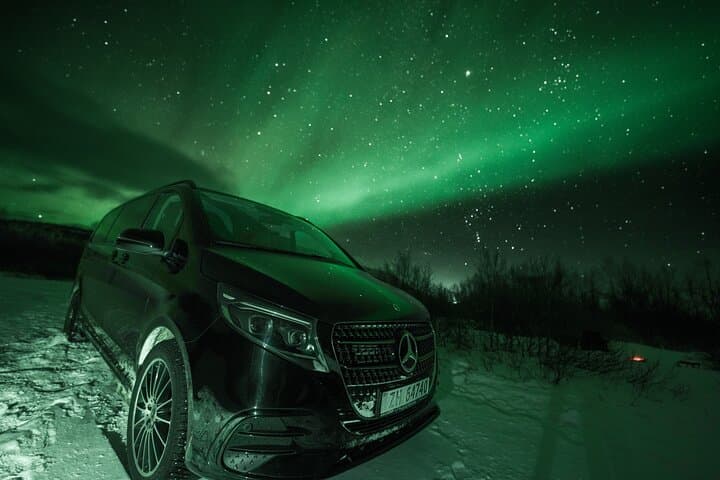
A hush settles over the road as the Mercedes glides away from Tromsø’s sodium-lit harbor and into a landscape whitened by Arctic night. Headlights carve a path between dark fjord shoulders and silvered birch; beyond the windscreen the sky is the thing that keeps you honest—vast, black, and watchful. Then, like a breath held and released, a pale green ribbon unfurls. It shivers, thickens, and flows across the vault of stars. For a few minutes the world tilts. The road, the tires, the quiet—everything exists in service of that slow, liquid motion.
A private Northern Lights tour gives this moment a different feel than a crowded viewing platform. You trade the bustle and bundled groups for a tailored pace: a guide who reads the forecast, an expert driver who knows where to find open sky, and the luxury of stopping exactly where the aurora is most alive. In Tromsø, the aurora is both a local calendar marker and a cultural mirror. The Sami—Indigenous to the region—told stories for centuries about lights that sang and spirits that danced across the heavens; modern guides often weave these folktales into the night, not to romanticize the science but to root the spectacle in place.
Geologically and astronomically, aurorae are the result of solar wind particles slamming into Earth’s magnetosphere; the collisions excite atmospheric gases and paint the sky in luminous greens, pinks, and purples. The farther north you are, the more places your skies can show these collisions at work. Tromsø sits at about 69.65°N—comfortably within the auroral oval—and serves as a pragmatic launch point: short drives to darker vantage points, dependable local guides, and predictable winter weather patterns that often give clear windows after the storms pass.
This Private Northern Lights Experience runs roughly 5–8 hours, an evening tailored for small groups or families who want privacy, comfort, and flexibility. You’ll travel in a premium Mercedes, meaning heated seats, space for equipment, and swift movement away from light pollution. A guide reads satellite images and cloud cover, checks aurora forecasts, and makes route calls that maximize sky exposure. Often the evening includes stops for a short walk, a hot drink by a portable fire, and storytelling—modern science threaded with Sami lore—so the sky fits into a bigger human narrative.
Why choose a private tour? For photographers it’s priceless: more time at promising sky shows, a guide who stages shots and helps with tripod setup, and fewer distractions when your shutter opens. For families, it’s about pacing: longer warm-ups in the car, flexible bathroom stops, and personalized timing for children. For travelers chasing a single, meaningful night in the Arctic, it’s the difference between glimpsing a green smear between lampposts and watching the sky perform.
Practicalities matter in the cold. Dress in layers: a moisture-wicking base, insulating mid-layer, and a windproof outer shell. Down boots or warm insulated footwear will keep toes functional once you step into deep snow. Bring a tripod, a camera with manual controls, and a remote shutter; the aurora favors long exposures and steady glass. Guides will often lend local insight—where the foregrounds are clean of powerlines, where reflections on a fjord lengthen a streak into a double. Apps like AuroraWatch, SpaceWeatherLive, and Yr.no (for Norwegian weather) are useful, but the best choices come from people who know which back roads in Tromsø clear fastest after a snow squall.
Remember: no guide can guarantee an aurora. Weather, solar activity, and plain luck all conspire. What a private experience buys you is the best available odds, comfort if the night turns lean, and cultural context that deepens the memory. After the sky calms or intensifies—whichever way the night goes—many groups return to Tromsø where you can warm up with local food: reindeer stew, fresh Arctic cod, and a pint at Ølhallen, Tromsø’s oldest beer hall, all reminders that the Arctic is lived-in as well as watched.
For travelers planning the trip: aim for clear, cold months—late autumn through early spring—and expect nights of 5–8 hours for a private outing. Bring patient curiosity and a camera that can be pushed into manual; bring questions for your guide about Sami stories and aurora science. Above all, go with the hope of being surprised. The lights travel on their own timetable—sometimes they barely stir, sometimes the whole sky becomes a map of motion—and being in good company makes either outcome memorable.
If you want control and comfort with a sky full of potential, a private Northern Lights excursion from Tromsø is a compact way to stack the odds: great local knowledge, the intimacy of a small group, and the polish of a private vehicle. At its best, the experience is equal parts spectacle and storytelling—a night where science, culture, and the wild northern sky come into sync, and you get to watch it all unfold from the warm seat of a Mercedes, then step out into a silence that lets the aurora be the loudest thing around.
Trail wisdom
Small choices, better day.
Dress in Layers
Base layers, insulating mid-layer, and a waterproof outer shell keep you warm during long exposures or walks between photo spots.
Bring a Tripod
Aurora photography relies on long exposures—steady support makes the difference between a crisp arc and a soft blur.
Watch the Weather Window
Clear skies after storms often offer the best viewing; trust local guides who read microclimates around fjords and valleys.
Charge Spare Batteries
Cold drains camera and phone batteries fast—keep spares warm in inner pockets and swap as needed.
Local knowledge
Read the place, not just the route.
Watch for native species including Reindeer, Sea eagles.
Keep an eye out for wildlife during the transition between areas and habitats. Respect distance guidelines.
Respect dark-sky practices: avoid using strong lights during viewings and follow guide directions to minimize disturbance to wildlife and snow-covered vegetation.
Follow the guide's instructions on size limits, ethical handling, and leave-no-trace practices.
Ersfjordbotn lookout for framed aurora reflections on still fjord water. Small roadside pullouts east of Tromsø where light pollution drops dramatically
Locally recommended viewpoints and quiet spots known best to local operators.
Tromsø, long a hub for Arctic exploration, sits within Sápmi—the traditional territory of the Sami—whose oral traditions include stories tying celestial phenomena to seasonal cycles and spiritual life.
Maritime roots and regional tradition shape the waterways and working coasts.
Seasonal guide
Four versions of the same landscape.
Spring
Best forStable cold nights · Longer daylight for day activities
ChallengesUnpredictable shoulder-season weather · Thawing snow and slushy roads
Late winter into early spring often brings clear, cold nights ideal for aurora watching, plus improving daytime conditions for sightseeing.
Summer
Best forMidnight Sun experiences · Fjord and whale-watching tours
ChallengesNo dark nights—aurora largely unobservable · Higher tourist traffic
Summer in Tromsø is bright and lively, but the Midnight Sun means the Northern Lights are effectively invisible.
Fall
Best forEarly aurora season · Fewer crowds and autumnal landscapes
ChallengesVariable cloud cover · Shorter daylight can limit day activities
Autumn offers an opening window for aurora watchers; colder nights begin to return while landscapes turn copper.
Winter
Best forPeak aurora visibility · Snow activities like dog sledding
ChallengesVery cold temperatures · Short daylight hours
Winter is the prime season: long, dark nights and frequent clear spells create the best odds for strong aurora displays.
Operator details
What the booking data adds.
Included
- ✓Private transportation
- ✓Snacks
- ✓Coffee and/or Tea
- ✓Thermo suit
Good to know
- ✓Specialized infant seats are available
- ✓Public transportation options are available nearby
- ✓Suitable for all physical fitness levels
Pack with intention
What to bring.
Good to know
Common questions.
Guides maximize odds by choosing dark-sky locations and reading forecasts, but aurora are a natural phenomenon and cannot be guaranteed.
Plan the edges
The details that make the day easier.
Tromsø is north of the Arctic Circle and is nicknamed the 'Gateway to the Arctic'—its latitude gives it one of the longest aurora-viewing seasons in mainland Europe.
After the tour, head to Fiskekompaniet for Arctic seafood, try reindeer stew at a local bistro, or warm up with a craft beer at Ølhallen—Tromsø’s oldest pub where explorers and locals mingle.
- Closest airport
- Tromsø Airport Langnes (TOS); Typical pickup: central Tromsø hotels; Driving to dark-sky spots: 20–90 minutes depending on conditions; Cell service: generally available but can drop in remote valleys; Permits: none required for standard viewing.
Minimize light use during viewings, follow guide instructions, and support local Sami-led experiences to ensure cultural and environmental respect for fragile Arctic landscapes.
Explore by topic
Follow the threads.
Keep exploring
Make the story part of the trip.
In four hours you can move from shaded canyon ferns to wind-scoured coastal ridgelines, guided by someone who knows where the light—and the hidden views—live. This private half-day hike on the Monterey Peninsula or Big Sur is compact, curated, and perfect for travelers who want depth without a multiday commitment.
 Related story
Beneath a sky of shifting light, Skaftafell’s ice reads like a map of time. This three-hour guided glacier hike mixes technical instruction with geology and culture: compact, safe, and unforgettable.
 Related story
Lose the city for a few hours without leaving it: this 5-mile, 900-foot-gain Forest Park loop threads old-growth pockets, city viewpoints, and cultural landmarks for a compact taste of Portland’s wild side. Expect moss, roots, and stories.