
What the day feels like
The van noses out of Rovaniemi like a small, determined animal, its heater murmuring and windows frosting at the edges. Behind us, sodium streetlights dim into the rearview and the city exhales. Ahead lies Lapland’s cathedral of dark: a stretch of boreal forest and open fell country where the sky stretches further and the stars feel larger. For the next two hours you trade the convenience of neon for a gamble with the northern sky—guided by someone who knows how to read auroral whispers and cloud drift.
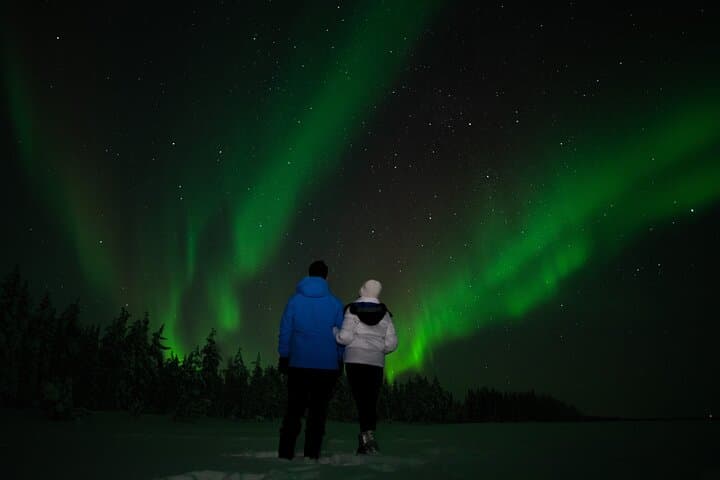
The aurora arrives with no guarantee and with all the drama of a high-stakes performance. Sometimes it’s a slow, ghostly band that lifts and fades; sometimes it ripples across the horizon like green silk. The phenomenon itself is deceptively scientific: charged particles from solar wind slam into Earth’s magnetosphere and excite atoms in the upper atmosphere, which then release light. But on nights when conditions align—clear skies, active geomagnetic conditions, minimal light pollution—the aurora becomes more than physics. It becomes a sky that seems to breathe, pulse, and answer the hush of the Arctic night.
Rovaniemi sits inside the auroral belt of Lapland, a region shaped by glacial geology, ancient trade routes, and the resilient cultures that learned to live here. The Sámi, the Indigenous people of northern Fennoscandia, have long woven stories about the lights—some reverent, some wary—treating the aurora as animate and watchful. Modern Rovaniemi is also known for the Santa Claus Village and winter tourism infrastructure, but a short drive from town the human imprint thins until the only lights are headlights and stars.
This particular experience is straightforward and efficient: a two-hour guided northern lights tour by car that takes you beyond the city’s glow. The compact duration is ideal for travelers who want an evening commitment rather than an overnight expedition—three hours total often includes driving time, stops for observation, and time to set up photographs. The operators who run these excursions bring local knowledge: where open river valleys and frozen lakes sit under clearer skies, which roads avoid heavy snowdrifts, and how to read a cloud deck at a glance.
If you go, you’re not just hunting lights—you’re stepping into a fragile, cold ecosystem. The grasses under snow and the lichen on old pines are slow-growing; reindeer graze along the road edges; and light pollution here is both a nuisance and a recent development. Good guides balance patience with practicality, relocating when cloud cover obstructs the view and offering tips on camera settings, batteries, and keeping warm between exposures.
Practical details matter. The tour runs year-round during aurora season—roughly autumn through spring—and lasts about 180 minutes. Price points typically start in the mid-hundreds of dollars in local currency (this particular offering lists a from-price in USD), and confirmation is usually instant when booked online. Dress for stillness: the most serious cold isn’t the wind-chill of a canyon but the way your core cools when you stand for 20 minutes waiting for a green curtain to flare. Hot thermals, waterproof outer layers, insulated boots, warm gloves, and a hat are non-negotiable. Bring spare batteries for cameras and phones; cold can halve battery life in minutes.
Photographers should think wide and manual. A sturdy tripod, a fast wide-angle lens (f/2.8 or faster), and an exposure plan—start at ISO 800–3200, 6–15 seconds, f/2.8–f/4—will get you started. Focus to infinity before it’s dark and tape the focus ring if you can. Guides usually help with framing, but good recommendations are to include some foreground—snow-laced trees or a distant ridge—to communicate scale.
Beyond photos, the best moments are quieter: the stray laughter when the aurora first shimmers, the sudden hush when the whole sky pivots green, or the small talk about constellations that slides into a long, companionable silence. Weather and solar activity govern the show—forecast apps exist for aurora probability, but local experience still matters most. Operators choose spots with lower tree cover and minimal artificial light, often driving 20–60 kilometers from Rovaniemi into open valleys or frozen lakeshores where the sky feels uninterrupted.
Responsible travel matters here. Stay on roads, don’t trample fragile vegetation, and observe wildlife from a distance: reindeer and hares are common, and fox tracks can be a fleeting thrill for early risers. If you’re curious about Sámi culture, reserve time for a daytime visit—listen more than you take, and consider supporting local businesses that preserve traditional crafts and foodways.
For travelers who want an evening that’s easy to plan but memorable in scale, a guided two-hour aurora hunt out of Rovaniemi is hard to beat. It’s accessible to families and solo travelers alike, offers a realistic window for photos, and plugs you directly into the rhythms of the Arctic night without requiring backcountry commitments. You leave with cold fingers, possibly a few sharp images, and the sense that you’ve visited something both scientifically explainable and quietly miraculous.
If the lights don’t show, a good guide will retrace, offer weather insights, and sometimes even share local stories that are worth the drive themselves—tales that anchor the fleeting green curtains to a place with long winters and longer memories. And on a clear night, when the aurora unfurls, you understand why people cross hemispheres for two hours under the Arctic sky: because for a moment, the Earth speaks in color and asks you to look up.
Trail wisdom
Small choices, better day.
Layer for Stillness
Wear insulating base layers and a windproof outer shell—you'll be standing relatively still while watching the sky.
Keep Batteries Warm
Store spare camera and phone batteries inside inner pockets to prevent rapid drainage in cold temperatures.
Bring a Tripod
A stable tripod is essential for sharp long-exposure aurora photos; rent one locally if you can't travel with it.
Limit White Light
Use red headlamps and avoid phone screens when observations are active to preserve night vision and reduce light pollution.
Local knowledge
Read the place, not just the route.
Watch for native species including Reindeer, Arctic hare.
Keep an eye out for wildlife during the transition between areas and habitats. Respect distance guidelines.
Light pollution and winter tourism impact delicate Arctic habitats—stick to roads, avoid trampling vegetation, and support local operators who follow low-impact practices.
Follow the guide's instructions on size limits, ethical handling, and leave-no-trace practices.
Frozen lakeshores around Ounasjärvi for quiet, reflective aurora views. Small roadside pullouts on the road toward Saariselkä with unobstructed horizons
Locally recommended viewpoints and quiet spots known best to local operators.
Rovaniemi lies near the Arctic Circle and has long been a winter crossroads; the city rebuilt rapidly after World War II and is now a winter tourism hub.
Maritime roots and regional tradition shape the waterways and working coasts.
Seasonal guide
Four versions of the same landscape.
Spring
Best forLonger daylight hours · Stable cold nights for clear skies · Photography with milder temps
ChallengesThawing snow · Variable road conditions
Late winter into early spring (February–March) often offers clearer nights and more predictable weather—still cold, but days start to lengthen.
Summer
Best forMidnight sun experiences elsewhere in Lapland · Hiking and cultural visits during daylight
ChallengesNo aurora visibility · Continuous daylight
Summer brings the midnight sun; aurora tours do not run because the bright sky hides the northern lights.
Fall
Best forEarly-season auroras · Fewer tourists · Crisp, clear nights
ChallengesUnpredictable weather and early snow · Shorter nights
Autumn (September–November) opens aurora season with colorful landscapes and increasing night hours, but weather can be changeable.
Winter
Best forPeak aurora visibility · Snow-covered landscapes · Full winter activities
ChallengesExtreme cold · Short daylight hours
Winter is prime time for aurora sightings and snowy backdrops, though you should prepare for long nights and very cold temperatures.
Operator details
What the booking data adds.
Included
- ✓Hot Juice is included
- ✓Thermal Clothes
- ✓Winter Boots
- ✓Air-conditioned vehicle
Not included
- —Hotel pick up / Drop off
Good to know
- ✓Public transportation options are available nearby
- ✓Specialized infant seats are available
- ✓Suitable for all physical fitness levels
- ✓Northern lights are a natural phenomenon, the visibility can't be guaranteed.
- ✓Tour operator won't cancel the activity according to the weather conditions. Please check the weather forecast couple of days before the activity start.
Pack with intention
What to bring.
Good to know
Common questions.
Sightings aren't guaranteed—visibility depends on solar activity and cloud cover—but operators position you where light pollution is lowest to maximize chances.
Plan the edges
The details that make the day easier.
Rovaniemi sits just south of the Arctic Circle (at about 66°33′N) and is one of the world’s most accessible gateways to aurora viewing.
After a night under the aurora, warm up with Lappish cuisine—try reindeer stew (poronkäristys) or a salmon soup at a local bistro, and sample craft beers brewed in Rovaniemi; for cultural context, visit a Sámi handicraft shop or museum during daylight hours.
- Closest airport
- Rovaniemi Airport (RVN). Typical driving to viewing areas: 20–60 km from city center. Cell service: good in town, intermittent in remote stops. Permits: none for guided tours, but respect private roads and reindeer fences.
Minimize light pollution and stay on established roads; avoid disturbing wildlife and pack out all waste—local ecosystems recover slowly in Arctic climates.
Explore by topic
Follow the threads.
Keep exploring
Make the story part of the trip.
Set out from Bass Harbor for a private, customizable day on Blue Hill Bay — lighthouses, puffins, seals, and the chance to feel Acadia from the water. Small groups, local captains, unforgettable views.
In four hours you can move from shaded canyon ferns to wind-scoured coastal ridgelines, guided by someone who knows where the light—and the hidden views—live. This private half-day hike on the Monterey Peninsula or Big Sur is compact, curated, and perfect for travelers who want depth without a multiday commitment.
 Related story
Beneath a sky of shifting light, Skaftafell’s ice reads like a map of time. This three-hour guided glacier hike mixes technical instruction with geology and culture: compact, safe, and unforgettable.