
What the day feels like
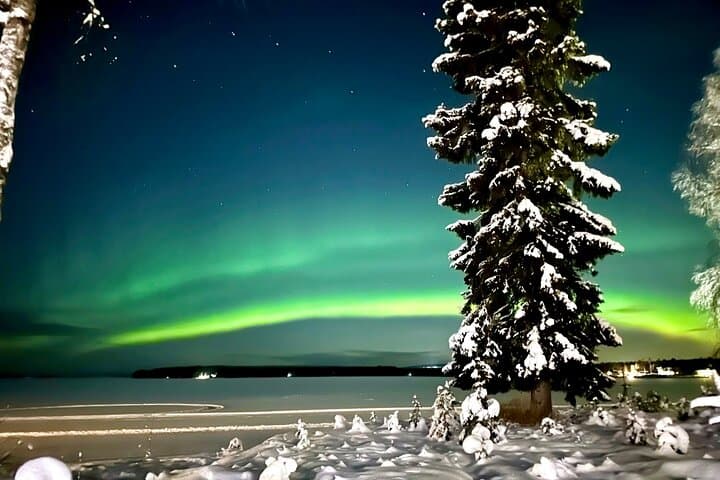
Night arrives like velvet over the boreal forest, and the snow under the snowmobile's treads exhales a thin, metallic scent that feels like the country itself holding its breath. Headlamps pierce a corridor of silver trunks; each drifted branch clicks as the machines glide past. You don't drive into the aurora so much as negotiate an invitation—following the guides who read the sky and the wind, searching the dark because the lights are not guaranteed but are generous when they appear. A soft hiss, a staccato of reindeer bells somewhere beyond sight, and then a slow, curving ribbon of green unfurls overhead: the Aurora Borealis, moving with a tempo that makes you want to slow your heartbeat to match it. In a matter of hours the machine's roar will be traded for the intimacy of a lakeside cottage, a low fire, and the taste of toast warmed over embers. This is winter travel in Lapland: kinetic, elemental, and quietly ceremonial. The Northern Lights Tour Snowmobile Driving out of Rovaniemi is a compact, three-hour slice of that ritual—equal parts speed, landscape, good company, and patient waiting under the open sky. The itinerary is direct: meet in Rovaniemi, receive a safety briefing and winter gear if needed, then ride out across frozen lakes and open taiga in search of clear skies. Guides—often locals who grew up reading weather and trail like books—scan horizons for activity, and when the lights come, they find a shoreline or a clearing, shut down engines, and hand you a mug of something hot while the aurora performs. The trip includes the cultural counterpoint that grounds the spectacle: a lakeside cottage stop. The Finnish lakeside cottage—simple, wood-scented, and practical—brings a domestic warmth to the wild. You'll share a fire, roast local snacks, and feel the way rural Finland stitches communal comfort into the landscape. Rovaniemi itself sits just south of the Arctic Circle, a town rebuilt in the postwar years and now both a gateway to wilderness and a living center of Sámi and Finnish culture. Lapland's geology is an old story of ice and patience; the pocked, low-relief terrain and broad, slow-draining lakes are the work of glaciation, and the trees—pines and spruces—stand as the enduring grammar of the region. This is also reindeer country. Seeing a herd cross at dusk is a reminder that human travel here borrows rules from animals and seasons. Practicality matters more than bravado on a night like this. The tour runs about three hours, and operators typically price it from roughly $178 per person. No prior snowmobile license is required—guides provide instruction on the controls and set a pace so drivers with little experience can manage comfortably. The machines are stable, the routes chosen to minimize technical challenge, and guides monitor weather closely. Still, winter can be brittle: batteries die faster, fingers go numb, and wind steals heat. Dress for the worst and hope for the best. Take a quality camera and tripod if you want more than a phone snapshot; aurora photography is technical but rewarding. Aim for the core winter months—December through March—when nights are long and the atmosphere favors displays, with February often delivering a sweet combination of cold, stable air and predictable darkness. If the lights don't show, you still leave with a winter landscape engraved in memory and the satisfaction of having driven into a place few visitors experience. Beyond the tour itself, there are cultural notes worth carrying home. Sámi people have lived with the aurora for millennia, weaving the lights into myth and daily practice. The lakeside cottage is not just a scenic touch; it is a lesson in hospitality that turns a chase into a shared story. Sustainability counts here: operators that use marked trails and briefed groups reduce noise and vegetation damage, and supporting local guides invests directly in the small businesses that steward the landscape. For planning: expect pickup near central Rovaniemi, bring insulated layers and full camera batteries, and build your evening to avoid rushing—this is a slow, observational adventure even if it begins with speed. When the lights bloom, the world simplifies to warmth, color, and the small human rituals that make wild places feel like home. If you leave with frost in your eyelashes and a photograph you can't stop looking at, you've done it right.
Trail wisdom
Small choices, better day.
Dress in layers
Wear moisture-wicking base layers, an insulated mid-layer, and a windproof outer shell; heat loss at extremities ends the evening early.
Protect your camera batteries
Cold drains batteries quickly—bring spares in an inner pocket and keep them warm until use.
Listen to the guide
Guides pick routes for safety and aurora potential; follow instructions on speed, spacing, and stopping.
Hydrate and snack before the ride
Cold increases energy use; a warm drink at the cottage is lovely but bring a snack to maintain fuel during the ride.
Local knowledge
Read the place, not just the route.
Watch for native species including Reindeer, Snowy owls and Arctic fox sightings possible at dusk.
Keep an eye out for wildlife during the transition between areas and habitats. Respect distance guidelines.
Stick to marked trails and follow guides to avoid fragile tundra and bird nesting areas; support operators who practice low-impact touring.
Follow the guide's instructions on size limits, ethical handling, and leave-no-trace practices.
A quiet clearing on a small frozen lake just outside Rovaniemi where reflections double the aurora. A traditional lakeside smoke sauna experience available from select local hosts
Locally recommended viewpoints and quiet spots known best to local operators.
Rovaniemi was rebuilt after World War II and designed in part by architect Alvar Aalto; it has since become the cultural and logistical hub for Lapland.
Maritime roots and regional tradition shape the waterways and working coasts.
Seasonal guide
Four versions of the same landscape.
Spring
Best forLonger daylight · Stable temperatures · Late-night aurora hunting in March
ChallengesVariable snow conditions · Shorter nights late in spring
March and early April offer milder temperatures and still-good aurora chances, though days lengthen quickly toward late spring.
Summer
Best forMidnight sun experiences · Extended daylight activities
ChallengesNo snowmobile tours—snow melted · No aurora visibility on bright nights
Snowmobile aurora tours are not available in summer; visit for hiking and river activities instead.
Fall
Best forChanging light · Fewer tourists
ChallengesUnpredictable early snow · Short but intermittent nights for aurora
Late fall can be atmospheric but is less reliable for snowmobile-based aurora hunts until consistent snow arrives.
Winter
Best forSnowmobiling · Predictable aurora viewing · Lakeside cottage evenings
ChallengesExtreme cold snaps · Short daylight hours for daytime activities
Peak season for this experience—long, dark nights and stable snowmake winter the optimal window for aurora snowmobiling.
Operator details
What the booking data adds.
Included
- ✓A Guide in English (other languages available on request: French, Spanish, & Finnish)
- ✓Information about the Northern Lights
- ✓Snowmobiling Equipments (Snowmobile, a Helmet, and a pair of Balaclavas)
- ✓Pick-ups and drop-offs are included in the price in 10 km radius from Rovaniemi city center
- ✓About 1 hour total driving time with the Snowmobile
- ✓Photos taken with your own device
- ✓Winter clothing (Adult & Child size), overalls, boots, gloves
- ✓Local Snacks & Drinks by the campfire
- ✓Air conditioned car
- ✓Detailed instructions on how to safely operate a snowmobile
Not included
- —Not recommended for children under the age of 3
- —If you want to operate a snowmobile, Driver’s License is required. This does not apply to passengers
- —You must be 18 years or older to drive a snowmobile
- —Max self-liability for snowmobile is 900€. You can buy waiver 25€, then self-liability is 250€
- —When booking a Twin drive snowmobile, book 1 ticket per person. Twin Drive = 2 person per snowmobile
- —If the child is 140 cm or taller, they can be seated on the snowmobile paying the adult’s price
- —If the child is shorter than 140 cm, they sit in the sled pulled by snowmobile, is driven by guide
- —Children under 13 years old must be accompanied by adults paying the full price
- —Please be ready and wait in your hotel lobby 10 minutes prior to your scheduled pickup time
- —Product may be cancelled or rescheduled if the group size is smaller than 4 persons
- —Product may be cancelled or rescheduled in case of extreme weather conditions
Good to know
- ✓Specialized infant seats are available
- ✓Not recommended for travelers with spinal injuries
- ✓Not recommended for pregnant travelers
- ✓Not recommended for travelers with poor cardiovascular health
- ✓Suitable for all physical fitness levels
Pack with intention
What to bring.
Good to know
Common questions.
No prior experience is required; guides provide a safety briefing and supervise all riders, setting a comfortable pace for beginners.
Plan the edges
The details that make the day easier.
Rovaniemi lies on the Arctic Circle (approximately 66°30′N) and markets itself as the official hometown of Santa Claus.
After the ride, warm up at a local Lappish restaurant—try reindeer stew or smoked salmon with cloudberry jam—and seek out a smoke sauna for a Finnish post-adventure ritual; Rovaniemi’s cafés also serve hearty rye breads and local berry pies.
- Closest airport
- Rovaniemi Airport (RVN). Typical drive to meeting point: 10–30 minutes from central Rovaniemi. Cell service: generally available in town, patchy on remote trails. Permits: none typically required, but follow guide and private land rules.
Choose operators that use marked trails and brief groups on low-impact behavior; avoid driving off established routes and respect wildlife—noise and disturbance reduce local biodiversity.
Explore by topic
Follow the threads.
Keep exploring
Make the story part of the trip.
Set out from Bass Harbor for a private, customizable day on Blue Hill Bay — lighthouses, puffins, seals, and the chance to feel Acadia from the water. Small groups, local captains, unforgettable views.
In four hours you can move from shaded canyon ferns to wind-scoured coastal ridgelines, guided by someone who knows where the light—and the hidden views—live. This private half-day hike on the Monterey Peninsula or Big Sur is compact, curated, and perfect for travelers who want depth without a multiday commitment.
 Related story
Beneath a sky of shifting light, Skaftafell’s ice reads like a map of time. This three-hour guided glacier hike mixes technical instruction with geology and culture: compact, safe, and unforgettable.