
What the day feels like
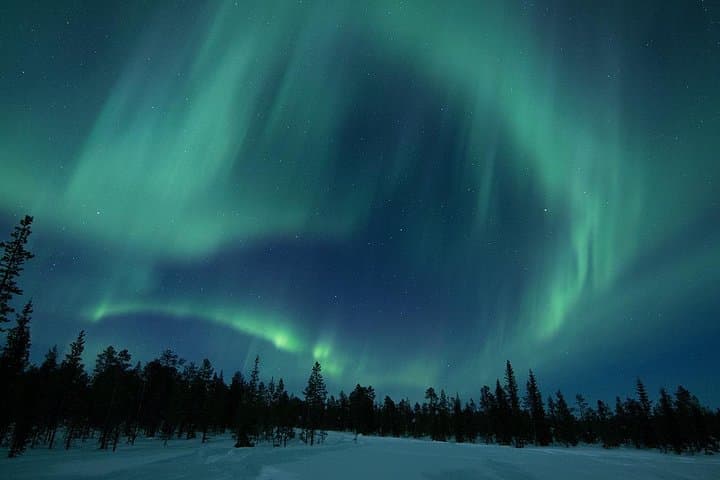
The night arrives like a switched-on memory — cool, immediate, and wide. A convoy of headlights cuts through a white corridor of forest; the snow spits softly against helmets as engines settle into a steady thrum. You push forward, the air tasting of iron and wood smoke, and above the black silhouette of trees the sky begins to breathe: ribbons of green and violet unfurl, hang, and roll like a slow ocean. This is less a postcard moment than a small, exacting performance between you and the Arctic sky, and you are both audience and actor.
This five-hour outing out of Kiruna is a compact lesson in northern contrasts. The ride follows groomed and wild tracks through birch stands, over frozen lakes and along the Torne River’s white ribbon. The terrain is largely flat — the Swedish interior here is shaped by ancient glaciers, not jagged peaks — so elevation gain is minimal. What matters is distance, cold, and timing: in the span of roughly 40–70 kilometers of riding (depending on route and stops), you move from village-edge light pollution into genuine dark-sky country, arriving at a timbered forest hut where a Lappish dinner is set over an open flame.
The landscape is older than names. Swedish Lapland is a palimpsest of glacial troughs and proglacial sediments; the Torne River itself has been a corridor for trade and culture for millennia. Sami reindeer herders stitched a seasonal life into this geography long before iron ore turned Kiruna into a modern mining town. Today, the region balances extractive industries, tourism, and a living Indigenous culture; the Icehotel in nearby Jukkasjärvi and the town’s ongoing relocation because of subsidence from mining are reminders that human stories here are as consequential as the slow churn of ice and rock.
Culturally, the trip is domestic as much as dramatic. Guides lead the convoy, trade tracks for storytelling, and open the hut for a traditional Lappish meal — think reindeer or fish stews, flatbreads warmed by embers, and coffee poured into tin cups under a sky that refuses to be ordinary. The meal is simple, robust, and social; it re-centers the adventure into a human scale, with the aurora as a roving, generous guest.
Practical bones: the experience runs about five hours door-to-door, with several hours of riding and multiple photographic stops. Snowmobile speeds vary with conditions, but expect moderate pace riding across packed trails, river ice, and lake crossings — all navigable in winter gear but demanding respect. There’s no technical climbing or route-finding; the guides scout, set pace, and stop where the show is best. Dress in warm, layered clothing, bring spare batteries (cold kills them fast), and plan for limited cell service once you leave Kiruna’s edges.
The trip’s appeal is practical and immediate. For less experienced travelers, sharing a sled with a guide or passenger is an approachable way to feel the sport without carrying full responsibility. For people who know snowmobiles, there’s the option to upgrade and drive solo, which stretches the fun and the photo angles. Photographers will prize the multiple photo opportunities on shorelines and frozen lakes where the aurora’s reflection doubles the spectacle; bring a tripod and a camera that performs in long exposures.
Safety and stewardship matter. Snowmobile tracks cut sensitive winter ranges, and thaw-season damage to tundra can be long-lasting; operators typically use established trails and huts to minimize footprint. Follow guides’ instructions about staying on marked routes and avoid driving over visible vegetation or thin ice. If you want to increase your odds of a sighting, travel between late autumn and early spring when nights are longest, but remember that auroras are natural phenomena: patience and clear skies are the only guarantees.
If you go: start your night with a solid, warm meal in town, carry extra layers, and let the guide brief you thoroughly on handling. Expect to be cold in stoppages, warm in motion, and thrilled whenever the motors go quiet to let the northern lights take over. The trip makes for a tight, high-reward evening: speed, solitude, community, and dinner by the fire — all condensed into one moving tableau.
For bookings and local expert coordination — from meeting logistics to upgrading to a single-driver sled — check the operator’s detailed listing and local expert page here: https://app.advcollective.com/local-experts/snowmobile-aurora-expedition-swedish-lapland-northern-lights. That page also covers what’s included (helmet, instruction, dinner) and typical group sizes, which helps you plan how social or private you want your night to be.
This is a trip that rewards simple preparation and open senses. So bundle your base layer, learn the throttle basics, and bring a sense of smallness under a very large sky. The aurora doesn’t belong to anyone, but for a night you get the closest thing: a front-row seat to the northern theater, engines idling nearby, steam from your breath streaking the stars.
Trail wisdom
Small choices, better day.
Dress in moisture-wicking layers
Start with a merino base, insulating mid-layer, and a waterproof windproof outer shell to manage sweat and Arctic winds.
Bring spare batteries
Cold drains batteries quickly—carry spares for cameras, headlamps, and phones in an inner pocket.
Listen to the guide
Guides know ice conditions and wildlife patterns—follow their instructions for safe riding and best viewpoints.
Use a small tripod
A compact tripod stabilizes long-exposure aurora shots and is easier to stow on a sled than large gear.
Local knowledge
Read the place, not just the route.
Watch for native species including Reindeer, Arctic fox (rare).
Keep an eye out for wildlife during the transition between areas and habitats. Respect distance guidelines.
Operators typically use established trails to reduce impact; visitors should avoid off-trail driving and respect reindeer grazing areas, especially during breeding season.
Follow the guide's instructions on size limits, ethical handling, and leave-no-trace practices.
Drive a short distance to Jukkasjärvi to visit the original Icehotel and its year-round exhibition. Ask guides about quiet lakeside spots where the aurora reflects perfectly on glassy ice
Locally recommended viewpoints and quiet spots known best to local operators.
Kiruna and the Torne River corridor have been a crossroads for Sami culture and trade for centuries; modern mining transformed the town’s economy and footprint in the 20th century.
Maritime roots and regional tradition shape the waterways and working coasts.
Seasonal guide
Four versions of the same landscape.
Spring
Best forLonger daylight activities · Stable ice early season
ChallengesThawing ice late season · Variable snowpack
Early spring (March) still offers strong aurora chances and stable riding, but late spring brings thaw and reduced trail safety.
Summer
Best forMidnight sun activities (not this tour) · Long daylight sightseeing
ChallengesNo snow for snowmobiling · No aurora in bright nights
This snowmobile aurora expedition is not available in summer—plan other Lapland adventures like hiking or river trips instead.
Fall
Best forAurora season onset · Quieter lodges
ChallengesUnpredictable early snow · Shorter windows of full darkness
Late autumn can offer aurora views once snow and stable trails arrive, but conditions are more variable than deep winter.
Winter
Best forAurora viewing · Snowmobiling on lakes and rivers
ChallengesExtreme cold · Short daylight hours
Mid-winter is ideal for this tour—reliable snow, groomed trails, and long nights increase your odds of spectacular auroral displays.
Operator details
What the booking data adds.
Included
- ✓2/people per snowmobile ( if uneven number you need to add single driver fee or sit in a sled)
- ✓Local dinner & dessert
- ✓Snow suit, winter boots, wool socks, gloves, balaclava, helmet
Not included
- —Hotel transfers (these can be booked separately)
Good to know
- ✓Not recommended for travelers with spinal injuries
- ✓Not recommended for pregnant travelers
- ✓Not recommended for travelers with poor cardiovascular health
- ✓Suitable for all physical fitness levels
- ✓Wearing glasses is not recommended because they fog up (wear contact lenses)
Pack with intention
What to bring.
Good to know
Common questions.
The full experience runs about five hours with roughly 2–3 hours of riding and multiple stops for photos and the forest-hut dinner; total distance varies by conditions but is typically 40–70 km.
Plan the edges
The details that make the day easier.
Kiruna is being relocated in stages because subsidence from the nearby iron ore mine has made parts of the town unstable — one of the most consequential urban moves in modern Sweden.
After the ride, head back to Kiruna or nearby Jukkasjärvi for reindeer stew or local fish at a lodge; try a local microbrew or coffee (fika) and visit the Icehotel exhibition for a deeper sense of place.
- Closest airport
- Kiruna Airport (KRN)
- Trailhead
- 10–30 km from Kiruna center depending on operator
- Driving distance from town
- typically 15–45 minutes
- Cell service
- good in Kiruna, limited in remote areas
- Permits
- none typical, but follow operator guidance
Stay on marked trails to protect winter vegetation and reindeer ranges; pack out all trash and use local operators who prioritize established routes and low-impact practices.
Explore by topic
Follow the threads.
Keep exploring
Make the story part of the trip.
Set out from Bass Harbor for a private, customizable day on Blue Hill Bay — lighthouses, puffins, seals, and the chance to feel Acadia from the water. Small groups, local captains, unforgettable views.
In four hours you can move from shaded canyon ferns to wind-scoured coastal ridgelines, guided by someone who knows where the light—and the hidden views—live. This private half-day hike on the Monterey Peninsula or Big Sur is compact, curated, and perfect for travelers who want depth without a multiday commitment.
 Related story
Beneath a sky of shifting light, Skaftafell’s ice reads like a map of time. This three-hour guided glacier hike mixes technical instruction with geology and culture: compact, safe, and unforgettable.