
What the day feels like
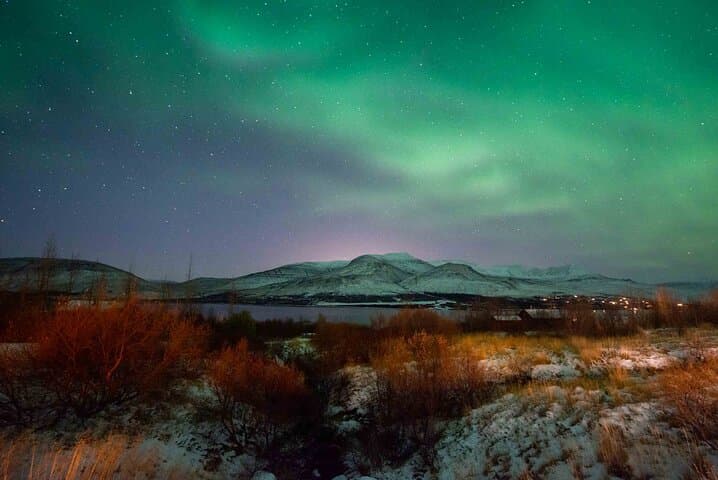
The Jeep rocks gently as the city lights of Reykjavík shrink behind us, a low hum of diesel and the quiet chatter of the guide our only company. Outside, the night is brittle and clear; the air tastes like metal and salt and the sort of cold that leaves a bright ache in your cheeks. We stop on a narrow shoulder where the landscape opens to a black plain. Someone unwraps a slab of Icelandic chocolate, another unwraps a wool blanket. The guide points up—first a whisper, then a surge—green curtains unfurling and folding across the northern sky. For a moment the world is only movement and light.
Seeing the aurora isn’t cinematic in any manufactured way; it’s built of small domestic rituals—hot chocolate in thermoses, layers zipped tight, the communal hush that falls when the sky begins to perform. That intimacy is the selling point of a private Northern Lights by-jeep outing out of Reykjavík: you’re not elbow-to-elbow with a coach load of tourists. Instead you get a four-hour, flexible run across dark country roads, chasing skies with a local who reads forecasts like maps and knows where to find clean horizons and minimal light pollution.
Iceland’s northern lights feel like a crossroads of geology and myth. The islands sit astride the Mid-Atlantic Ridge, an active seam where tectonic plates pull apart; volcanic fields and glacial tongues carve a terrain that, even at night, gives the aurora an oddly tactile stage. For centuries Icelandic lore folded the lights into explanations—Vikings and sagas referenced spectral phenomena variously as omens, spirits, or reflections of sword-wielding warriors. Today locals read solar weather reports instead, but the sense of sky as a storyteller endures.
Geography helps, too. Reykjavík’s latitude and Iceland’s sparse rural population mean dark skies often lie within a short drive. The jeep is an ideal conveyance: nimble on gravel, capable of reaching headlands and river valleys where the horizon is low and uninterrupted. Guides are part meteorologist, part storyteller—balancing solar indices, cloud cover, and an intimate knowledge of where the aurora railroads will appear.
Practicalities are simple but non-negotiable. Tours run roughly four hours, typically beginning after dinner; a private booking like this one costs more than a shared minibus but buys flexibility and a higher likelihood of escaping light-scatter. Expect hot chocolate and local chocolates, woollen blankets, and pick-up from central Reykjavík. Bring patience and a willingness to move; the aurora rarely performs like a scheduled show. Guides will drive until skies clear enough for a satisfying display.
Photographers should come prepared—tripod, wide-angle lens (f/2.8 or faster), manual settings for long exposure, and an understanding of high-ISO noise management. For non-photographers, the best equipment is simple: a warm hat, dry gloves, and a willingness to stand in silence while the sky rearranges itself.
The seeing conditions depend on two things: cloud cover and solar activity. Solar storms create brilliant displays, but a thin overcast can erase even the strongest aurora. Your guide will consult local cloud maps and auroral forecasts in real time and will pivot—sometimes driving 30–60 minutes from Reykjavík—to find clear sky. The private nature of the tour means the route is flexible: you might end up scanning the shoreline near Seltjarnarnes, perched above a black-sand strand, or on a quiet bend of the countryside where only grazing horses witness the show.
Culturally, these tours are also an introduction to contemporary Icelandic life—stories about settlement, the resilience required to live on an island with constant geologic change, and the small, persistent comforts like lamb soup and keflavík-brewed beers that punctuate a long winter evening. Guides often weave in practical local knowledge: where to warm up after a cold night, which baths are open late, and where to find a hot dog at midnight.
Safety and sustainability are central to a responsible aurora chase. Stick to roads and designated pullouts: Icelandic moss and lichens are fragile, and off-road damage can take decades to heal. Keep noise low, avoid bright flash photography that ruins the view for others, and respect private land and grazing animals.
If you want the aurora without the logistics headache, a private jeep tour is a streamlined option: you get doorstep pickup in Reykjavík, expert route-finding, local treats, and the freedom to move until the sky obliges. No guide can guarantee lights—solar weather is capricious—but a good private operator stacks the odds in your favor and makes the hunt itself an intimate, vividly Icelandic experience.
At the end of the night, when you sip the last of your hot chocolate and watch the jeep slide back toward the city lights, the aurora has a way of settling into memory that’s not loud or literal. It’s the hush that follows the fizz; the knowledge you were present for an old cosmic process and, for a few minutes, were allowed to watch the sky paint itself.
Trail wisdom
Small choices, better day.
Dress in layers
Temperatures drop fast at night; use moisture-wicking base layers, an insulating midlayer, and a waterproof outer shell.
Bring a tripod
Long-exposure aurora shots need stability—avoid handheld photos if you want crisp starfields and light curtains.
Trust the guide
They’ll read forecasts and move locations to find clear skies—be prepared to change plans on the fly.
Keep batteries warm
Cold drains camera and phone batteries quickly—carry spares close to your body until you need them.
Local knowledge
Read the place, not just the route.
Watch for native species including Icelandic horse (often seen grazing along country roads), Harbour seals along coastal estuaries.
Keep an eye out for wildlife during the transition between areas and habitats. Respect distance guidelines.
Stick to roads and designated pullouts to avoid damaging fragile moss and lichen; minimize light pollution by using red-light modes and avoiding unnecessary flash photography.
Follow the guide's instructions on size limits, ethical handling, and leave-no-trace practices.
Seltjarnarnes lighthouse coastline for low-horizon views. Quiet gravel pullouts on the Reykjanes Peninsula away from light pollution
Locally recommended viewpoints and quiet spots known best to local operators.
Icelandic sagas and Norse folklore frequently referenced unusual sky phenomena; modern viewing overlays that myth with meteorology and solar forecasting.
Maritime roots and regional tradition shape the waterways and working coasts.
Seasonal guide
Four versions of the same landscape.
Spring
Best forEarly-night aurora viewing · Fewer clouds than mid-winter
ChallengesUnpredictable weather · Shortening nights
Late winter-to-spring transitions can offer clear skies but shorter dark hours—go early in the season for the best odds.
Summer
Best forMidnight sun activities · Long daylight adventures
ChallengesNo true darkness for aurora · High tourist season
Summer’s near-continuous daylight means aurora viewing is effectively impossible—this tour is not recommended between May and July.
Fall
Best forCrisp nights and fewer tourists · Increasing auroral activity
ChallengesUnstable weather · Early nightfall requires flexible timing
Autumn balances darkness and accessibility—cloud cover can still frustrate, but the aurora returns as nights lengthen.
Winter
Best forPeak aurora season · Longest nights
ChallengesExtreme cold, icy roads · Short daylight hours
Winter is prime time for aurora chases—expect long nights and the highest probability windows, but pack for severe cold.
Operator details
What the booking data adds.
Included
- ✓Private transportation
- ✓WiFi on board
- ✓Bottled water
- ✓Snacks
- ✓Blankets
- ✓Hot chocolate
Good to know
- ✓Specialized infant seats are available
- ✓Service animals allowed
- ✓Public transportation options are available nearby
- ✓Infants and small children can ride in a pram or stroller
- ✓Suitable for all physical fitness levels
Pack with intention
What to bring.
Good to know
Common questions.
No—aurora sightings depend on solar activity and cloud cover; private tours increase flexibility and odds but cannot guarantee a display.
Plan the edges
The details that make the day easier.
Aurora borealis appear when charged particles from solar winds collide with Earth’s atmosphere, producing light; Iceland’s latitude and low rural population make it one of the world’s top aurora-viewing regions.
After the chase, warm up in Reykjavík: try a bowl of kjötsúpa (Icelandic lamb soup) at Café Loki, grab a lobster soup at Sægreifinn, or enjoy a local craft beer at a harbor-side pub—nighttime in the city often finishes with late snacks and long conversations about the sky.
- Closest airport
- Keflavík International Airport (KEF)
- Typical meeting
- central Reykjavík pickup
- Driving distance
- up to 60 minutes from town depending on cloud cover
- Cell service
- reliable near Reykjavík, patchy in rural spots
- Permits
- none for public roads; do not drive off-road
Avoid off-road stops—Icelandic vegetation is fragile and slow to recover; minimize light pollution by keeping lights low and using red-light modes, and pack out all trash.
Explore by topic
Follow the threads.
Keep exploring
Make the story part of the trip.
Set out from Bass Harbor for a private, customizable day on Blue Hill Bay — lighthouses, puffins, seals, and the chance to feel Acadia from the water. Small groups, local captains, unforgettable views.
In four hours you can move from shaded canyon ferns to wind-scoured coastal ridgelines, guided by someone who knows where the light—and the hidden views—live. This private half-day hike on the Monterey Peninsula or Big Sur is compact, curated, and perfect for travelers who want depth without a multiday commitment.
 Related story
Beneath a sky of shifting light, Skaftafell’s ice reads like a map of time. This three-hour guided glacier hike mixes technical instruction with geology and culture: compact, safe, and unforgettable.