
What the day feels like
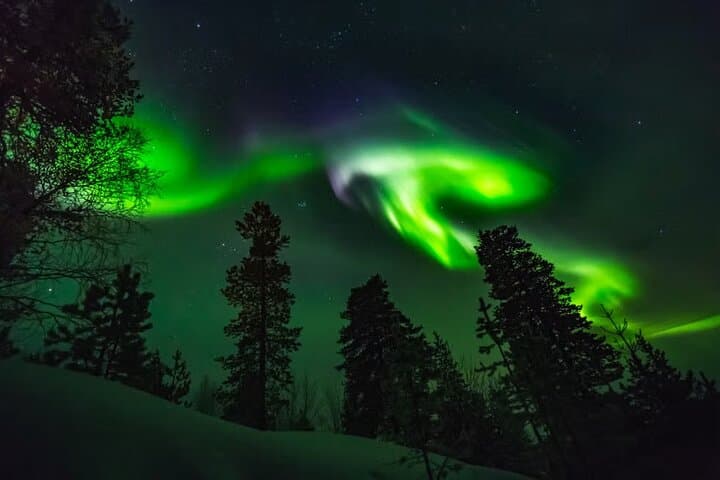
The bus eases off the frost-lined road and into a black so quiet it feels like a held breath. Above, a scatter of stars thickens until the sky seems to tilt and breathe; a pale green ribbon unfurls and reaches, hesitant at first, then with the confidence of something that has practiced this dance for millennia. Your guide clicks off the engine. Silence does what a million words can’t: it sharpens the cold and the light and the fact that you are watching the Earth’s atmosphere sing.
This is the Levi Northern Lights Experience with Arctic Midnight Group — less a tourist checklist item and more a carefully composed night in the Arctic. Rather than the hurried loops of a coach tour, the small-group rhythm here is patient and exacting: guides read real-time weather and solar data, and the route is flexible. If the sky near Levi is heavy with cloud, the van will push deeper into the surrounding wilderness to hunt for clear pockets. When the aurora appears, it’s from an Aurora Base Camp — a quiet clearing chosen for its horizon views, minimal light pollution and a shelter where you can warm your hands over hot drinks while the heavens perform.
Levi sits at 67.8ºN, above the Arctic Circle in Finnish Lapland, and that latitude gives you a leg up on seeing the aurora: long winter nights, stable polar air masses and low humidity combine to make this one of Europe’s most reliable aurora latitudes. The tour’s beauty comes from that reliability paired with a local’s respect for the dark. You won’t be kept moving for photo ops; you’ll be invited to watch, to breathe, to listen to the wind that seems to push the lights into motion. Guides also take professional photographs for you, delivering high-quality images the next day — useful if you want to remember the night but also to leave the composure of a long exposure to a steady hand.
Geology and culture cloak the event. The bedrock here is ancient Precambrian shield — a stable, rounded landscape that funnels northern winds and gives clear vistas for those long, low auroral arcs. The cultural layer is Sámi, the indigenous people of the region, whose relationship to the seasons and the sky is woven into local stories and hospitality. Expect small moments of localness: simple hot berry drinks, a modest shelter lit by lanterns instead of floodlights, and a guide who’ll point out constellations and explain how solar storms translate into the green and crimson bands you’re seeing.
Practically, the tour is streamlined. It runs 2–4 hours in the evening, priced from about $173, and operates as a small-group experience with instant confirmation and free cancellation. It’s ideal for travelers based in or near Levi village; the drive from Kittilä Airport is short (about 15–20 minutes), and meeting logistics are handled in town. The physical demands are low — you shuttle, you stand, you walk over a few compacted trails — but the cold is the real challenge. Batteries drain, fingers stiffen and the line between comfortable and miserable is surprisingly narrow.
To tilt that balance in your favor: dress in layers, bring a windproof outer shell, use a camera with manual exposure capability and a sturdy tripod, and carry spare batteries warmed in an inner pocket. The guides will advise on camera settings and help frame shots, but they also encourage you to sometimes just watch without the lens between you and the light.
The appeal of this trip is equal parts spectacle and craftsmanship. The aurora is capricious — you can’t command it — but a good guide improves your odds and makes the night pleasurable even when the sky is coy. You get context with that: the science of solar wind meeting Earth’s magnetosphere, the history of Lapland, and the hush that can make a single streak of green feel like a private performance.
Who should book it? Travelers who want a curated, small-group night with photography support and local insight rather than a mass-market bus run. Families with older kids, couples craving a memorable evening and photographers who want help with long exposures will find a lot to love. If your trip to Lapland is short, the tour’s 2–4 hour window makes it an efficient way to add an authentic Arctic night to your itinerary.
Timing matters beyond the calendar: avoid nights after heavy snowfalls or full clouds, and plan to be flexible with dates. A little patience goes a long way — sometimes the sky refuses to perform until late, and sometimes an entire horizon lights up at once. When the lights come, they move like living things; curtains fold, ripples race, and the sky seems to correct itself, always searching for a new composition.
On arrival back in Levi, the glow of the village feels almost domesticated: warm restaurants, Sámi craft shops and a local beer or two. But you’ll find the night’s quiet clinging to you for a while; it’s common to carry that silence into the next day, looking up with a new expectation whenever the sky is clear. That expectation is part of the appeal of Lapland — not just a destination for a single spectacle, but a place that trains you to notice the slow, rare theater of the natural world.
If you go, do it because you want the whole package: careful logistics, local expertise and a night that respects both the photographer and the person who simply wants to be still. The Aurora Base Camp isn’t a backdrop; it’s a carefully tended setting where the Arctic becomes a stage and the Northern Lights, for one elastic night, are the lead performers.
Trail wisdom
Small choices, better day.
Layer aggressively
Temperatures drop quickly; use a moisture-wicking base, insulating midlayer, and windproof outer shell to stay comfortable during long, still watches.
Bring fresh camera batteries
Cold halves battery life—carry spares in an inner pocket and swap them into the camera when needed.
Use a tripod and remote
Long exposures need stability; a sturdy tripod and a remote shutter or timer reduce blur and let you capture the aurora’s motion.
Respect dark etiquette
Avoid bright lights and flash photography; your group’s view and nearby photographers’ long exposures will thank you.
Local knowledge
Read the place, not just the route.
Watch for native species including Reindeer, Arctic hare.
Keep an eye out for wildlife during the transition between areas and habitats. Respect distance guidelines.
Operators use established meeting points and low‑impact lighting to protect nocturnal environments—stay on designated areas and pack out waste.
Follow the guide's instructions on size limits, ethical handling, and leave-no-trace practices.
Aurora Base Camp clearings with panoramic northern horizons. Short, ungroomed walking tracks near Levi that offer private sky views
Locally recommended viewpoints and quiet spots known best to local operators.
Levi sits in Finnish Lapland above the Arctic Circle; the region is part of Sámi traditional lands and long used for reindeer herding and seasonal travel.
Maritime roots and regional tradition shape the waterways and working coasts.
Seasonal guide
Four versions of the same landscape.
Spring
Best forLonger daylight for activities · Late‑season aurora chances
ChallengesUnpredictable melt and freeze cycles · Variable cloud cover
Late winter and early spring still deliver strong aurora chances with slightly milder nights—expect crisp skies and rapidly changing temperatures.
Summer
Best forMidnight sun experiences · Hiking and extended daylight
ChallengesNo aurora viewing (midnight sun) · Short nights eliminate aurora visibility
Summer in Levi is wonderful for daylight adventure but not suitable for aurora watching due to continuous light through the night.
Fall
Best forEarly aurora season · Fewer tourists
ChallengesLess predictable weather · Thinner infrastructure for late season tours
Autumn brings first aurora displays and dramatic color shifts, though cloudier weather can make nights less reliable.
Winter
Best forPeak aurora viewing · Snow activities and Arctic ambiance
ChallengesExtreme cold · Short daylight hours for other sightseeing
Winter is the prime season for aurora hunting around Levi—long, dark nights and frequent clear spells make sightings most likely.
Operator details
What the booking data adds.
Included
- ✓Small group guarantee
- ✓In-person: English, Finnish, German
- ✓Professional DSLR photos INCLUDED
- ✓Campfire experience
- ✓Snacks
- ✓Hotel pickup & drop-off
Not included
- —Alcoholic Beverages
Good to know
- ✓Service animals allowed
- ✓Public transportation options are available nearby
- ✓Suitable for all physical fitness levels
Pack with intention
What to bring.
Good to know
Common questions.
Tours run between 2 and 4 hours depending on conditions and how far guides need to travel for clear skies.
Plan the edges
The details that make the day easier.
Levi lies north of the Arctic Circle at about 67.8°N, making it one of Europe’s more accessible and reliable places to view the Aurora Borealis.
After a night under the lights, head to Levi village for Lappish cuisine—try reindeer or smoked Arctic fish—and warm up with a local craft beer or hot berry drink; look for Sámi handicrafts to connect with regional culture.
- Closest airport
- Kittilä Airport (KTT) ~15–20 min drive to Levi village; Driving distance from Levi center: variable (most meeting points are within village); Cell service: reliable in Levi and main roads, limited in some remote viewing sites; Permits: none required for guided aurora tours—follow guide instructions and respect private land.
Operators prioritize low‑impact sites and minimal lighting—pack out all trash, avoid flash photography that disturbs wildlife and other guests, and support local providers who use established access points.
Explore by topic
Follow the threads.
Keep exploring
Make the story part of the trip.
Set out from Bass Harbor for a private, customizable day on Blue Hill Bay — lighthouses, puffins, seals, and the chance to feel Acadia from the water. Small groups, local captains, unforgettable views.
In four hours you can move from shaded canyon ferns to wind-scoured coastal ridgelines, guided by someone who knows where the light—and the hidden views—live. This private half-day hike on the Monterey Peninsula or Big Sur is compact, curated, and perfect for travelers who want depth without a multiday commitment.
 Related story
Beneath a sky of shifting light, Skaftafell’s ice reads like a map of time. This three-hour guided glacier hike mixes technical instruction with geology and culture: compact, safe, and unforgettable.