
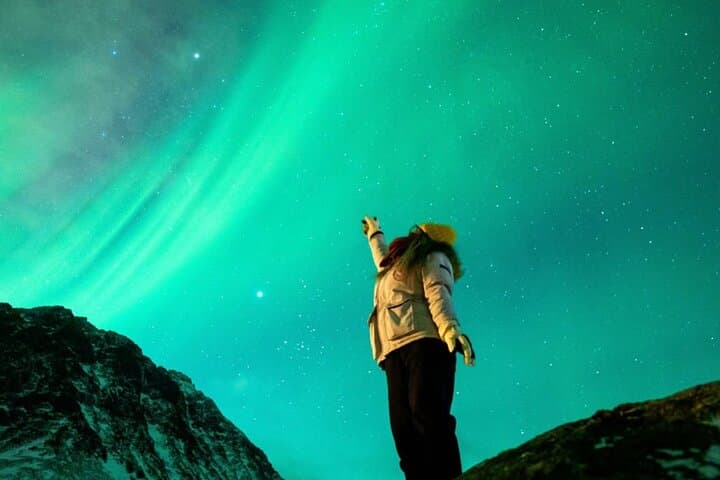
What the day feels like
On a black Arctic night, the sky begins to move like a slow, deliberate ocean. It doesn’t roar—it ripples and pulls, a curtain of green that breathes over fjords and snowdrifts. Guides scan the horizon with headlamps tucked down; their breath fogs in front of them and their voices are low, reverent. When the Aurora Borealis unfurls—a pale emerald ribbon that brightens, flickers, then blossoms into violet and gold—the world seems to hold still, as if the mountains and sea are leaning in to watch.The Northern Light Chase out of Tromsø is built around this kind of quiet theater. For six hours you surrender to the weather, the wandering magnetism of the auroral oval, and the local instinct of guides who read not only forecasts but the mood of the sky. Their vans thread tiny coastal roads and backcountry tracks, chasing clear skies and low light pollution. You’ll step out on gravel shoulders and frozen beaches, sip hot tea from a thermos, breathe cold air that stings the cheeks, and learn the old stories—Sámi myths and Viking tales—spun beneath constellations older than any map.The science of it is tidy and still a little mystical. Auroras are sunlight made strange: charged solar particles slamming into Earth’s magnetic field, energized atoms and molecules emitting color. Up here, Tromsø sits inside the auroral oval, a ring of higher probability for displays. That placement makes the city one of the world’s more reliable jump-off points for sky-chasing, yet success is never guaranteed. Any good chase balances meteorology, solar-activity data and practical know-how: a skilled guide, a willingness to move, and the right kit to wait in the cold.Sámi people, the indigenous inhabitants of northern Scandinavia, have watched these lights for millennia. Their stories treat auroras with cautious intimacy: some tales say the lights are the souls of the dead; others warn against singing to them. Vikings stitched simpler meanings into night navigation and omen-reading. Today, local guides often blend this oral history with an explanation of particle physics—anchoring the spectacle in place and culture so the experience feels both ancient and immediate.Practicalities matter here. The tour runs about six hours and begins in the evening; its instant confirmation and free-cancellation policy make it flexible for travelers juggling fickle weather. Expect drives from 20 minutes to an hour or more—the guide’s rule is to go where the sky is clearest. Dress for sitting and standing still in subzero conditions: layers, insulated boots, hand warmers and a windproof shell. Photography gear is essential if you want to take the memory home: a tripod, wide-aperture lens and a camera you can set to manual; typical settings range from ISO 800–3200 and 5–15 second exposures depending on brightness and lens speed.If the lights are shy, the night still pays dividends. You learn to read the Arctic: the hush of a fjord, the crust of hoarfrost on birch branches, the way distant towns throw an orange glow that the guides avoid. You hear stories about local fishing settlements and reindeer herding; you taste hot chocolate and sometimes locally made snacks while scanning the sky. There’s a social element, too—travelers from different places pressed together under blankets, strangers sharing long, cold laughs when a strong arc of light snaps into being.The best windows for aurora-chasing in Tromsø are the darker winter months, typically late September through early April. December and January bring long polar nights but also more cloud cover; February and March often offer a steadier combination of clear skies and comfortable cold. Spring and autumn can surprise, and in summer the midnight sun rules out auroras entirely. Tools the guides use include local cloud charts and aurora forecasts from agencies like the Norwegian Meteorological Institute and SpaceWeather—check them before you go if you’re planning independently.Getting there is straightforward: Tromsø is served by Tromsø Airport (TOS), with regular connections from Oslo and other Scandinavian hubs. The tour’s price point places it within reach of many travelers and the instant booking confirmation makes it easy to slot into a short Arctic itinerary.It’s easy to romanticize the chase, but what keeps people coming back is the balanced mix of raw nature and reliable logistics. You don’t just spot the lights; you learn how to wait for them properly. You come away warmed by the whole kit and ritual—hot drinks, woolen layers, and the slow, patient excitement as the sky prepares to perform.If you go, leave no trace. The best chases happen in quiet, dark places where local wildlife grazes and fishermen sleep through the night; respect that silence. Be ready for a genuine Arctic night, and you’ll be rewarded with something both ancient and electrifying: the sky in motion, and the small, human feeling of standing beneath it.
Trail wisdom
Small choices, better day.
Dress in layers
Bring a thermal base layer, mid-layer fleece, and an insulated outer shell to handle long periods of standing in subzero air.
Bring a tripod
Long exposures are needed to capture the aurora—stabilize your camera to avoid motion blur.
Download aurora apps
Use real-time aurora and cloud-coverage apps to understand why your guide moves locations during the night.
Respect private property
Guides pick quiet vantage points—stay with the group and avoid trampling vegetation or approaching reindeer.
Local knowledge
Read the place, not just the route.
Watch for native species including Reindeer, White-tailed sea eagles.
Keep an eye out for wildlife during the transition between areas and habitats. Respect distance guidelines.
Minimize light pollution by sticking to guide-chosen dark spots, avoid disturbing grazing reindeer, and pack out all trash to protect fragile tundra ecosystems.
Follow the guide's instructions on size limits, ethical handling, and leave-no-trace practices.
Kvaløya coastal pullouts for dramatic fjord-and-sky compositions. Small fishing hamlets where town lights are low and horizons are wide
Locally recommended viewpoints and quiet spots known best to local operators.
Tromsø has long been a gateway to Arctic exploration and whaling; the area is also central to Sámi culture, whose oral traditions include aurora lore.
Maritime roots and regional tradition shape the waterways and working coasts.
Seasonal guide
Four versions of the same landscape.
Spring
Best forLate-night auroras · Fewer tourists · Crisp skies
ChallengesUnpredictable weather · Thawing roads can be slippery
Late winter/early spring can offer clear nights and milder cold—good aurora chances but variable weather.
Summer
Best forMidnight sun activities · Hiking and fjord cruises
ChallengesNo auroras due to continuous daylight · Higher prices for lodging
Summer is beautiful in Tromsø but not suitable for aurora viewing—midnight sun replaces the night sky.
Fall
Best forAurora season begins · Autumn colors on the fjord
ChallengesShorter daylight hours · Increasing cloud cover
Fall offers a growing window for night displays as nights lengthen; weather can be changeable.
Winter
Best forPrime aurora viewing · Polar night ambiance · Snow activities
ChallengesExtreme cold in some periods · Short daylight hours for other activities
Winter is the optimal season to chase the aurora, with long nights and frequent displays—dress warmly.
Pack with intention
What to bring.
Good to know
Common questions.
Tromsø is inside the auroral oval and offers high probability, but visibility depends on solar activity and cloud cover; guides increase chances by moving to clearer skies and the operator often offers free rebooking if no lights appear.
Plan the edges
The details that make the day easier.
Tromsø lies above the Arctic Circle at about 69.65°N, placing it within the auroral oval where Northern Lights are commonly visible.
After the chase, warm up at local favorites: try freshly caught cod or Arctic char at the harbor-side restaurants, grab a beer at Ølhallen (Tromsø’s oldest pub), or visit a Sámi-run café for reindeer stew and cultural insight.
- Closest airport
- Tromsø Airport (TOS)
- Typical drive to viewing area
- 20–60 minutes from city center
- Cell service
- generally good near roads, spotty in remote pullouts
- Permits
- none typically required for commercial tours
Avoid using bright white lights at viewing sites, stay on established access points to protect tundra, and follow guide instructions to reduce disturbance to wildlife.
Explore by topic
Follow the threads.
Keep exploring
Make the story part of the trip.
Set out from Bass Harbor for a private, customizable day on Blue Hill Bay — lighthouses, puffins, seals, and the chance to feel Acadia from the water. Small groups, local captains, unforgettable views.
In four hours you can move from shaded canyon ferns to wind-scoured coastal ridgelines, guided by someone who knows where the light—and the hidden views—live. This private half-day hike on the Monterey Peninsula or Big Sur is compact, curated, and perfect for travelers who want depth without a multiday commitment.
 Related story
Beneath a sky of shifting light, Skaftafell’s ice reads like a map of time. This three-hour guided glacier hike mixes technical instruction with geology and culture: compact, safe, and unforgettable.