
What the day feels like
The morning starts with the quiet crunch of gravel underfoot and the low murmur of water doing what it’s done here for millennia—sliding, leaping, and shouldering through stone. At the Hooker Falls trailhead in DuPont State Recreational Forest, a small group falls into an easy rhythm beneath tulip poplars and hemlocks. The air is cool, scented with damp leaves and a hint of pine. Ahead, the Little River clears its throat and the first waterfall appears, rafters of white water fanning into a wide pool. Hooker Falls doesn’t tower; it welcomes. And right here on a flat shelf above the pool, the guide unpacks a stove, a kettle, and a hand grinder. The day’s first act is coffee.
There’s something disarming about brewing at the edge of a cascade. The river dares you to match its pace, and the steam rising from the kettle answers back. You’ll learn to filter water pulled straight from the source—safely, properly, with a respect that comes from knowing this flow feeds ecosystems and towns downstream. While the coffee blooms in the cone, the falls throw cool spray across your forearms, and conversation unfurls at the speed of the current.
DuPont State Recreational Forest is where the Blue Ridge eases out of the high country toward the Piedmont, and water takes full advantage of the gradient. The geology here—hard, old metamorphic rock—has been folded and scoured into ledges and runnels that produce photogenic waterfalls. The Little River drops repeatedly across resilient granite and gneiss, each ledge carving another scene. Triple Falls, a stair-step trio of cascades, is the second act of this hike, reached by a steady climb on a well-graded, gravel path that will get your heart rate up without demanding alpine lungs. The trail is forgiving, the switchbacks reasonable, but the river keeps you honest: you feel the terrain.
At a mid-level overlook, Triple Falls flexes. Spray drifts on the breeze and small rainbows wink in and out. It’s a familiar view to film buffs. DuPont has starred in more than one blockbuster—sequences from The Hunger Games and The Last of the Mohicans were staged on these slabs—though the forest’s backstory is quieter. Once a company tract owned by the DuPont Corporation, this landscape shifted from industry to recreation through a series of public acquisitions in the late 1990s and early 2000s, driven by relentless local advocacy. Today, more than 80 miles of trails serve hikers, bikers, and horseback riders, and the waterfalls are a democratic prize: accessible yet still wild at the edges.
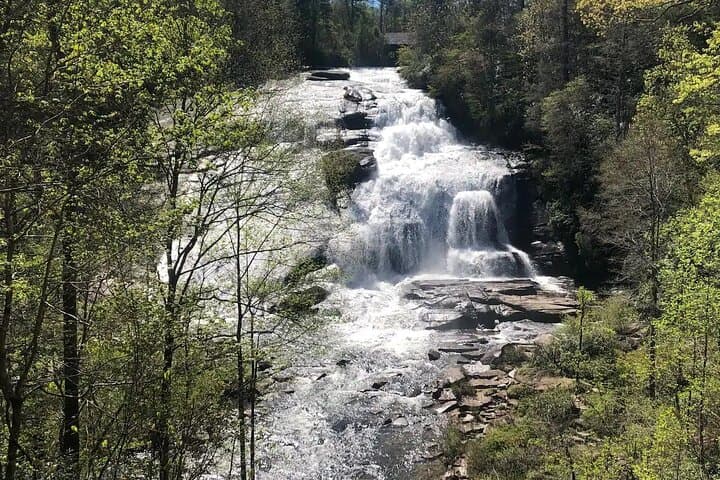
From Triple, the route tracks upstream to High Falls, the trip’s crescendo. Here the river spreads and plunges more than a hundred feet down a broad rock face, the sound deepening to a stadium roar after rains. On sunny days, the falls glow silver; after storms, they thunder brown, shouldering whole trees like toothpicks. The forest seems to lean in to watch. You can feel the damp in your bones—a reminder to bring a layer—even as the sun tags in and out above the canopy. A covered bridge spans the river just above, an architectural wink that adds an extra viewpoint and a sense of place.
This guided loop clocks roughly 3.5 miles with two short but steep pitches (roughly 70 yards each) that offer a quick cardio burst. Most of the walking is on wide, gravel multi-use paths with excellent signage, and the guide sets a comfortably social pace. Expect to take your time at the falls—this is a savoring hike, designed as much for conversation and photography as for mileage. The coffee ritual—the small act of grinding, pouring, and sharing—slows the morning into focus. It’s as if the forest pours you a cup and says: stay a while.
Spring brings ephemerals—trillium and spring beauties scattering the understory—and reliable flows. In summer, families gather at Hooker’s downstream pool, where the river, mellowed by the ledge, is safe for careful wading when levels are low and posted signs allow it. Fall is the headline act: maples and sourwood flare red and orange against granite and white water. Winter pares everything back to texture and line; the falls speak louder, the crowds thin, and you might have an overlook to yourself while your breath steams in the air.
Practical matters are refreshingly straightforward. Park at the Hooker Falls Access Area off Staton Road; arrive early on weekends and holidays because lots fill quickly. Facilities are available at the trailhead, but not on the trail itself. Expect spotty cell service once you’re in the trees. Trails remain open year-round, though occasional closures occur after severe weather or high water—obey all signs. And a friendly reminder that wet rock is a trickster: stay behind railings and off closed areas, especially around Triple and High Falls, where currents are merciless and the consequences are real.
Photographers will want a circular polarizer to cut glare off wet stone, plus a microfiber cloth to keep mist off the lens. For that silky-water look, try a shutter speed between 1/4 and 1 second with a tripod or a stable rock. The mid-deck view at Triple Falls gives perfect perspective lines; at High Falls, step back to incorporate trees as a frame. Early and late light keeps contrast manageable, but overcast days are also a gift here, flattening harsh shadows into even tone.
Then there’s the coffee. Out here, it’s less about caffeine and more about cadence. The ritual turns a simple hike into a shared experience—hands warming on mugs, the river making its case for patience. You’ll leave with practical knowledge about backcountry brewing and water filtration you can carry to your next campsite—or your next city park bench. Either way, the lesson sticks: when the forest offers a seat and the falls keep talking, the best plan is to linger and listen.
Trail wisdom
Small choices, better day.
Beat the parking rush
Hooker Falls Access fills quickly on weekends and peak foliage days. Arrive before 9 a.m. for the smoothest start.
Wear real traction
Grippy trail shoes handle gravel climbs and damp overlooks better than casual sneakers.
Pack a dry layer
Waterfall spray chills fast, even in summer. A light synthetic layer keeps you comfortable during photo and coffee breaks.
Respect the railings
Slick rock near Triple and High Falls is dangerous year-round—enjoy the views from designated overlooks only.
Local knowledge
Read the place, not just the route.
Watch for native species including Pileated woodpeckers, White-tailed deer.
Keep an eye out for wildlife during the transition between areas and habitats. Respect distance guidelines.
Stay on designated trails to limit erosion around fragile banks. Pack out all trash—including coffee grounds—to keep the Little River clear.
Follow the guide's instructions on size limits, ethical handling, and leave-no-trace practices.
The Covered Bridge above High Falls for a unique top-down view of the river. The mid-deck overlook at Triple Falls for perfect symmetry shots after the short spur trail
Locally recommended viewpoints and quiet spots known best to local operators.
Once owned by the DuPont Corporation, the forest was purchased by the state after community advocacy. Scenes from The Hunger Games and The Last of the Mohicans were filmed at DuPont’s waterfalls.
Maritime roots and regional tradition shape the waterways and working coasts.
Seasonal guide
Four versions of the same landscape.
Spring
Best forWildflowers · Consistent flow
ChallengesMud on shaded sections · Cool mornings
Fresh greenery and lively water make spring a standout; expect damp trails and pack a light rain shell.
Summer
Best forFamily outings · Wading at Hooker (when allowed)
ChallengesCrowds · Heat and humidity
Shaded trails help with the heat. Start early to avoid parking woes and the midday rush at overlooks.
Fall
Best forPeak foliage · Crisp hiking temps
ChallengesFull parking lots · Variable water levels
October often brings the best color contrast against granite and whitewater—arrive early and plan extra time for photos.
Winter
Best forQuiet trails · Powerful post-rain flows
ChallengesIcy patches · Wind-chill at overlooks
With leaves down, views open up. Watch for ice on steps and bridges after freeze-thaw cycles.
Pack with intention
What to bring.
Good to know
Common questions.
Plan on about 3.5 miles with roughly 450–550 feet of cumulative elevation gain, including two short but steep hills.
Plan the edges
The details that make the day easier.
DuPont State Recreational Forest protects more than 12,000 acres and over 80 miles of trails—Triple Falls and nearby Bridal Veil Falls appeared in The Hunger Games (2012).
Back in Brevard, refuel at The Square Root for Southern fare with a twist, then walk to Broad Street’s Cup & Saucer for a pastry. Beer lovers gravitate to Oskar Blues’ Tasty Weasel taproom or Ecusta Brewing for post-hike pints. If you’ve still got legs, cruise the greenway that connects town to Pisgah Forest and the bike-friendly Hub & Pisgah Tavern.
- Closest airport
- Asheville Regional (AVL), ~40 minutes by car. Trailhead: Hooker Falls Access Area off Staton Rd. Driving: ~20 minutes from downtown Brevard; ~55 minutes from Asheville. Cell service: Spotty to none on trail. Permits: None required; parking is free but fills early. Facilities: Restrooms at trailhead only.
Water here feeds downstream communities—filter responsibly, never wash gear in streams, and keep to established overlooks to protect mossy seeps and riverbank vegetation.
Explore by topic
Follow the threads.
Keep exploring
Make the story part of the trip.
 Related story
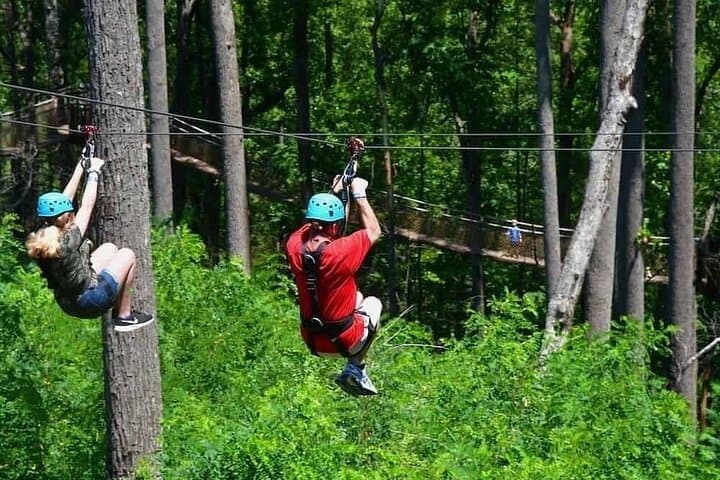
Less than two hours from Nairobi, Kereita Forest pairs hands-on canopy adventure with quiet montane trails and a sobering colonial history—perfect for families, teams, and curious travelers seeking a full-day pulse of nature.
Set out from Bass Harbor for a private, customizable day on Blue Hill Bay — lighthouses, puffins, seals, and the chance to feel Acadia from the water. Small groups, local captains, unforgettable views.
In four hours you can move from shaded canyon ferns to wind-scoured coastal ridgelines, guided by someone who knows where the light—and the hidden views—live. This private half-day hike on the Monterey Peninsula or Big Sur is compact, curated, and perfect for travelers who want depth without a multiday commitment.