
What the day feels like
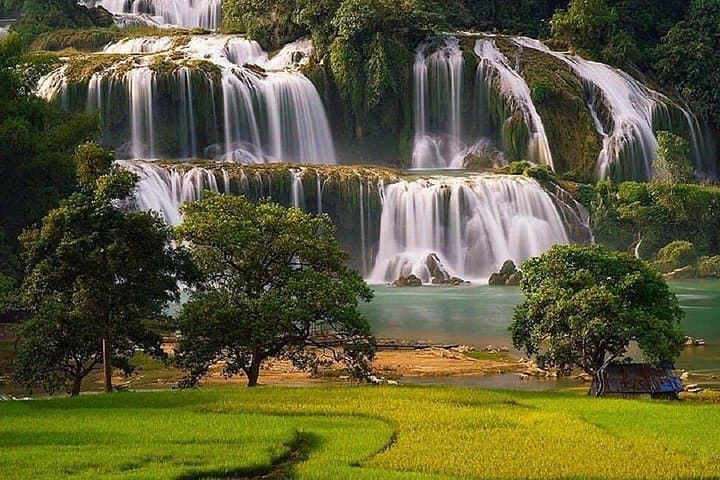
On the second morning, mist hangs low over the river and the sound arrives before the view: a thunder you feel in your chest, a cascade that keeps repeating itself until you accept there's no single moment that defines it. Ban Gioc—Bản Giốc in Vietnamese—doesn't announce itself quietly. It pours, splits, and furls across tiers of jungle-clad limestone, spilling into a green pool that seems to have been carved for the simple purpose of showing off. Stand at the Vietnamese viewpoint and you can look upstream to where the border with China threads along the river, then across the spray to broad shoulders of karst plateau. The air tastes of wet stone and rice fields; a river boat will take you close enough to get soaked if you want the full confession.
This two-day itinerary is compact and deliberately kinetic: a long haul from Hanoi, time spent in the shadow of one of the world's largest transboundary waterfalls, a walk through Nguom Ngao (Tiger Cave), and the quiet, lived-in villages of Cao Bang that anchor the landscape. The trip isn't a difficult backpacking expedition—it's a focused nature-and-culture sprint that rewards with cinematic scenery, close encounters with karst geology, and evenings spent in homestays where local cooking punctuates the day's damp gear.
Geology and history give Ban Gioc its personality. The waterfalls tumble over a sheet of limestone layered with fossils, shaped over millennia as subterranean rivers dissolved rock to create caverns, then collapsed to form the dramatic cliffs you see today. The karst towers are porous; they hold caves like Nguom Ngao and feed the ribbons of water that insist on rushing everywhere. Historically, this borderland has been a corridor and sometimes a faultline—between ethnic groups, between empires, and across modern nation-states. Ethnic Tay and Nung communities farm the river terraces and maintain long-standing relationships with the land, and you'll notice terraced fields, conical hats, and markets where produce is traded beside the road.
Nguom Ngao Cave opens like a folded throat into the mountain. Developed trails take you 300–600 meters past dramatic stalactites and chambered vaults, but you can easily spend a couple of reflective hours tracing formations, listening to the drip rhythm, and taking the lower, cooler temperature as a reprieve from the wet heat outside. Mat Than Mountain, nearby, is a low but commanding presence—more for the views and local lore than for alpine challenge. Both stops complement the waterfall's drama with quieter geological biography.
Practical details: the tour is a two-day, 48-hour experience. Plan on about 6–8 hours of driving each way from Hanoi by road depending on traffic and stops; the route is largely paved but can narrow through mountain passes. Walking at the falls is short but slippery: expect 400–800 meters of paved or compacted trails with roughly 30–80 meters of elevation change to reach lookouts and the river docks. Boat rides to the base of the falls are optional and typically brief—15–25 minutes—but they let you experience the spray and the roar up close and often leave you dripping and grinning. Cave walks are well-marked but uneven underfoot.
Timing and gear make the difference. Visit in the late monsoon-to-post-monsoon window (September–October) for full flow and greener rice terraces; spring (April–May) also offers high water but with more variable weather. Bring waterproof layers, good grippy shoes, and a small dry bag for electronics. If you are after photos, go early or late in the day for softer light and to avoid tourist crowds that cluster at midday.
Cultural notes and local logistics matter. Homestays and village restaurants serve hearty, regional food—river fish, mountain greens, sticky rice, and corn wine—and they are where you will feel the human rhythm of Cao Bang. Cash is king; ATMs can be sparse outside the provincial capital. Passport on hand: though you won't cross the river into China on a standard itinerary, you are literally at a border, so identification is required and sometimes checked. The language in villages may be primarily Vietnamese with local dialects; English is limited outside tour groups.
For the traveler who wants a dense, two-day infusion of geology, water, and rural culture, Ban Gioc is an efficient thrill. It's not remote in the way of weeks-long treks, but it feels removed: waterfalls that punch above their scale, caves that preserve the slow architecture of stone, and people whose lives have adapted to a landscape that alternates between abundance and blunt weather.
Final practical tips: move with a guide who knows the boat operators, the best viewpoints, and how to time the light; respect local customs at homestays; and be deliberate about packing layers—mist and river spray turn evening air brisk, even when the day is humid. If you want the noise of a waterfall to stay with you, sit on the riverbank as the light softens, listen, and let the terrain do what it does best—reshape the ordinary into something persistent and loud.
Trail wisdom
Small choices, better day.
Wear grippy shoes
Trails around the falls and inside Nguom Ngao are wet and uneven—sturdy trail runners or light hiking shoes with good tread are essential.
Bring a light dry bag
Boat rides and waterfall spray can soak electronics—store phones and passports in a small waterproof pouch.
Time your visit for morning or late afternoon
Soft light reduces glare on the spray and avoids the midday crowds at popular viewpoints.
Carry Vietnamese Dong cash
Smaller vendors, homestays, and boat operators often accept only cash—ATMs are limited outside Cao Bang town.
Local knowledge
Read the place, not just the route.
Watch for native species including Kingfishers along the river, Water buffalo grazing on terraces.
Keep an eye out for wildlife during the transition between areas and habitats. Respect distance guidelines.
The karst and riverine systems are fragile—stick to marked trails, avoid stepping on mosses or fragile limestone, and use local guides who support sustainable visitor practices.
Follow the guide's instructions on size limits, ethical handling, and leave-no-trace practices.
Row to the small river islands behind the main cascade for a different perspective. Visit a local market in Cao Bang town early morning for regional produce and crafts
Locally recommended viewpoints and quiet spots known best to local operators.
Ban Gioc lies in a borderland shaped by centuries of ethnic trade and, in the 20th century, geopolitical tension; local Tay and Nung communities have farmed these terraces for generations.
Maritime roots and regional tradition shape the waterways and working coasts.
Seasonal guide
Four versions of the same landscape.
Spring
Best forLush green terraces · Moderate water flow · Cool cave visits
ChallengesOccasional rain showers · Variable river levels
April–May brings warm days and refreshed vegetation; you’ll get strong visuals in the higher water months, though expect intermittent rain.
Summer
Best forWet-season water volume · Fewer international tourists
ChallengesHeavy monsoon rains · Slippery trails and higher river flows
Summer is dramatic—waterfalls are powerful—but road and trail conditions can be unpredictable in heavy rains.
Fall
Best forFull waterfall flow · Crisp, clear skies · Festival season in some villages
ChallengesShorter daylight hours · Cooler nights
September–November is ideal: rivers run full, terraces are emerald, and the weather is generally stable for exploring.
Winter
Best forFewer visitors · Crisp visibility on clear days
ChallengesCooler temperatures at night · Lower water levels reducing waterfall volume
December–February brings cooler days and lower flows; the falls are quieter but less dramatic.
Operator details
What the booking data adds.
Included
- ✓Lunch
- ✓All Fees and Taxes
- ✓Dinner
- ✓Breakfast
- ✓English speaking tour guide
- ✓Pick-up and drop off at Hanoi Old Quarter
- ✓Set-menu meals.
- ✓Accommodation based on twin/double.
Not included
- —Drinks and other services not clearly mentioned.
- —Personal expense.
- —Tips and gratuities.
- —Single supplement extra surcharge 20$ for solo traveler stay private room
Good to know
- ✓Suitable for all physical fitness levels
- ✓Itineraries are subject to change due to bad weather, tide levels and operating conditions.
Pack with intention
What to bring.
Good to know
Common questions.
Ban Gioc is about 320–360 km from Hanoi depending on route; expect 6–8 hours by car including short stops—many tours break the journey into two days.
Plan the edges
The details that make the day easier.
Ban Gioc is one of the largest transboundary waterfalls in the world, straddling the Vietnam–China border and celebrated for its multi-tiered limestone cascades.
After a day of spray and caves, head to Cao Bang town for grilled river fish, sticky rice, and a small glass of local corn wine; seek out a family-run homestay for a home-cooked meal and stories about the karst farms.
- Closest major airport
- Noi Bai International (Hanoi). Driving distance: ~320–360 km
- 6–8 hours by road. Cell service
- patchy near falls. Permits: No special permits for the Vietnamese side, but carry passport; Chinese side requires visa.
The cascade and its karst landscape are sensitive—stay on paths, don’t collect rock or plant material, and support local guides who contribute to conservation and community income.
Explore by topic
Follow the threads.
Keep exploring
Make the story part of the trip.
Set out from Bass Harbor for a private, customizable day on Blue Hill Bay — lighthouses, puffins, seals, and the chance to feel Acadia from the water. Small groups, local captains, unforgettable views.
In four hours you can move from shaded canyon ferns to wind-scoured coastal ridgelines, guided by someone who knows where the light—and the hidden views—live. This private half-day hike on the Monterey Peninsula or Big Sur is compact, curated, and perfect for travelers who want depth without a multiday commitment.
 Related story
Beneath a sky of shifting light, Skaftafell’s ice reads like a map of time. This three-hour guided glacier hike mixes technical instruction with geology and culture: compact, safe, and unforgettable.